Japanese Lanterns: What Chōchin, Tōrō, and Andon Are Called and What They Mean
"Japanese lanterns" is a catch-all name for several different things. The paper chōchin 提灯 on a bamboo frame, the stone or hanging tōrō 灯籠 at temples, the indoor andon 行灯 on a stand, and the small bombori familiar from Hinamatsuri — each has its own shape and place. Only the kanji 灯, "fire, lamp," unites them.
The word "lantern" in English mixes up different Japanese things, though in Japanese they have nothing in common except the fire inside: chōchin, tōrō, andon, and bombori are not interchangeable synonyms but different objects with different histories. Let's look at how they differ, what the red chōchin at the entrance to an izakaya means, and why lanterns that are released into the sky are not a Japanese tradition at all.
Chōchin, Tōrō, Andon, Bombori: Who's Who
It's easier to tell these things apart not by a photo but by two questions: what is the lantern made of, and does it stand in place or is it carried in the hand? Paper and portability are about chōchin; stone or metal and immobility are about tōrō; beyond that, we just need names and a table.
| Type | Japanese | Where it appears | What it's for |
|---|---|---|---|
| Chōchin | 提灯 | Entrance to a home, shop, izakaya, matsuri processions | A collapsible paper lantern on a bamboo frame — the most portable of all |
| Stone tōrō | 石灯籠 | Courtyards and gardens of temples and shrines | A stone lantern offered to a deity, now often just decorative |
| Hanging tōrō | 釣灯籠 | Under the eaves of temple buildings | Usually a bronze lantern hung on a chain |
| Andon | 行灯 | Homes and roadside shops in the old days | A stationary lantern on a stand with a paper shade around the fire |
| Bombori | 雪洞 | Hinamatsuri, tea room | A small portable lantern with a handle or leg, often decorative |
| Tōrō-nagashi | 灯籠流し | The last day of Obon | Paper lanterns floated on water to see off ancestral spirits |
How a Chōchin Is Made: Paper on a Frame That Folds
The chōchin frame is made of thin strips of bamboo coiled into a rigid ring; washi paper is stretched over them, and wooden rims hold it top and bottom. Inside, a candle used to burn; now an electric bulb is more common. According to Japanese reference books, the collapsible design was invented by the end of the Muromachi period: lanterns that came from China were held together by vertical bamboo ribs and did not fold.
Where Lanterns Burn: From Shrine to Beer Mug
At gates and along paths to temples and shrines, rows of chōchin and stone tōrō are not just decoration but an offering: light given to a deity or Buddha, in gratitude or as a request. In the past, open flames were lit inside; now electricity is more common.
What's Written on Chōchin: Names, Crests, Titles
On chōchin at a shrine entrance or festival, people often write the name of the establishment, the name of the person who donated the lantern, or the family crest kamon.
- At matsuri, chōchin are simply hung in garlands along streets with stalls — for light and atmosphere, without a separate ritual meaning.
- At Obon, chōchin are lit at the entrance to a home so ancestral spirits don't get lost on the way — the same principle as a welcoming bonfire.
- The red chōchin 赤提灯 at the entrance is a sign of a budget izakaya, a sign that "they serve drinks here," not something more exotic.
- Chōchin-obake — a reanimated lantern with torn paper for a mouth, a long tongue, and one or two eyes: a recognizable character from woodblock prints since the Edo period, though almost no detailed legend about it survives.
The most famous chōchin in the country hangs on the Kaminarimon gate at Sensō-ji temple in Tokyo: 3.9 meters tall, 3.3 meters wide, weighing about 700 kilograms. The current gate with the lantern was restored in 1960 with donations from Matsushita Kōnosuke, head of Matsushita Denki (now Panasonic) — 95 years after the 1865 fire.
From Candle to Lightbulb: The Sign 灯 in Words About Light
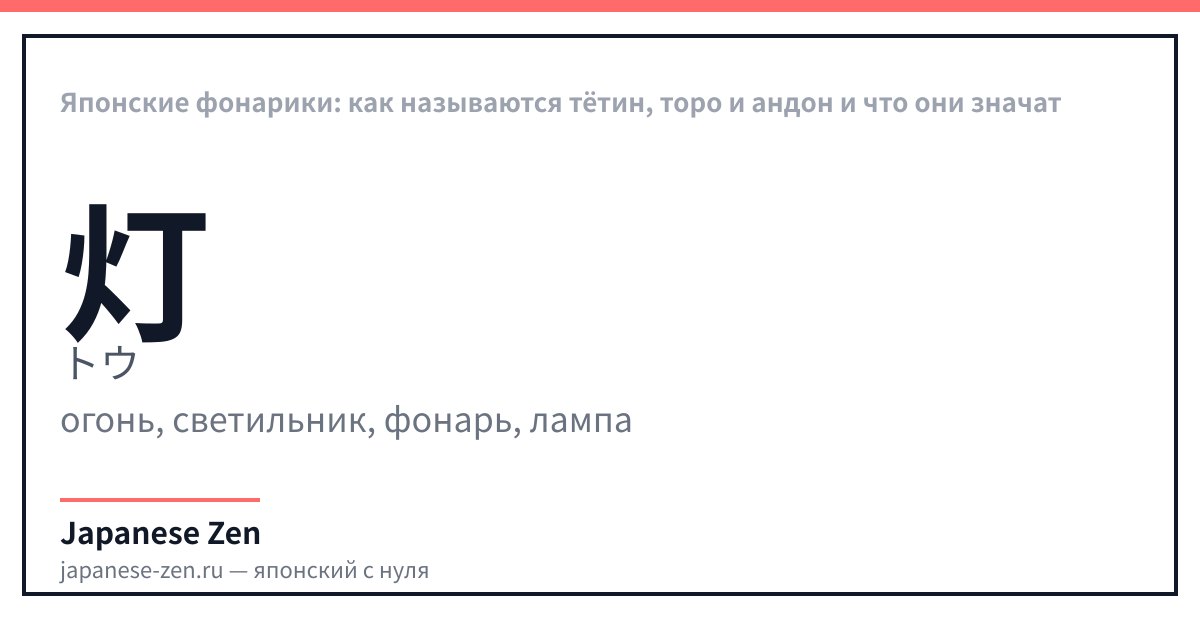
灯 — значение: fire, lamp, lantern, light — онъёми: トウ — кунъёми: ひ、ほ-、ともしび、とも.す、あかり — 6 штрих(ов). 灯 rarely stands alone as a word, but it appears in 提灯 (chōchin), 灯籠 (tōrō), and 電灯 (dentō, electric light) — in everything related to fire in a shelter. The character used to be written more complexly, 燈, and 灯 is its later simplified form with the same meaning and readings.
Why 提灯 Is Read "Chōchin" and Not by the Usual Readings of the Characters
提灯 — 提 "to hold in the hand" plus 灯 "fire, lamp" — together means "a lantern held in the hand." But the reading chōchin itself is not the usual Japanese reading of these two characters separately; it is an old Chinese borrowing that spread in Japan through Zen Buddhist monks in the Muromachi period.
The same character 灯 sounds different in related words: 灯籠 — tōrō, a stone or metal offering lantern; 行灯 — andon, an indoor lantern on a stand; 電灯 — dentō, electric light in the most everyday sense.
| Japanese | Reading | Translation |
|---|---|---|
| 提灯 | chōchin · chōchin | Collapsible paper lantern |
| 灯籠 | tōrō · tōrō | Stone or metal offering lantern |
| 行灯 | andon · andon | Indoor lantern on a stand |
| 電灯 | dentō · dentō | Electric light, lightbulb |
| 赤提灯 | akachōchin · akachōchin | Red chōchin — izakaya sign |
| 灯籠流し | tōrōnagashi · tōrōnagashi | Ritual of floating lanterns on water |
Write 灯 along the guides — the common fire character for chōchin, tōrō, and street lanterns.
They're Floated on Water, Not in the Sky, and Not All Are Paper
- "Japanese lanterns are released into the sky." In fact, paper lanterns released into the night sky on hot air are a Chinese and Thai tradition, not Japanese. In Japan, a similar paper lantern is more likely to be floated on water in the tōrō-nagashi ritual at Obon, not into the sky.
- "A red lantern means a red-light district." A red chōchin 赤提灯 at the entrance to an establishment is a sign of an ordinary budget izakaya or beer hall, not a signal of an entertainment district: the color of the lantern itself has nothing to do with that.
- "All Japanese lanterns are paper." Tōrō at temples and shrines are more often stone or bronze: paper is the material of chōchin and some bombori, not of all lanterns at once.
- "Chōchin and andon are the same thing." Chōchin folds and is usually portable, while andon is a stationary lantern on legs with a shade around the fire that does not fold at all.
FAQ
- What are Japanese lanterns called?
- There is no common word for all cases. Chōchin 提灯 is a collapsible paper lantern on a bamboo frame, tōrō 灯籠 is a stone or metal lantern at temples, andon 行灯 is a stationary indoor lantern on a stand, and bombori 雪洞 is a small portable lantern for festivals. Each word names its own specific thing, not lanterns in general.
- How does chōchin differ from tōrō?
- Chōchin is paper on a collapsible bamboo frame, light and portable: it is hung at an entrance or carried in a procession. Tōrō is usually stone or metal, stands on the ground or is hung under a temple roof as an offering to a deity, and is not carried from place to place.
- Why are lanterns placed at temples and shrines?
- Rows of stone tōrō and chōchin at the entrance are an offering of light to a deity or Buddha, in gratitude or as a request. Many of them bear the name or title of the person who donated the lantern — like a signature on a gift that remains for years.
- What does a red lantern mean in Japan?
- A red chōchin 赤提灯 at the entrance to an establishment is a sign of a budget izakaya or beer hall: it means they serve drinks and you can grab a bite. The color of the lantern itself has nothing to do with entertainment districts.
- What is tōrō-nagashi?
- A ritual in which paper lanterns with a candle inside are floated on a river or lake on the last day of Obon. This symbolically sees off the ancestral spirits — after several days they are believed to have spent in their home.
- How do you say "lantern" in Japanese?
- It depends which one: a collapsible hand lantern is chōchin 提灯, a stone garden or temple lantern is tōrō 灯籠, an indoor lantern on a stand is andon 行灯. There is no single word for all these things in Japanese, only a common meaning — fire in a shelter.
Sources
Updated: 2026-09-14