Tsukimi — the Japanese moon-viewing festival: when and how it's celebrated
Tsukimi (月見) is the festival of viewing the full moon in mid-autumn: the night of jūgoya, the fifteenth night of the lunar calendar, usually falls in September or early October. On this evening people set out bundles of susuki grass and a mound of round rice dumplings called dango, and a month later they more modestly observe the second moon — jūsan'ya. The date of tsukimi changes every year, and the actual full moon sometimes differs from it by a day or two.
Tsukimi is easy to mistake for a quiet contemplative evening, but in fact it's a family ritual with clear attributes: grass, food offerings, and a gaze toward the sky in the right direction. Let's look at how the date of tsukimi is calculated, what the rabbit pounding mochi has to do with it, where the phrase "the moon is beautiful" came from, and why a raw egg sits on top of tsukimi udon.
Susuki, dango, and silence: jūgoya step by step
- Wait for the night of jūgoya — the fifteenth night after the new moon in the eighth month of the old lunar calendar, usually in September or early October.
- Place a vase with bundles of susuki grass by the window or on the veranda: real rice ears aren't out yet at the end of summer, and susuki temporarily stands in for them.
- Arrange tsukimi dango in a mound — round rice dumplings, traditionally fifteen in number, stacked in a pyramid.
- Add taro satoimo to the offerings — the fresh harvest at the time of the festival.
- Sit so that the moon is fully visible, and for a while simply look at it without being distracted by conversation.
- If you like, compose or read aloud a tanka about the moon — as people did at court centuries ago.
- A month later, on jūsan'ya, the thirteenth night of the ninth month, repeat the ritual on a smaller scale — with a different number of dango and different seasonal offerings.
How the date of jūgoya is calculated and why the moon isn't always full
Jūgoya isn't a fixed date in our calendar, but the fifteenth day of the eighth month of the old lunar calendar, so the date shifts each year within roughly a month. The full moon is a separate astronomical event — the moment when the Moon is exactly opposite the Sun — and it doesn't have to coincide with the fifteenth day of the lunar month. The interval between new moons averages 29.5 days, and half of that is about 14.8 days, slightly less than fifteen days from the start of the month. Because of this, according to the National Astronomical Observatory of Japan, jūgoya more often falls on a moon that hasn't yet reached fullness, and the full moon itself occurs a day or two later.
From courtly boats to satoimo on the plate
The custom of moon-viewing came to Japan from China in the Heian period. Courtiers would go boating and look not so much at the moon itself as at its reflection in the water or in a cup of wine.
Later, when the custom spread from the nobility to farmers, tsukimi became more of a harvest festival: the fifteenth night is also called imo-meigetsu, "the moon of the taro harvest," because that's when satoimo are dug up. The thirteenth night a month later is called mame-meigetsu or kuri-meigetsu — "bean moon" or "chestnut moon" — after what is offered at that time.
The rabbit on the moon: mochi or the elixir of immortality
The rabbit pounding rice cakes (mochi) on the moon is an image borrowed from China, but in the Chinese version the same rabbit pounded not mochi but the elixir of immortality for the lunar goddess Chang'e. The association specifically with mochi arose in Japan later, partly from a play on words: mochizuki, "full moon," sounds similar to mochitsuki, "pounding rice dough in a mortar."
The same lunar motif appears elsewhere in Japanese culture: the heroine of "The Tale of the Bamboo Cutter," Kaguya-hime, at the end of the story flies back to the moon, where she came from.
"Tsukimi" on the menu: a raw egg instead of the moon
In dish names, tsukimi doesn't mean the festival itself but the raw egg placed on top of the food: the round yolk resembles the full moon. This is how tsukimi udon and tsukimi soba are made — noodles with a raw egg — and in autumn some fast-food chains have been releasing seasonal burgers with a fried egg of the same "lunar" appearance since the early 1990s.
Hanami, tsukimi, yukimi — the shared view 見
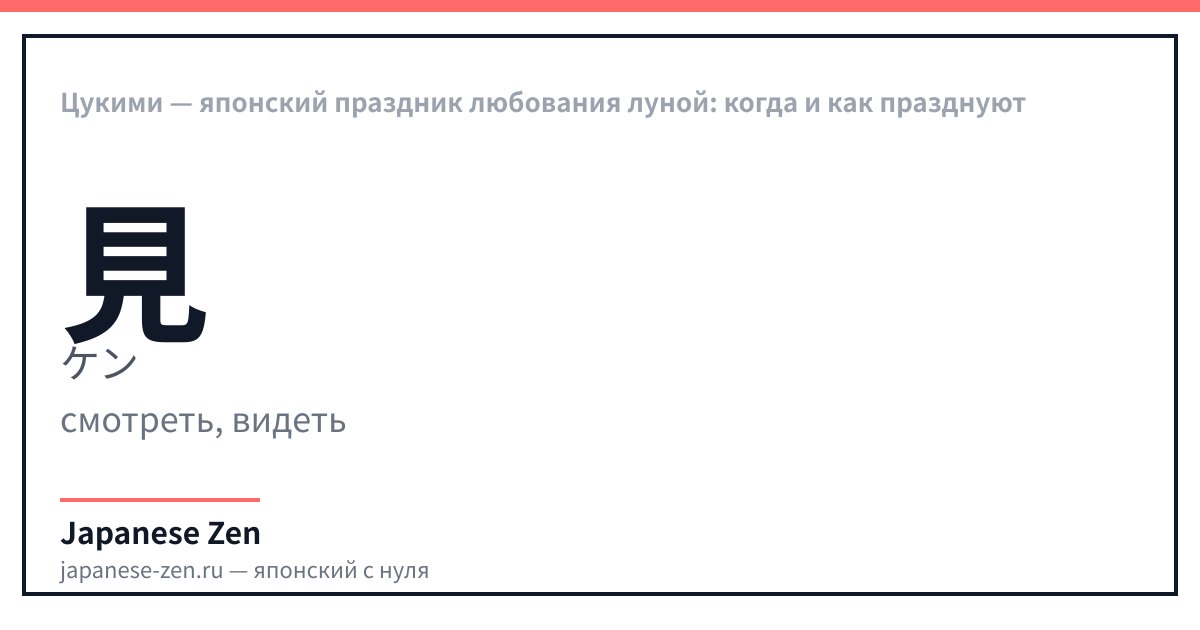
見 — значение: to see, to look — онъёми: ケン — кунъёми: み.る、み.える、み.せる — 7 штрих(ов). 見 — "to see": the same character stands at the end of a whole family of words for seasonal viewing — 花見 (hanami, in spring, for flowers), 月見 (tsukimi, in autumn, for the moon), and 雪見 (yukimi, in winter, for snow). Here it's not a casual glance but going out of the house specifically for one natural spectacle.
月見 — a moon you look at, not one you study
月見 is made up of 月 "moon" and the verb 見る "to see" in noun form. The moon of this night is called 中秋の名月, "the celebrated moon of mid-autumn," and the fifteenth night itself is 十五夜, jūgoya; the second, less crowded one is 十三夜, jūsan'ya.
"The moon is beautiful" — a legend without an author
The phrase 月が綺麗ですね, "the moon is beautiful, isn't it?", is popularly attributed to Natsume Sōseki as a delicate translation he supposedly invented for an English declaration of love in an English lesson. The story has been widely repeated, but no confirmation is found either in Sōseki's own texts or in the memoirs of his contemporaries — it's a beautiful legend with no established source, not a documented fact.
| Japanese | Reading | Translation |
|---|---|---|
| 月見 | tsukimi · tsukimi | Moon viewing |
| 花見 | hanami · hanami | Viewing cherry blossoms in spring |
| 雪見 | yukimi · yukimi | Viewing snow in winter |
| 十五夜 | jūgoya · jūgoya | The fifteenth night — the main evening of tsukimi |
| 十三夜 | jūsan'ya · jūsan'ya | The thirteenth night — the second, less crowded moon |
| 月が綺麗ですね | tsuki ga kirei desu ne · tsuki ga kirei desu ne | The moon is beautiful tonight, isn't it? (according to legend, a phrase by Natsume Sōseki; no confirmation has been found in his texts) |
Write 見 along the guides — the character that appears at the end of both hanami and tsukimi.
Not always a full moon, not a day off, not once a year
- "Tsukimi always falls on a full moon." Jūgoya is a fixed day of the lunar calendar, not the moment of the exact astronomical full moon: according to the National Astronomical Observatory of Japan, these dates often differ by a day or two.
- "Tsukimi is a national holiday." There is no official day off for tsukimi in Japan: it's a household tradition, not a holiday on the calendar of days off.
- "Tsukimi happens once a year." A month after jūgoya, the second, less crowded night is observed — jūsan'ya — and by custom both are meant to be celebrated, not just one of your choosing.
- "The rabbit with mochi is a purely Japanese image." The motif came from China, and in the Chinese version the same rabbit pounds not rice cakes but the elixir of immortality for the lunar goddess.
FAQ
- What is tsukimi?
- Tsukimi 月見 is the tradition of viewing the full moon in mid-autumn: in the evening people set out susuki grass and round rice dumplings (dango), then simply look at the moon. The festival goes back to a court custom of the Heian period, borrowed from China.
- When is tsukimi celebrated?
- On the night of jūgoya, the fifteenth night of the eighth month of the old lunar calendar — usually in September or early October, and the date changes from year to year. A month later, the second, less crowded night is observed: jūsan'ya.
- What do people eat on tsukimi?
- The main offerings are tsukimi dango, round rice dumplings stacked in a mound, and taro satoimo — the fresh harvest at this time of year. In dish names like tsukimi udon, "tsukimi" means a raw egg on top: the yolk resembles the full moon.
- Why is susuki grass placed out on tsukimi?
- Susuki stands in for rice ears, which aren't out yet at the end of summer: the ear-like plume symbolizes the coming harvest and, by belief, also protects the home for the coming year. It's often placed in a vase together with other autumn grasses, not on its own.
- Who lives on the moon according to Japanese legend?
- A rabbit pounding rice cakes (mochi) in a mortar. The image is borrowed from China, and in the Chinese version the same rabbit pounded not mochi but the elixir of immortality for the lunar goddess Chang'e.
- How is "tsukimi" written in kanji?
- 月見: 月 "moon" plus the verb 見る "to see" in noun form. The moon of this night is called 中秋の名月, "the celebrated moon of mid-autumn," and the fifteenth night itself is simply 十五夜, jūgoya.
Sources
Updated: 2026-09-14