Momiji — Japanese Maples and Autumn Leaf Viewing: What It Means
Momiji (紅葉) in Japanese means both the autumn coloring of leaves and the maple tree with such leaves: one word does the work of two in English. It is read as a whole, "momiji", not by the usual readings of the characters 紅 "crimson" and 葉 "leaf". The word is most often associated with the Japanese maple: its jagged leaves resemble a splayed palm.
Momiji is confused either with any autumn leaf fall or with one specific tree, although the word covers both meanings at once and lives its own grammatical life — it is read not by parts of the characters, but as a single whole. Let's figure out where this reading came from, how momiji differs from kaede, what a deer on a hanafuda card has to do with it, and why not only maples turn yellow.
Two Meanings of One Word: Leaf Color and Maple
Even a Japanese person can easily confuse the two meanings by ear: both the tree and the color of its leaves are called the same, "momiji", with no difference in word form. Only the neighboring word in the phrase helps to distinguish — whether it is what grows in the park, or what color it turned by November.
The word itself goes back to the Old Japanese verb momizu — "to color, to be dyed": at first it referred to the process of leaf color change, and later the form became established as a noun. The characters 紅葉 were chosen later to fit the already existing word, so their reading does not match the usual readings of the characters separately.
Momiji and Kaede: Are They the Same Tree?
Kaede 楓 is the usual botanical name for maple, while momiji in conversation more often denotes the same tree, but with reddened autumn leaves. According to one version, the name "kaede" itself goes back to the old word 蛙手 (kaerude) — "frog's paw": the jagged, multi-lobed leaf resembles a splayed frog's paw.
"Hunting" Without Prey, and the Front Moves Down, Not Up
紅葉狩り (momijigari) — an outing for viewing autumn leaves, modeled after spring hanami. The tradition goes back to the Japanese nobility of the Nara and Heian periods: already in the "Man'yōshū", the oldest poetic anthology of the 8th century, there are poems about viewing autumn colors.
The word "gari", "hunting", here is not about catching anything: according to one version, it was not proper for noble persons to wander the mountains on foot, and the outing for leaves was called "hunting" — an activity more respected than simple walking.
The Momiji Front: From Mountains to Plains, From North to South
紅葉前線 (momiji front) — a conventional line on a map where autumn coloring is most vivid on a given day. It moves in the opposite direction from the spring cherry blossom front — from north to south and from top to bottom, from mountains to cities. In Hokkaido, maples turn red already in mid-October, while in southwestern Kyushu — only in late November: the journey across the whole country takes more than a month. One of the most famous places for viewing is the gardens and temples of Kyoto, where maples are often illuminated in the evening.
What the Deer Has to Do With It: The Word Shikato
On the October card of the hanafuda deck, a maple and a deer are depicted, turned to the side, as if it has turned away from the viewer. It is from this image, according to one version, that the slang word shikato, "to pointedly ignore", originated — first as street gang jargon.
Momiji You Can Eat
Food without a single leaf in its composition is also connected with momiji: momiji-manju — a cookie in the shape of a maple leaf, which in 1906 was invented by confectioner Takatsu Jōsuke for a hotel near the Momijidani valley on Miyajima island. And in the city of Mino near Osaka, tempura made from real maple leaves has been fried for over a century — according to legend, the custom goes back to the hermit En no Gyōja, the semi-legendary founder of the ascetic practice of Shugendō.
Crimson Like Lipstick and Tea: What 紅 Does in the Word 紅葉
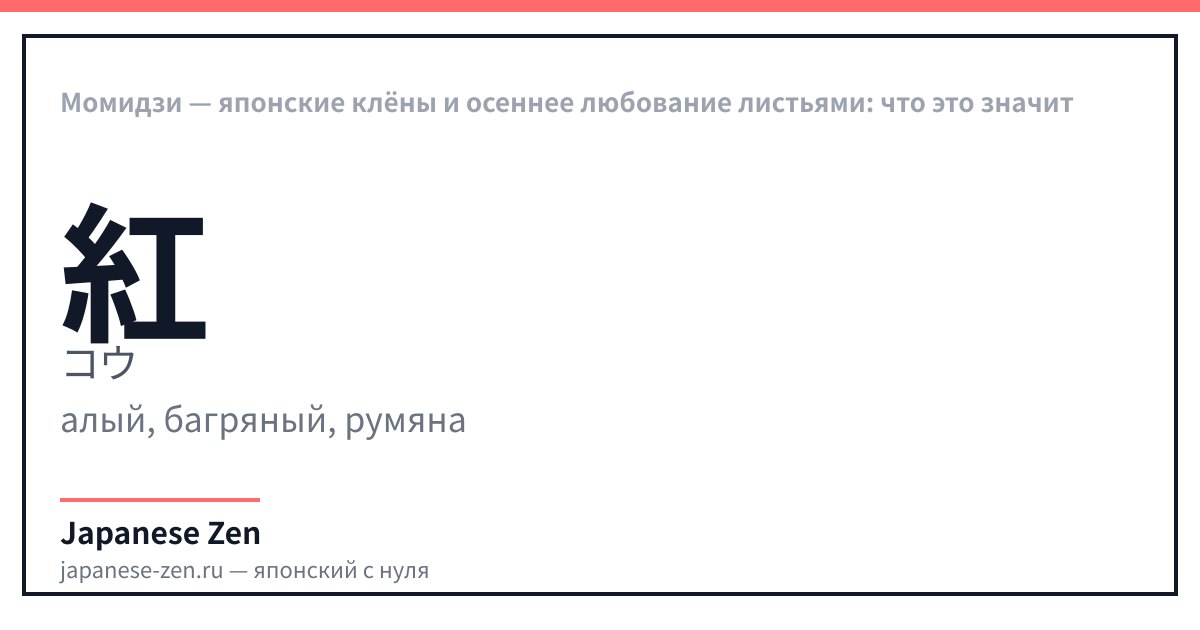
紅 — значение: crimson, scarlet, rouge — онъёми: コウ、ク — кунъёми: べに、くれない、あか.い — 9 штрих(ов). 紅 — "crimson, scarlet": the first of the two characters in 紅葉 (momiji), the same color as in 口紅 (lipstick) and 紅茶 (black tea, literally "crimson tea").
Why 紅葉 Cannot Be Split into 紅 and 葉 Separately
The character 紅 itself has the kun readings beni and kurenai in the dictionary, and 葉 has the kun reading ha, but in the word 紅葉 neither of them is heard. The reading momiji is assigned to the whole combination at once, not assembled from the parts of the characters. This type of reading is called jukujikun — in the same way, for example, the word 明日 "tomorrow" (ashita) is read: it also cannot be broken down into individual characters by kana, only memorized as a whole.
The same characters 紅葉 also have a second, more dry reading variant — kōyō, which refers to the process of leaves turning red in scientific and meteorological texts, whereas momiji is a more poetic and everyday word. And for leaves that turn yellow rather than red — for example, ginkgo — there is a separate word 黄葉, also kōyō, but with a different first character: 黄 "yellow" instead of 紅 "crimson".
| Japanese | Reading | Translation |
|---|---|---|
| 紅葉 | momiji · momiji | Autumn maples or their coloring |
| 紅葉狩り | momijigari · momijigari | An outing for viewing autumn leaves |
| 口紅 | kuchibeni · kuchibeni | Lipstick |
| 紅茶 | kōcha · kōcha | Black tea, literally "crimson tea" |
| 紅白 | kōhaku · kōhaku | Red and white — colors of celebration and opposing teams |
| 黄葉 | kōyō · kōyō | Yellowed leaves, for example ginkgo |
Write 紅 along the guides — that very crimson color into which momiji maples turn in autumn.
Not Only Maples Turn Yellow, and "Maple" Is Not the Only Name
- "Momiji is only maple." In fact, the word is broader: at first it referred to the autumn coloring of leaves in general, and only later to the specific maple with such leaves.
- "Momijigari is autumn hanami, only with flowers." Momijigari is about leaves, not flowers: people "hunt" for red maples, not for blossoming, as in spring hanami.
- "Only maples turn red." Ginkgo and many other trees turn yellow, not red: for this case the Japanese have a separate word 黄葉 (kōyō) — the same reading as the "reddening" variant, but with a different first character.
- "Momiji and kaede are two different trees." Botanically, it is more often the same maple: kaede is its usual generic name, momiji is the same tree, but applied to its already reddened autumn leaves.
FAQ
- What does momiji mean?
- Momiji 紅葉 has two meanings at once: the autumn coloring of falling leaves and the plant — the maple with such jagged leaves. Which of the two is meant is usually clear from context: "let's go see momiji" — about trees, "momiji has begun" — about the color.
- How is "momiji" written in kanji?
- 紅葉: 紅 "crimson" plus 葉 "leaf", but the combination is read not by individual characters, but as a whole — momiji. This special reading, jukujikun, goes back to the Old Japanese verb momizu, "to be dyed". The same characters also have a second, more dry reading variant — kōyō, for scientific texts.
- When is the momiji season in Japan?
- There is no single date: the autumn coloring front moves from north to south and from mountains down, in the opposite direction from the spring cherry blossom. In Hokkaido, maples turn red already in mid-October, in southwestern Kyushu — in late November.
- What is momijigari?
- 紅葉狩り — an outing for viewing autumn maples, modeled after spring hanami. The tradition has been known since the Nara and Heian periods: poems about viewing autumn colors are already in the "Man'yōshū", the oldest Japanese poetic anthology.
- How does momiji differ from kaede?
- Kaede 楓 is the usual name for maple as a tree, while momiji is the same tree, but applied to its autumn, already reddened foliage. In most cases it is the same plant, just with a different emphasis in the name.
- Why are a deer and a maple depicted on a hanafuda card?
- The October card in the hanafuda deck combines a maple and a deer — both images of autumn. The deer on it is turned to the side, as if it has turned away from the viewer, and, according to one version, this is where the slang word shikato — "to pointedly ignore" — comes from.
Sources
Updated: 2026-09-14