Holidays in Japan: Public Days Off and Traditions of the Year
Holidays in Japan are 16 public days off under the 1948 law, from New Year's Day on January 1 to Labor Thanksgiving Day on November 23, plus dozens of traditional days like Hinamatsuri and Tanabata that are not considered days off. Some dates are fixed, while others are tied to a Monday for long weekends—the so-called Happy Monday system.
Japan has far fewer public holidays than it might seem at first glance, and some of the most recognizable dates—Obon, Hinamatsuri, Christmas—are not on that list at all. Let's look at the official list under the law, the difference between the words 祝日 and the outdated 祭日, and what really lies behind Golden Week and the New Year holidays.
16 Public Holidays: The List Under the 1948 Law
| Date | Holiday | Japanese Name |
|---|---|---|
| January 1 | New Year's Day | 元日 |
| 2nd Monday of January | Coming of Age Day | 成人の日 |
| February 11 | National Foundation Day | 建国記念の日 |
| February 23 | The Emperor's Birthday | 天皇誕生日 |
| around March 20–21 | Vernal Equinox Day | 春分の日 |
| April 29 | Showa Day | 昭和の日 |
| May 3 | Constitution Memorial Day | 憲法記念日 |
| May 4 | Greenery Day | みどりの日 |
| May 5 | Children's Day | こどもの日 |
| 3rd Monday of July | Marine Day | 海の日 |
| August 11 | Mountain Day | 山の日 |
| 3rd Monday of September | Respect for the Aged Day | 敬老の日 |
| around September 22–23 | Autumnal Equinox Day | 秋分の日 |
| 2nd Monday of October | Sports Day | スポーツの日 |
| November 3 | Culture Day | 文化の日 |
| November 23 | Labor Thanksgiving Day | 勤労感謝の日 |
Happy Mondays and "Sandwich" Weekends
Since 2000, some holidays have been tied not to a date but to a Monday: together with the weekend, this creates three consecutive days off—the Happy Monday system. This shifted Coming of Age Day and Sports Day, and later Marine Day and Respect for the Aged Day. A weekday squeezed between two holidays also becomes a day off—that's how May 4 worked until 2007.
Traditional Days That Are Not Considered Days Off
- Shogatsu—Japanese New Year, from late December through the first days of January.
- Setsubun—early February: roasted beans are scattered to drive away misfortune.
- Hinamatsuri—March 3, Girls' Day with hina-ningyo dolls.
- Hanami—late March to early April: viewing the blooming cherry blossoms.
- Tanabata—July 7: wishes are written on strips of paper and hung on bamboo.
- Obon—mid-August: honoring ancestors and the bon-odori dance.
- Shichi-go-san—November 15: children of three, five, and seven are taken to a shrine.
- Tsukimi—autumn moon viewing, the date shifts according to the lunar calendar.
Golden Week, Obon, and the New Year Holidays
Three periods when all of Japan is on the road: Golden Week in early May, Obon in mid-August, and the New Year holidays. The latter two are not based on law but on the custom of companies letting employees take time off.
祝日 Is Not the Same as 祭日, 休日, and 祝祭日
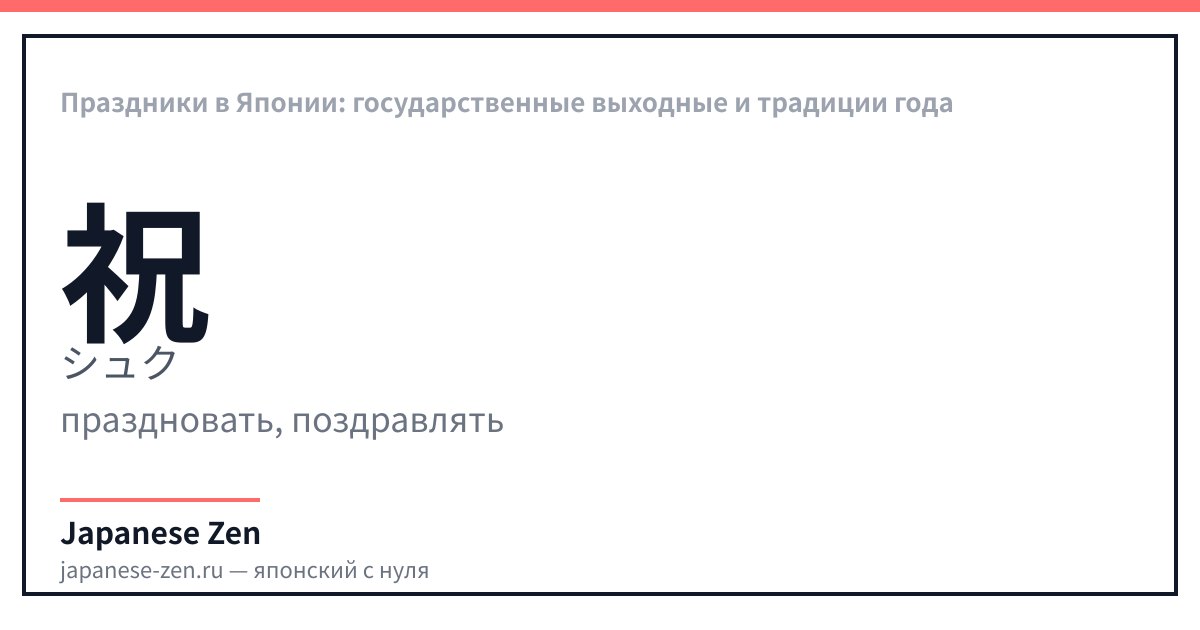
祝 — значение: celebrate, congratulate — онъёми: シュク、シュウ — кунъёми: いわ.う — 9 штрих(ов). 祝—"celebrate": the character in the official term 祝日, "public holiday." The same character appears in 祝う, "to congratulate, to celebrate."
Four similar words mean different things. 祝日 (shukujitsu) is the official term from the 1948 law, exactly 16 days a year. 祭日 (saijitsu) is an old word for days of religious and court rituals; as a separate legal category it was abolished, but in colloquial speech "祭日" is still sometimes used as a synonym for holiday. 休日 (kyūjitsu) is any non-working day in general, including regular weekends and vacation. 祝祭日 (shukusaijitsu) is an old collective word for 祝日 and 祭日 together, from the pre-war system, which is still heard out of habit in some places.
| Japanese | Reading | Translation |
|---|---|---|
| 祝日 | shukujitsu · shukujitsu | Public holiday |
| 祝う | iwau · iwau | To celebrate, to congratulate |
| 祭日 | saijitsu · saijitsu | Outdated word for holiday |
| 休日 | kyūjitsu · kyūjitsu | Any non-working day |
| 振替休日 | furikae kyūjitsu · furikae kyūjitsu | Substitute holiday |
| お祝い | oiwai · oiwai | Congratulations, celebration |
Why 祭日 Is an Outdated Word
Before 1948, an old law was in effect where religious and court ritual days (祭日) and public holidays (祝日) existed as two separate categories, together called 祝祭日. The new post-war law abolished 祭日 as a legal concept and defined all days on the list with one word—祝日. Since then, "祭日" has had no official status, although out of habit some people still call public holidays that.
Write 祝 along the guides—the character for "celebrate" from the official term 祝日.
Christmas, the Emperor's Birthday: Three Mistakes
- "Christmas is a day off in Japan." No, December 25 is a regular working day: it is not on the official list of 16 holidays. For many Japanese, Christmas is not a religious but a romantic evening for couples, and it has long been associated with KFC chicken—thanks to a successful advertising campaign in the 1970s.
- "The Emperor's Birthday is December 23." That was true under Emperor Akihito, but in May 2019 Naruhito ascended the throne, and since 2020 the public holiday has been celebrated on his birthday—February 23.
- "Obon is a public holiday." No, Obon is not on the list of 16 official days off, but in practice many companies close or give employees leave during those days, so in fact it is one of the busiest travel days of the year.
FAQ
- What holidays are there in Japan?
- The state observes 16 days a year under the 1948 law—from New Year's Day to Labor Thanksgiving Day in late November. Besides these, there are dozens of traditional dates like Hinamatsuri or Tanabata: they are genuinely loved, but they do not have the status of a public day off.
- How many public holidays are there in Japan?
- 16—the list became this long in 2016 when Mountain Day was added. In 1948, when the law was passed, there were only 9 official holidays, and since then their number has grown gradually through individual amendments to the law.
- What is the main holiday in Japan?
- By law, all 16 days are equal, but in terms of importance for the family, Shogatsu—Japanese New Year—comes first. Formally, only January 1 itself is a day off, but the rituals, visits to relatives and the shrine stretch over several days around that date.
- Is Christmas celebrated in Japan?
- As a public holiday—no, December 25 is a working day. But as an occasion for a romantic evening or a family dinner, Christmas has taken root: it is associated with KFC chicken, which has become a Christmas tradition for many families.
- What is Golden Week?
- A cluster of four consecutive holidays in late April to early May: Showa Day, Constitution Memorial Day, Greenery Day, and Children's Day. Together with the regular weekends, it creates the longest continuous vacation period in the Japanese year, and tickets for those days sell out in advance.
- How do you say "holiday" in Japanese?
- A public holiday under the law is called 祝日 (shukujitsu). A folk festivity like a street festival at a Shinto shrine is called differently—祭り (matsuri): the words are related in meaning but denote different things and are not interchangeable.
Sources
Updated: 2026-09-14