Setsubun — what this tradition is and how it goes
Setsubun (節分) is a rite of seeing off winter on February 3 or 4, on the eve of the beginning of spring according to the old calendar. At home and at shrines, people throw roasted soybeans while saying "Oni out, happiness in," sometimes through the door at a family member wearing an oni demon mask. Afterward, it is customary to eat beans equal to one's age plus one — for good luck in the coming year.
It seems like a fun home game with dressing up. In essence, setsubun is a rite of purifying the house before the new season, just done without a single solemn note.
What is setsubun and when is it held
Setsubun is a rite of seeing off winter on the eve of risshun, the beginning of spring according to the old lunisolar calendar: usually February 3 or 4. The main action is mamemaki, scattering roasted soybeans, which symbolically drives out oni, evil spirits, and the bad luck of the past season from the house.
- Roast the soybeans fukumame in advance — raw ones are not suitable for the rite.
- One family member sometimes puts on an oni mask so that the others symbolically drive him away with beans.
- Open the front door and scatter beans outside with the cry "Oni out!".
- Then throw beans inside the house with the cry "Happiness in!", closing the circle of the rite.
- Eat one bean for each year of your life plus one more — for good luck in the coming year.
Chinese rite of exorcising spirits
The rite goes back to the court Chinese tradition of exorcising evil spirits at the end of the year, which came to Japan and took root at Shinto shrines and Buddhist temples. Over time, the home version with beans became widespread and replaced the more complex court ceremonies.
Words and characters: 節分
| Japanese | Reading | Translation |
|---|---|---|
| 節分 | setsubun · setsubun | Setsubun |
| 鬼 | oni · oni | Demon, evil spirit |
| 豆 | mame · mame | Beans |
| 鬼は外 | oni wa soto · oni wa soto | "Oni out!" (rite cry) |
節分 — division of seasons
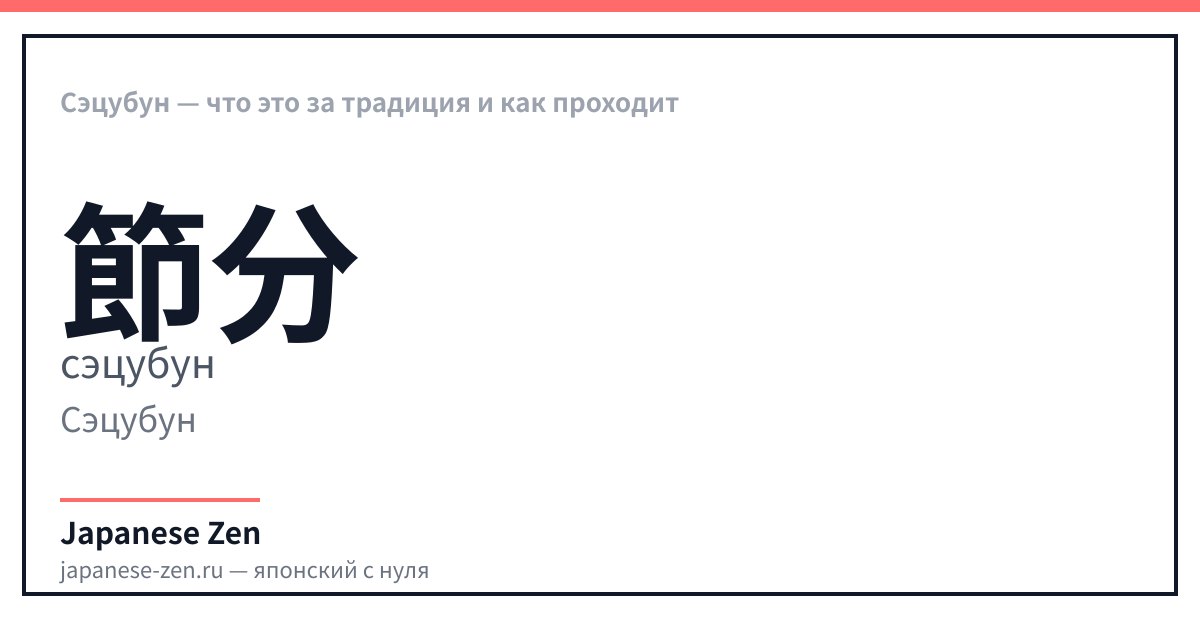
節分 is two characters: 節 "season, knot, joint" and 分 "to divide, to separate." Literally — "division of seasons": originally it referred to the transition between any two seasons of the year, and only later did the word become attached specifically to the boundary between winter and spring.
節 — значение: knot, season, period, case, verse — онъёми: セツ、セチ — кунъёми: ふし、-ぶし、のっと — 13 штрих(ов). 節 — "season, knot": the same character in 季節 "kisetsu", season, and in 関節 "kansetsu", body joint — also a kind of "knot."
Listen to the words setsubun and repeat — the app will evaluate your pronunciation.
Setsubun in anime
Setsubun is a convenient winter episode for a comedy scene: a rite with dressing up and throwing things almost always looks funny on screen.
- One of the characters in an oni mask, whom the others jokingly pelt with beans, is the most common comedic move.
- The cry "Oni wa soto, fuku wa uchi" in chorus by the whole family or a class at school is a recognizable sound detail of the episode.
- Counting beans by the character's age is sometimes used as a joke about their real, hidden age.
- The modern custom of eating ehomaki rolls silently while facing the lucky direction of the year is a newer detail that is also sometimes shown.
How not to confuse it with another holiday
The oni demon in setsubun is driven out with beans as a ritual figure of the season, not as a character from myth — unlike stories about specific oni antagonists in fantasy plots, where the demon threatens seriously and does not just participate in a family game.
FAQ
- What is setsubun?
- A rite of seeing off winter on the eve of the beginning of spring according to the old calendar, usually February 3 or 4. The main action is scattering roasted soybeans, which symbolically drives bad luck out of the house.
- When is setsubun held?
- February 3 or 4, on the eve of risshun, the beginning of spring according to the old lunisolar calendar. The exact date floats a little from year to year due to the astronomical calculation of the calendar itself.
- How does setsubun go?
- Roasted beans are scattered outside the door with the cry "Oni out!", then inside the house with the cry "Happiness in!". Afterward, beans are eaten equal to the number of years lived plus one.
- How is "setsubun" written in Japanese?
- 節分, in kana せつぶん. The first character 節 — "season, knot", the second 分 — "to divide". Literally — "division of seasons", originally the boundary between any two consecutive seasons.
- Where can one catch mamemaki?
- Yes, many large shrines and temples hold public mamemaki, which everyone is welcome to attend. At home, repeating the rite is even easier: you only need roasted soybeans from the supermarket.
- How is setsubun played out in comedies?
- Often as a winter comedy episode: a character in an oni mask, who is jokingly pelted with beans under the family's general cry. Here the demon is driven out as a ritual figure, not as a serious threat to the plot.
Sources
Updated: 2026-08-24