What does "yōkai" mean in Japanese
"Yōkai" (妖怪) means a supernatural being from Japanese folklore: from the shapeshifting fox kitsune to the animated umbrella. The kanji read as 妖 "charm, bewitchment" and 怪 "strange, inexplicable". A yōkai is not a demon or a ghost: the spirit of a dead person is called 幽霊 (yūrei), and an evil demon is 鬼 (oni).
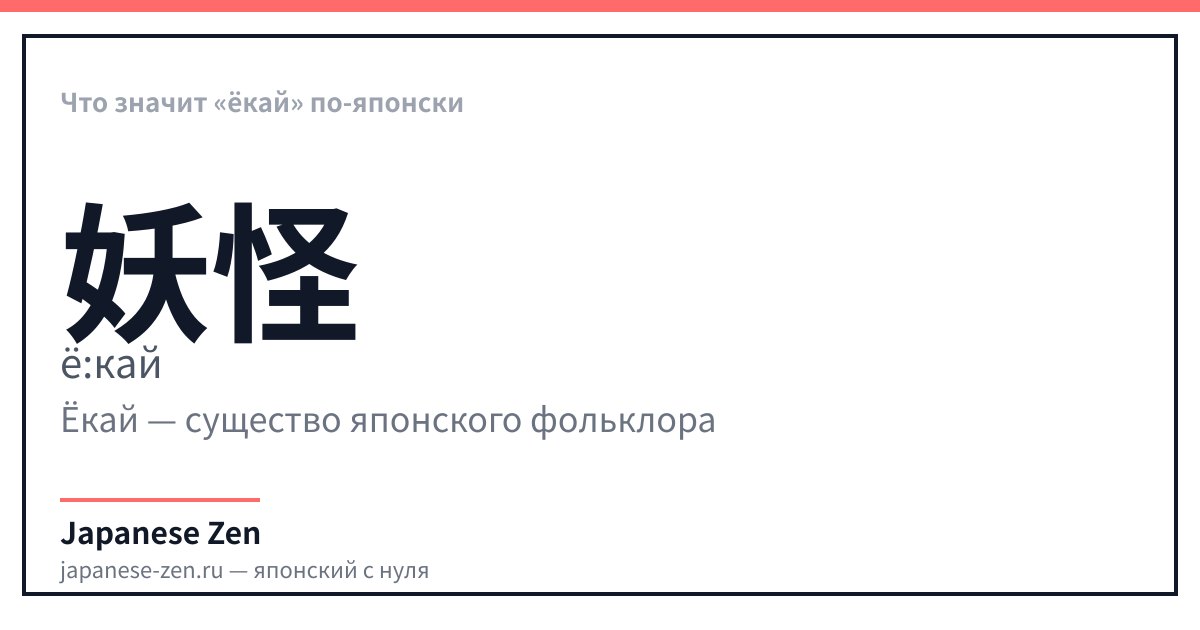
In Japanese tales of the supernatural, what matters is not malice but strangeness: a yōkai may drown you, or it may simply count beans under your window all night. Let's look at what 妖怪 means, how it differs from ghosts and demons, and which of them you already know from anime.
What "yōkai" means and who counts as one
The word gathers everything inexplicable into one category: shapeshifters, spirits of objects, water imps, mountain old men. The common trait is that the being is not a dead person but a separate entity with its own rules.
| Japanese | Reading | Translation |
|---|---|---|
| 妖怪 | yōkai · yōkai | Yōkai — a being from Japanese folklore |
| 幽霊 | yūrei · yūrei | Ghost of a dead person (this is not a yōkai: a yūrei had a human life) |
| 鬼 | oni · oni | Demon, horned ogre (the most recognizable kind of supernatural being) |
| 河童 | kappa · kappa | Water imp with a dish on its head (loves cucumbers, drowns the careless) |
| 狐 | kitsune · kitsune | Shapeshifting fox (grows up to nine tails with age) |
| 付喪神 | tsukumogami · tsukumogami | An object that came to life after a hundred years (hence umbrellas and lanterns with eyes) |
Yōkai, yūrei and oni are three different things
幽霊 (yūrei) is the spirit of a specific dead person, usually with unfinished business. 鬼 (oni) is a horned demon strongman, a separate kind of supernatural being. 妖怪 is the general category of strange beings, which oni also fall into, but yūrei does not. The Western word "demon" is almost always inaccurate for Japanese material: a yōkai has no hell and no deals over souls.
妖 — значение: charm, bewitchment, magical — онъёми: ヨウ — кунъёми: あや.しい、なま.めく、わざわ.い — 7 штрих(ов). 妖 — "charm, bewitchment", an N1-level character. Click "Show stroke order": the radical "woman" 女 is on the left.
Where to see yōkai in anime and games
- "Naruto": the nine-tailed Kurama is a kitsune, a shapeshifting fox from folklore.
- "Demon Slayer" — in the original 鬼滅の刃, that is, about 鬼 (oni), not about yōkai in general.
- "Spirited Away" — almost a catalogue of yōkai: from the river god to the faceless Kaonashi.
- Yōkai were traditionally collected in scroll lists: the artist Toriyama Sekien drew them as an encyclopedia in the 18th century.
- Many anime "yōkai" are invented by the authors, but according to the rules of the genre: strangeness, a tie to a place, and a quirk of their own.
Yō: — the vowel is long
"Yō-kai" — the first vowel is long, this is key: ようかい, not "yokai". The usual English spelling "yokai" loses the length. The "i" at the end is part of the diphthong "ai" and does not form a separate syllable.
Say the words out loud — the app will check the length of the first vowel.
FAQ
- What does "yōkai" mean in Japanese?
- 妖怪 — a supernatural being from Japanese folklore: a shapeshifter, a water imp, an object that came to life. Literally "charm and strangeness".
- How is a yōkai different from a ghost?
- The ghost of a dead person is 幽霊 (yūrei), who had a human life. A yōkai is a separate entity, not the spirit of a deceased person.
- Is the demon oni a yōkai?
- Yes, 鬼 (oni) belongs to the category of yōkai, but it is a specific kind: a horned demon strongman.
- What are Japanese spirits and yōkai called?
- The most famous: kappa — a water imp, tengu — a mountain spirit with a long nose, kitsune — a shapeshifting fox, tanuki — a shapeshifting raccoon dog, yuki-onna — a snow woman, rokurokubi — a woman with a stretching neck, nekomata — a two-tailed cat, tsukumogami — old objects that came to life. The spirit of a dead person among them is not a yōkai but a yūrei.
- How is "yōkai" written in Japanese?
- 妖怪, in kana ようかい. Note: the first vowel is long — "yōkai".
Updated: 2026-09-29