Japanese Demon Masks and Their Meanings
Japanese demon masks, whose meanings are often confused. 般若 (hannya) — a jealous woman turned demon. 鬼 (oni) — a horned ogre, embodiment of elemental force. 天狗 (tengu) — a long-nosed mountain spirit. 狐面 (kitsune) — a festive fox mask, not demonic at all. Each comes from its own cultural layer.
At a festival, in theater, and on a tattooed person's shoulder, these are different objects with different histories. Let's examine five masks that are most often lumped together.
What kinds of Japanese demon masks are there
| Mask | Who it is | How to recognize |
|---|---|---|
| 般若 hannya | A woman turned into a demon by jealousy | Two horns, metallic eyes, sorrowful mouth |
| 鬼 oni | Horned ogre of Japanese folklore | Red or blue face, fangs, rage without suffering |
| 天狗 tengu | Mountain spirit, arrogant guardian | Long nose, red face, sometimes a beak |
| 狐面 kitsune | Fox mask for festivals | White face with red patterns, narrow eyes |
| 翁 okina | Old man deity, blessing | Wrinkles, kind smile, not a demon at all |
Which of them are not demons at all
Kitsune-men are bought at summer festivals and worn on the back of the head — it's a festive accessory associated with the fox messenger of the god Inari. Okina depicts a blessing deity, and in Noh theater this mask is kept separately, with special reverence.
Where they come from and where they are found
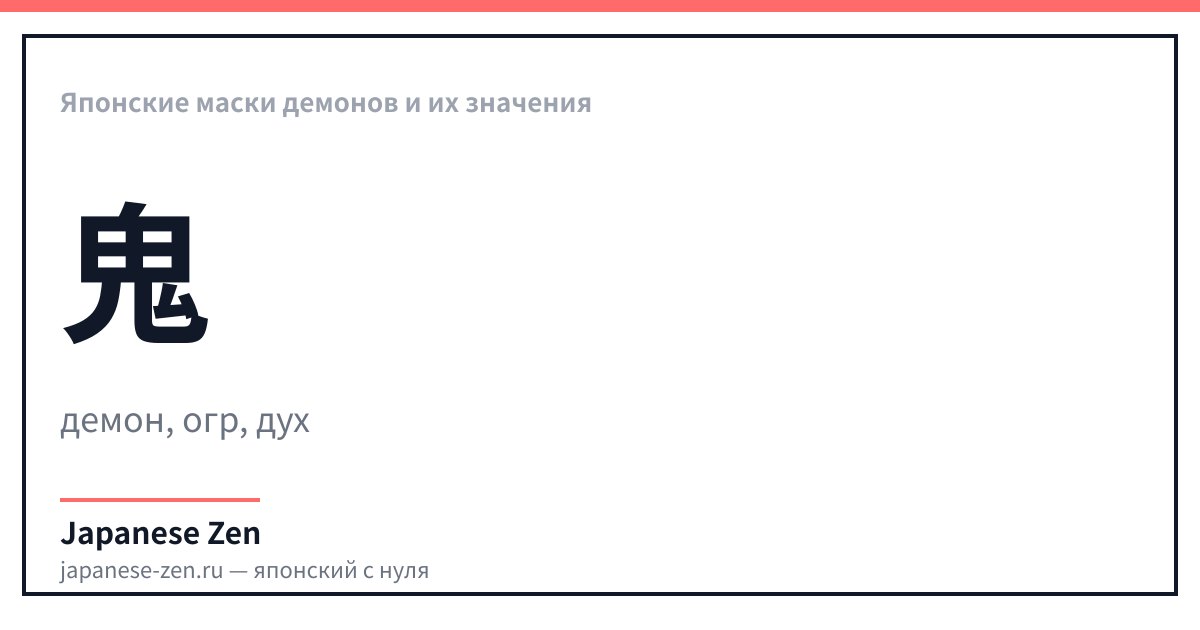
鬼 — значение: demon, ogre, spirit — онъёми: キ — кунъёми: おに、おに- — 10 штрих(ов). 鬼 — the kanji for demon. The same character appears in the title 'Demon Slayer' — 鬼滅の刃.
- Noh theater: masks were carved from Japanese cypress, and the finest examples from the 15th–16th centuries hold the status of Important Cultural Property (重要文化財).
- Setsubun festival: people in masks throw beans at them shouting 'oni wa soto' — 'demons out'.
- Irezumi: a mask on the shoulder or back is read as a story, not decoration — usually accompanied by peonies, snakes, or waves.
- Anime and games added a fifth layer: the mask became a sign of 'Japaneseness' in general, which is what created the confusion.
- What not to do: don't choose a mask just by its appearance — in Japan they will ask if you know its story.
How this relates to yokai
Oni and tengu belong to the broad category of 妖怪 (yokai) — supernatural beings. Hannya, however, is not a folkloric character but a theatrical image: a person who crossed the line. The difference explains why human pain remains in her face.
FAQ
- How many Japanese demon masks are there?
- In Noh theater there are about 60 canonical mask types, of which several are demonic. In folklore there are more images, but recognizable ones — five or six.
- How is hannya different from oni?
- Oni is a demon from the start. Hannya is a human who became a demon: her face retains suffering, while oni has none.
- Is the fox mask also a demon?
- No. 狐面 is associated with the fox messenger of the god Inari and is worn at festivals as an accessory.
- Who is tengu?
- A mountain spirit with a long nose or beak. He is considered a punisher of the arrogant, and sometimes a martial arts mentor.
Updated: 2026-07-25