Hinamatsuri — the Doll Festival on March 3: tiers, dolls, and the superstition about marriage
Hinamatsuri (雛祭り) is a festival honoring girls on March 3: families display hina-ningyō dolls led by an emperor and empress on a tiered stand. The day is not among Japan's 16 national holidays — only the May boys' festival received holiday status in 1948. A superstition is tied to putting the dolls away after the festival: if you leave them on the shelf too long, your daughter will marry later.
Hinamatsuri is easy to mistake for a children's toy party, but the arrangement of figures on the tiers follows a strict order, and the tradition itself is younger than it first appears. Let's look at who stands on each tier, how the arrangement differs between Kyoto and Tokyo, where the custom of floating dolls down a river came from, and what the character 段 — 'step' — has to do with it.
Hinamatsuri on March 3: who the day is for and why it isn't a day off
Hinamatsuri (雛祭り) is celebrated on March 3 in honor of girls: families wish their daughters health and a happy future. The festival's second name is Momo no Sekku, the 'Peach Festival': by the old lunar calendar the day fell in late March to early April, when peach trees really do bloom. After the calendar reform the date was fixed to March 3 of the new calendar, and by then the peach usually hasn't blossomed yet, so artificial branches are often used in the decorations.
Why Hinamatsuri is not a national holiday
Hinamatsuri is one of the five seasonal festivals of the year, gosekku, along with the May boys' festival, Tango no Sekku. Only the latter was made a national holiday in 1948 by the Holidays Act: it became Children's Day, Kodomo no Hi. Hinamatsuri and the other seasonal festivals received no official status and remain ordinary working days — that doesn't stop Japan from celebrating them at home.
Who stands on the tiers: the seven levels of hina-ningyō
A full set of hina-ningyō dolls is arranged in tiers on a stand covered with red cloth — hence the name 'seven-tier display', 七段飾り. At the top is the dairi-bina pair: figures of the emperor and empress in court attire. Below are three court ladies, then five musicians with a flute and drums, then two guards and three servants with different facial expressions: anger, tears, and laughter. In total a full set has fifteen figures, and the two bottom tiers hold not people but wedding utensils and a palanquin. The number of tiers in more modest sets — three or five — is also always odd: in Japanese counting, odd numbers are considered luckier for festive displays.
Kyoto and Tokyo place the imperial couple in mirror image
In old Japanese tradition the left side is considered more honorable than the right, and the male doll was placed in the place of honor — to his own left, that is, on the right when viewed from the front. This is still how dolls are arranged in Kyoto and throughout western Japan. In Tokyo and the rest of Kanto the order was changed in 1928, after the accession ceremony of Emperor Showa. By then the court had adopted Western protocol, and craftsmen in the capital adjusted to it. Since then, in Kanto the emperor stands on the viewer's left and the empress on the right.
From river purification to dolls on a chest of drawers
The festival has two different roots that over time merged into one. The first is the ancient Chinese custom of bathing in a river in early March, which in Japan turned into nagashi-bina: figures made of straw or paper, into which impurity and misfortune were transferred, were set afloat on water. The second is hina-asobi, the Heian-era game of noble children playing with small paper dolls, something like a dollhouse. These were two different traditions — a purification rite and a children's amusement — not one custom under two names.
Court hina-asobi is not the same as today's festival
The dolls displayed on tiers today are a much later thing than the courtly hina-asobi. Standing figures resembling today's appeared in the Muromachi period, and the custom of keeping them at home in a prominent place took hold only by the 17th century: roughly until the middle of the Edo period the festival was still called simply 'doll play'. The stand itself grew with fashion — from a flat base in the early Edo period to seven or eight tiers by the end of the period, and the festival became nationwide even later, in the Meiji era.
A superstition is tied to putting the dolls away: if you leave them on the shelf longer than you should, your daughter will marry later. Few people seriously believe this, but hina-ningyō are indeed customarily put away quickly and always in dry weather — dampness makes the figures moldy.
The kanji 段: the steps on which the dolls stand
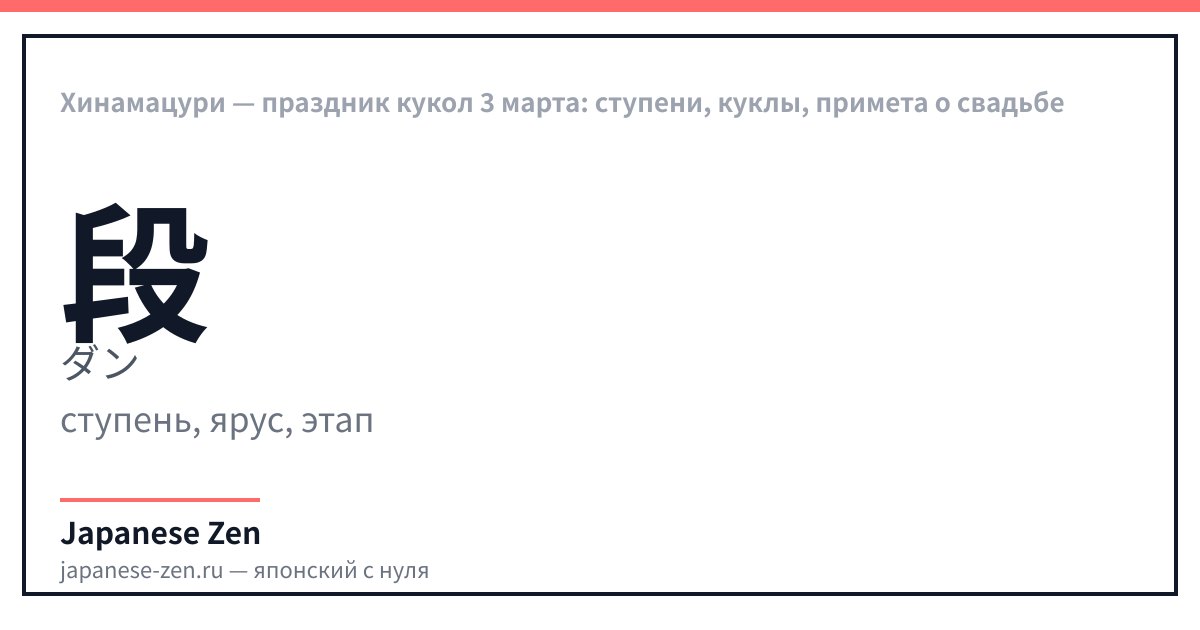
段 — значение: step, tier, stage — онъёми: ダン、タン — 9 штрих(ов). 段 means 'step, tier' — the same character writes hinadan (雛壇), the doll stand, and the seven-tier display, 七段飾り. The whole hierarchy of hina-ningyō is distributed across these tiers — from the imperial couple at the top to the wedding utensils at the bottom.
Dan and tan: two readings of one character
段 is read in two ways: dan — the most common on-reading, as in 雛壇 (hinadan) and 階段 (kaidan) 'staircase' — and the rarer tan. The word 'hina doll' itself is written with a different character, 雛: it means 'chick' or 'young animal', and the same kanji is used for chicks in general, not just for festival figures.
| Japanese | Reading | Translation |
|---|---|---|
| 雛祭り | hinamatsuri · hinamatsuri | Hinamatsuri |
| 雛壇 | hinadan · hinadan | Tiered stand for dolls |
| 七段飾り | shichidan kazari · shichidan kazari | Seven-tier display |
| 桃の節句 | momo no sekku · momo no sekku | Peach Festival — another name for the day |
| 流し雛 | nagashi-bina · nagashi-bina | Dolls set afloat on a river |
| 菱餅 | hishimochi · hishimochi | Diamond-shaped rice cakes of the festival |
Write 段 along the guides — the character for 'step', on which the hina-ningyō dolls stand.
FAQ
- What is Hinamatsuri and when is it celebrated?
- Hinamatsuri is a festival honoring girls, celebrated on March 3. In homes with daughters, hina-ningyō dolls are displayed on a tiered stand and the girls are wished health and a happy future. The day's second name is Momo no Sekku, the 'Peach Festival', although by March 3 of the new calendar the tree itself usually hasn't bloomed yet.
- Who is depicted on the tiers of hina-ningyō?
- In a full set of fifteen figures, at the top is a pair representing the emperor and empress, below are three court ladies and five musicians with instruments, and below them guards and servants with different facial expressions. The lower tiers hold not people but wedding utensils: chests, a mirror, and a palanquin.
- Why isn't Hinamatsuri considered a national holiday in Japan?
- Of the five seasonal festivals of the year, only one became a national holiday under the 1948 law — the May boys' festival, which was renamed Children's Day. Hinamatsuri, like the other seasonal dates, received no official status and remains an ordinary working day, though at home it is celebrated no less diligently.
- Is it true that the dolls shouldn't be left on the shelf long after the festival?
- This is a folk superstition, not a strict rule: it is said that the longer the dolls stay out after March 3, the later the daughter will marry. Behind the superstition there is also a practical reason — hina-ningyō are advised to be put away quickly and in dry weather, because dampness makes them moldy.
- Where did the Hinamatsuri tradition come from?
- The festival has two roots. One is the Chinese custom of purification by a river, which in Japan turned into nagashi-bina, floating straw dolls on water. The other is hina-asobi, the Heian-era game of noble children playing with paper dolls. The present form with figures on tiers took shape much later, by the end of the Edo period.
- How is 'Hinamatsuri' written in Japanese?
- 雛祭り, in kana ひなまつり. The first character 雛 means 'chick' or 'small creature' — hence the word 'hina' for dolls; the second, 祭り, means 'festival'. The stand on which the dolls are displayed is called by a different word — 雛壇, hinadan, with the character 段, 'step'.
Sources
Updated: 2026-09-15