Golden Week in Japan: Four Holidays in a Row and Where the Name Comes From
Golden Week in Japan is the stretch at the end of April and beginning of May when four national holidays fall in a row: April 29, May 3, 4, and 5. Because of substitute holidays and "citizens' holidays," the break often stretches to nine or ten days. The name was coined by the Daiei film studio in 1951 for movie promotion: it is not a translation from English but a Japanese word made from English roots, a wasei-eigo.
Behind the festive name lies fairly ordinary bureaucracy: the law on substitute holidays and the rule about a weekday squeezed between two holidays. Let's look at which four days make up Golden Week, how their names and dates have changed over recent decades, and why some Japanese media avoid the word "Golden Week" altogether.
Golden Week: Why There Are More Days Off Than Four Holidays
Golden Week is the stretch at the end of April and beginning of May when four national holidays fall in a row in Japan: April 29, May 3, 4, and 5. The name is often used more broadly, including the regular weekends around these dates, which is why the continuous break stretches to nine or ten days if the holidays fall favorably on the calendar.
Substitute Holidays and the "Citizens' Day" Between Holidays
If a national holiday falls on a Sunday, the nearest weekday after it becomes a substitute holiday — furikae kyūjitsu. And a weekday squeezed between two holidays with no regular day off between them has automatically become a "citizens' holiday," kokumin no kyūjitsu, since 1985. That is exactly how May 4 was set up until 2007: it had no name of its own yet, but it was already a day off thanks to its neighbors May 3 and 5. Before these rules appeared, the holidays at the end of April and beginning of May were interspersed with workdays, and this patchy period was called "hopping over stones," tobi-ishi renkyū.
Which Days Are Part of Golden Week
All four days are enshrined in the law on national holidays, but the names and status of two of them have changed over time.
| Date | Name | What the Day Is |
|---|---|---|
| April 29 | 昭和の日 (Shōwa no Hi) | Shōwa Day — an occasion to look back on the Shōwa era, which went through upheavals and recovery |
| May 3 | 憲法記念日 (Kenpō Kinenbi) | Constitution Memorial Day — the anniversary of the postwar constitution taking effect in 1947 |
| May 4 | みどりの日 (Midori no Hi) | Greenery Day — an occasion to get closer to nature and appreciate its gifts |
| May 5 | こどもの日 (Kodomo no Hi) | Children's Day — respect for the child's personality and gratitude to mothers |
How April 29 and May 4 Swapped Names
Until 1989, April 29 was the Emperor's Birthday — the Shōwa emperor himself was born on that day. After his death, the "Emperor's Birthday" holiday moved to December 23 — Akihito's birthday — and April 29, so as not to lose a day off in the middle of Golden Week, was renamed Greenery Day. In 2007 the name changed again: April 29 became Shōwa Day, and Greenery Day moved to May 4 — where the unnamed "citizens' holiday" between the other two holidays used to be.
Where the Name "Golden Week" Came From
"Gōruden Wīku" is not a translation but a word coined in Japan itself from English roots, a wasei-eigo. The Daiei film studio is considered the author of the term: in 1951 its film "Jiyū Gakkō" earned more during these days than the New Year and Obon premieres. To attract audiences to cinemas in the following years as well, the studio came up with an advertising name for this period — according to one version, it was done by its president Nagata Masaichi, according to another, by executive director Matsuyama Hideo.
Why NHK Says "Ōgata Renkyū" Instead of "Golden Week"
The term spread to other industries by 1952–1953. At the same time, NHK and some other TV channels deliberately use not "Golden Week" but ōgata renkyū, "major consecutive holidays." Various reasons are given: viewer complaints after the oil crisis of the 1970s, a desire to avoid loanwords on air, and the fact that the term was originally an advertising slogan for a private film studio, not an official name for the period.
Kanji 週: A Week Without a Single Kanji in the Word Itself
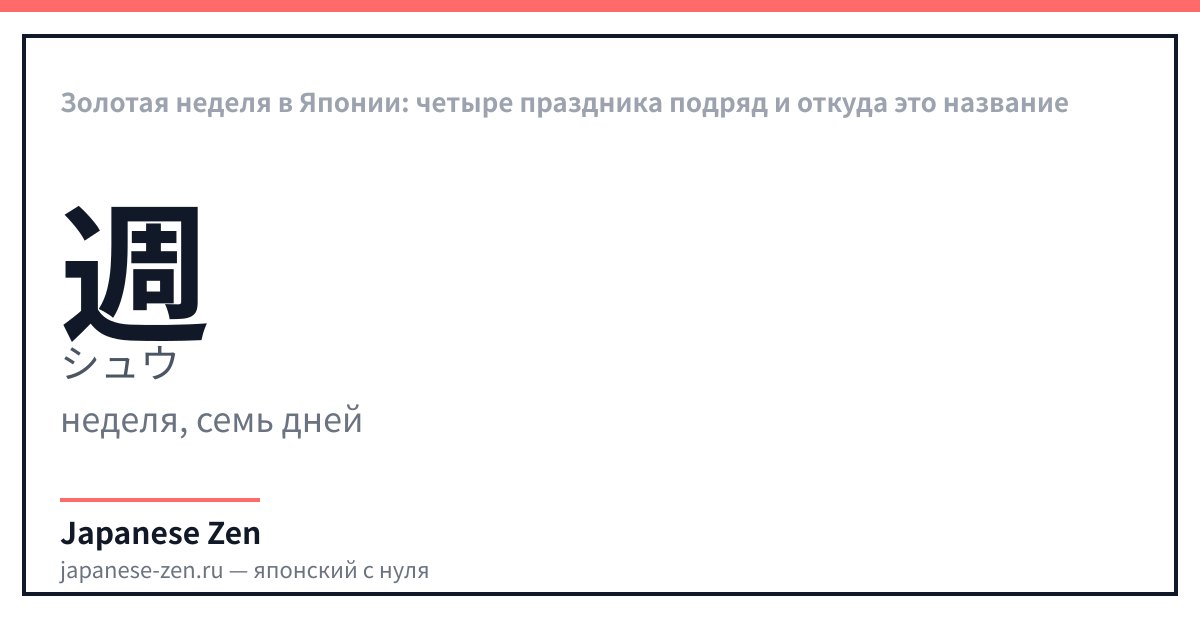
週 — значение: week, seven days — онъёми: シュウ — 11 штрих(ов). 週 means "week" — but the name ゴールデンウィーク itself contains no kanji at all; the word is entirely assembled from English roots. 週 does appear in ordinary words about the week: 今週 "this week," 週末 "weekend."
How to Decode 大型連休 by Its Characters
大型連休 is the very phrase NHK uses to replace "Golden Week": 大型 means "large, big in size," 連 means "in a row, continuously," 休 means "rest." Together it comes out as "a large-sized rest going in a row" — an almost literal synonym for Golden Week, but without English roots.
| Japanese | Reading | Translation |
|---|---|---|
| 今週 | konshū · konshū | This week |
| 来週 | raishū · raishū | Next week |
| 週末 | shūmatsu · shūmatsu | Weekend, end of the week |
| 大型連休 | ōgata renkyū · ōgata renkyū | "Major consecutive holidays" — what NHK calls Golden Week |
| 振替休日 | furikae kyūjitsu · furikae kyūjitsu | Substitute holiday |
Write 週 along the guides — the "week" character from everyday words like 今週 and 週末.
FAQ
- What is Golden Week in Japan and when does it take place?
- That is what the cluster of four national holidays in a row at the turn of April and May is called: April 29, May 3, 4, and 5. Counting regular weekends and substitute holidays, the break often stretches to nine or ten days in a row, and the exact boundaries of the period shift slightly each year.
- Which holidays are part of Golden Week?
- Shōwa Day on April 29, Constitution Memorial Day on May 3, Greenery Day on May 4, and Children's Day on May 5. The names and dates of the first two days in this list have changed over time: until 2007, April 29 was called Greenery Day, and the current Greenery Day was an unnamed "citizens' holiday."
- Why are there usually more than four days off during Golden Week?
- Two rules are at work: a holiday that falls on a Sunday is moved to the nearest weekday, and a weekday between two holidays automatically becomes a day off. Together with the regular Saturday and Sunday, this stretches Golden Week to nine or ten days.
- Where did the name "Golden Week" come from?
- The term was coined by the Daiei film studio in 1951 as an advertising move: after the record-breaking box-office film "Jiyū Gakkō," the studio wanted to attract audiences to cinemas in the following years as well. The authorship is attributed either to the studio's president Nagata Masaichi or to its executive director Matsuyama Hideo.
- Why doesn't NHK say "Golden Week"?
- NHK and some other TV channels use ōgata renkyū, "major consecutive holidays," instead. Among the reasons cited are viewer complaints after the oil crisis of the 1970s, a dislike of loanwords on air, and the fact that the term was born as advertising for a private film studio, not an official name for the period.
Sources
Updated: 2026-09-15