Gion Matsuri: A Month of Festival in Kyoto and the Yamaboko Floats
Gion Matsuri is a festival at Yasaka Shrine in Kyoto that runs throughout July. Its climax is two processions of wooden yamaboko floats: July 17 and July 24, with yoiyama evenings on the eve of each. Its origin is traced to a 869 ritual against an epidemic, and what UNESCO inscribed is not the festival as a whole but specifically the float procession ritual, Yamaboko Gyōji.
Gion Matsuri is easy to mistake for a single summer procession, but it is a month of preparation, rituals, and street festivities with a starting point: a 9th-century epidemic. Let's look at how yama floats differ from hoko, where the 869 ritual came from, and what exactly of the festival is recognized by UNESCO and what remains a local Kyoto tradition.
Gion Matsuri: A Month of Festival at Yasaka Shrine
Gion Matsuri runs throughout July at Yasaka Shrine in Kyoto — it is not a single day but a month of preparation, rituals, and street festivities. The climax is two processions of yamaboko floats: on July 17 the Saki Matsuri, the "front festival," takes place, and on July 24 the Ato Matsuri, the "back festival." Each procession is preceded by yoiyama evenings, when the decorated floats stand illuminated on the streets and townspeople stroll among them: July 14–16 before the first procession and July 21–23 before the second.
The Shrine That Changed Its Name
Before the Meiji Restoration, the shrine was called Gion-sha and was associated with the Buddhist complex Enryaku-ji on Mount Hiei. The name "Gion" goes back to the Buddhist monastery Jetavana in India, whose patron was Gozu Tennō — the same deity worshipped at the shrine. After the 19th-century decree separating Shinto and Buddhism, the shrine was renamed Yasaka, and the "Gion Goryōe" ritual became simply "Gion Matsuri": the Buddhist layer was removed from the name.
Yamaboko: How a Mountain Differs from a Spear
山 (yama) and 鉾 (hoko) are two different types of floats, and the difference lies primarily in size and method of movement. Yama are smaller and lighter: they are carried or led on wooden poles at shoulder height by several dozen people. Hoko can be taller than a house, stand on large wooden wheels, and move when teams pull them with ropes.
"Moving Museum" Is Not an Exaggeration
The floats are decorated with tapestries, carvings, and metal fittings, some of which are designated Important Folk Cultural Properties, which is why the yamaboko procession is called a "moving museum" — that is how Yasaka Shrine itself describes it. At the same time, the monument status is attached specifically to the procession ritual, Yamaboko Gyōji, and not to the festival as a whole.
869: How a Ritual Against an Epidemic Became a City Festival
The origin of Gion Matsuri is considered to be the goryōe of 869 (Jōgan 11) — a ritual to pacify angry spirits amid an epidemic and a series of disasters: the eruption of Mount Fuji in 864, and an earthquake and tsunami in Michinoku in 869. At that time, 66 hoko halberds were erected, one for each province of Japan at the time, impurity from all the lands was transferred into them, and three portable shrines with the deity Gozu Tennō were sent out, praying to stop the epidemic. The ritual did not become regular immediately, but about a century later, from 970.
From Palace Ritual to Townspeople's Festival
The procession with floats itself took shape much later than the original ritual, and the exact moment of its appearance is unknown. By the Muromachi period, the townspeople of the Shimogyō district had taken the organization of the procession into their own hands: each block built its own float. During a conflict with the clergy in the 16th century, the townspeople declared outright that they would carry the yamaboko even without a temple service — and so the festival became established as a city festival, not just a shrine one.
In 2009, "Yamaboko Gyōji Gion Matsuri Kyoto" was inscribed on the UNESCO Representative List of the Intangible Cultural Heritage of Humanity as a separate entry. In 2016, this entry was merged with similar rituals from other regions into a single collective nomination — "Yama, Hoko, Yatai, float festivals in Japan"; it now includes 37 rituals, from Aomori to Ōita. UNESCO recognizes not the festival as a whole but specifically the float procession ritual.
The Kanji 巡: A Procession That Goes Around the Block
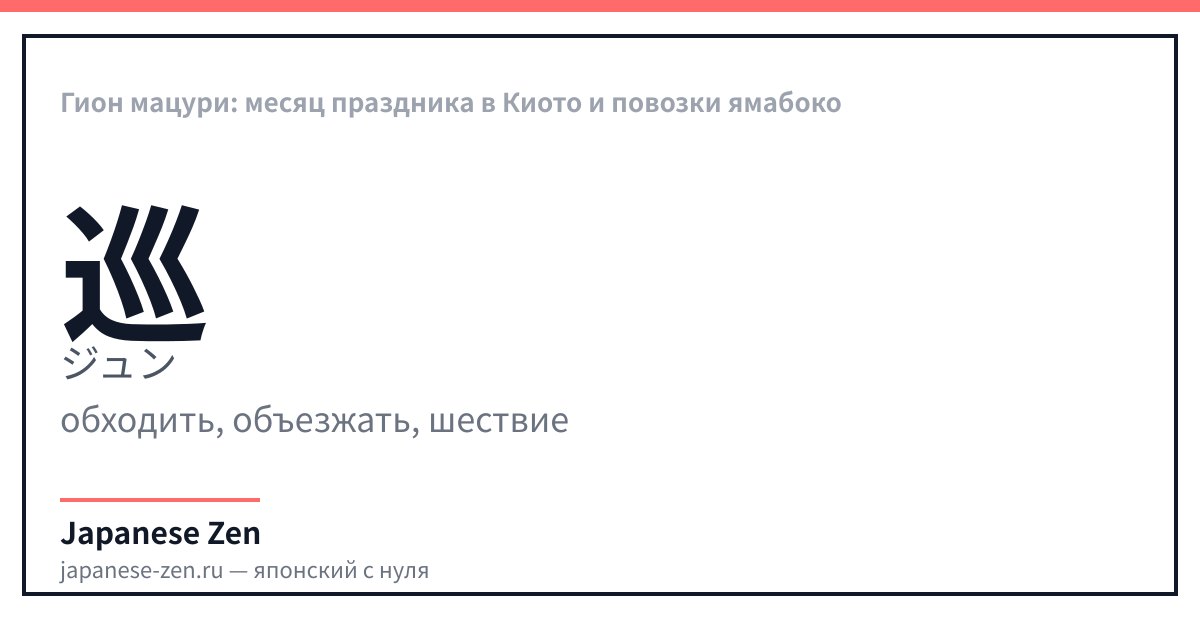
巡 — значение: to go around, to tour, procession — онъёми: ジュン — кунъёми: めぐ.る、めぐ.り — 6 штрих(ов). 巡 means "to go around, to tour" — as in 山鉾巡行, the procession of floats through the city: 巡行 literally means "circular movement."
Jun and Meguru: Two Readings of One Character
巡 is read jun in compounds like 巡行 (junkō), "procession, tour," and meguru as a standalone verb meaning "to go around, to circle, to wander." The Gion district, where Yasaka Shrine stands, was named after the Buddhist monastery Jetavana in India, and 祭, "festival," is the same character as in words like 祭壇, "altar."
| Japanese | Reading | Translation |
|---|---|---|
| 山鉾巡行 | yamaboko junkō · yamaboko junkō | Procession of yamaboko floats |
| 祇園祭 | gion matsuri · gion matsuri | Gion Matsuri |
| 宵山 | yoiyama · yoiyama | Evening on the eve of the procession |
| 山鉾 | yamaboko · yamaboko | Yama and hoko floats together |
| 八坂神社 | yasaka jinja · yasaka jinja | Yasaka Shrine |
Write 巡 along the guides — the character for "procession," which goes around the block during yamaboko junkō.
FAQ
- What is Gion Matsuri and when is it held?
- It is a summer festival at Yasaka Shrine in Kyoto, stretching across all of July rather than a single day. Its climax is two processions of wooden yamaboko floats, on July 17 and 24, with yoiyama evenings on the eve of each. It is one of Japan's most famous summer festivals.
- What is yamaboko and how does yama differ from hoko?
- Yamaboko is the collective name for the ornate wooden floats of the festival. Yama are smaller and lighter, carried or led on poles at shoulder height. Hoko can be taller than a house, stand on large wooden wheels, and move when teams of townspeople pull them with ropes.
- Where did Gion Matsuri come from and what does 869 have to do with it?
- In 869, amid epidemics and natural disasters, a goryōe was held in Kyoto — a ritual to pacify angry spirits: 66 halberds were erected, one for each province of the country, and portable shrines were sent out with prayers to stop the plague. This ritual is considered the origin of the festival, although it became regular only around 970.
- What part of Gion Matsuri is on the UNESCO list?
- Not the festival as a whole, but the float procession ritual, Yamaboko Gyōji. In 2009 it was inscribed as a separate entry. In 2016 the entry was merged with rituals from other regions into a collective nomination about yama, hoko, and yatai float processions; it now includes 37 such festivals.
- How is "Gion Matsuri" written in Japanese?
- 祇園祭, in kana ぎおんまつり. 祇園 is the name of the Kyoto district around Yasaka Shrine, going back to the Buddhist monastery Jetavana in India, and 祭 means "festival." Before Meiji, the festival was called differently — Gion Goryōe, with an explicit reference to the ritual of pacifying spirits.
Sources
Updated: 2026-09-15