Karoshi — Death from Overwork: What the Word Means and How Japan Fights It
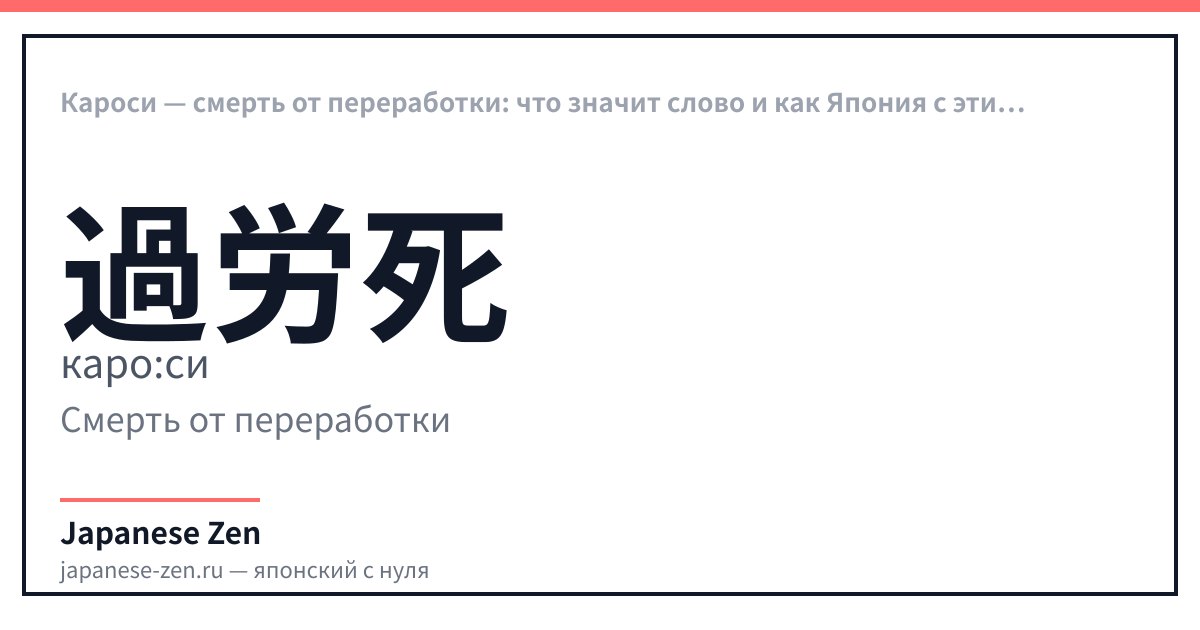
Karoshi (過労死) is death from overwork: a stroke, heart attack, or suicide caused by chronic work-related strain. The word became a medical term in the early 1980s, and since 2014 Japan has had a dedicated law on karoshi prevention. The "karoshi line" is overtime of 80 hours a month on average over 2–6 months, after which the government recognizes the illness as work-related.
Karoshi is not the story of one person but a line in government statistics: the term has a legal definition, an hourly threshold, and an annual report from the Ministry of Labor with numbers. Let's break down the literal meaning of the word, the character 労, and where official data on deaths from overwork diverge from the estimates of human rights advocates.
Karoshi as a Medical and Legal Term
過労死 literally means "death from excessive labor": 過 "excessive" plus 労 "labor" plus 死 "death." The term refers to death from a stroke, heart attack, or other cardiovascular event caused by chronic overwork, as well as suicide due to depression from exhaustion — for which there is a separate word, 過労自殺 (karō jisatsu). Both cases are legally combined under the concept of "karoshi and related conditions" (過労死等).
Karoshi Is Not the Same as "Overwork"
The English word "overwork" describes hours beyond the norm, while karoshi is a specific medical and legal consequence: a recognized cause of death or disability. The word has no direct English equivalent — "dying on the job" sounds closer to an accident, whereas karoshi always refers to accumulated months of strain, not a single hard day.
| Japanese | Reading | Translation |
|---|---|---|
| 過労死 | karōshi · karōshi | Death from overwork |
| 過労 | karō · karō | Exhaustion, excessive labor |
| 過労自殺 | karō jisatsu · karō jisatsu | Suicide due to overwork |
| 過労死ライン | karōshi rain · karōshi rain | "Karoshi line" — the hourly threshold for recognizing an illness |
| 働き方改革 | hatarakikata kaikaku · hatarakikata kaikaku | "Work style" reform — the law limiting overtime |
The Character 労: Labor and Fatigue in One Kanji
労 — значение: labor, work, exhaustion, to toil, to strive — онъёми: ロウ — кунъёми: ろう.する、いたわ.る、いた.ずき、ねぎら、つか.れる、ねぎら.う — 7 штрих(ов). 労 is the core of the word 過労死: "labor" and "fatigue from labor." It also appears in 労働 (rōdō) "labor, work" and 苦労 (kurō) "hardships, troubles."
Roof, Fire, and Strength: What the Character Is Made Of
The old form of the character is 勞: two fires on top, a cover below them, and 力 "strength" at the bottom. Dictionaries interpret this as "to toil with one's last strength, as if by torchlight, without rest." This is an explanation, not a proven history of the character, but it is easy to remember: in the simplified 労 the fires are reduced to three short strokes, while 力 remains in place.
Trace 労 along the guides — the character for "labor" that gave karoshi its name.
How Japan Counts and Prevents Karoshi
It took 36 years from the first scientific article on karoshi to a dedicated law.
- 1982 — doctors Uehata Tetsunojō, Tajiri Shun'ichirō, and Hosokawa Migiwa published the book "Karoshi: Recognition and Prevention of Occupational Brain and Heart Diseases." After it, the word became a medical term, though Uehata himself first used it in a 1978 study.
- 1988 — lawyers opened a free hotline, "Karoshi 110," for relatives of those killed or harmed by overwork.
- 2014 — the Act on Promotion of Measures against Karoshi (過労死等防止対策推進法) came into force: it obligated the state to collect statistics annually and prepare a prevention plan, but did not introduce direct sanctions for employers.
- 2015–2016 — the suicide of a young employee at the advertising agency Dentsu in December 2015 after overwork received nationwide attention. The company completely removed the "Ten Devil's Rules" (鬼十則) from its employee handbooks: its fifth rule — "once you take it on, don't let go, even if it kills you" — was considered the root of the overwork culture.
- 2018–2019 — the "work style" reform for the first time capped overtime by law with penalties for violation: as a rule, no more than 45 hours a month and 360 a year. In exceptional cases, up to 720 hours a year and less than 100 hours a month including work on days off.
How Many Karoshi Cases Are Officially Recognized
According to Japan's Ministry of Labor, in fiscal year 2025 the ministry received 6,212 claims for brain and heart diseases and mental disorders from overwork. Work-related causation was recognized in about 1,300 cases, of which around 140 involved deaths and suicides, including attempts. The threshold after which overwork is officially recognized as the cause of illness is the "karoshi line": at least 80 hours of overtime a month on average over 2–6 months, or 100 hours in the last month before the attack. In 2021 the criteria were refined: work-related causation can be recognized even with fewer hours if there is additional strain — night shifts, short rest between shifts, psychological pressure.
Myths about Karoshi: Numbers, the OECD, and "a Purely Japanese Problem"
- "Karoshi is only suicides." No: most recognized cases are strokes and heart attacks from chronic overwork, while suicide from exhaustion (過労自殺) is a separate, though related, category.
- "Thousands of people die from overwork in Japan every year." Official Ministry of Labor statistics for fiscal year 2025 cite about 140 recognized deaths and suicides, including attempts. Human rights advocates consider the figure understated: fewer than half of the claims filed are approved, and unpaid overtime rarely makes it into the documents on which decisions are based.
- "The Japanese work more than anyone in the world." According to OECD data, the average number of working hours in Japan in recent years is below the organization's average. But that figure includes part-time workers, and unpaid overtime (サービス残業) is not included. Among those working 40 hours a week or more, 8% worked 60 hours or more in 2024 — the government has set a goal to reduce that share to 5%.
- "Karoshi is a purely Japanese problem." The word entered the Oxford English Dictionary in January 2002. And the WHO and ILO estimated in 2021 that long working days caused about 745,000 deaths from stroke and ischemic heart disease worldwide in 2016. Similar cases were reported in France too — a wave of suicides among France Télécom employees in 2008–2009.
FAQ
- What does the word "karoshi" mean?
- Karoshi (過労死) is a recognized cause of death from chronic overwork: a stroke, heart attack, or other cardiovascular event, and in a broader sense, suicide due to depression from exhaustion. It is not a colloquial word but an official term in Japanese labor statistics and medicine.
- How is "karoshi" written in kanji?
- 過労死, read かろうし — "karōshi" with a long "o" in the second syllable. 過 means "excessive," 労 means "labor," and 死 means "death." The first two characters on their own are already the word 過労 "exhaustion": "death" is simply added to it.
- How many hours of overtime count as the "karoshi line"?
- At least 80 hours of overtime a month on average over 2–6 months before the onset of illness, or 100 hours in the last month. Since 2021 the criteria have been refined: work-related causation can be recognized even with fewer hours if there are night shifts, short rest between shifts, or strong psychological pressure.
- How many karoshi cases does Japan's Ministry of Labor officially recognize?
- In fiscal year 2025 the ministry received 6,212 claims for brain and heart diseases and mental disorders due to overwork. About 1,300 were recognized, of which around 140 involved death or suicide, including attempts. Human rights advocates believe the real number is higher: some unpaid overtime does not make it into the documents.
- What did the 2014 karoshi prevention law change?
- The law obligated the state to collect karoshi statistics annually, prepare a prevention plan, and educate the public, but it did not introduce fines for employers directly. A real cap on overtime with penalties for violation appeared later, in the 2018–2019 "work style" reform.
- How do you say "overtime work" and "exhaustion" in Japanese?
- Overtime work is 残業 (zangyō), literally "remaining work." Unpaid overtime is called サービス残業 (sābisu zangyō), "overtime as a gift" to the company. Exhaustion is 過労 (karō), the first two characters of the word 過労死. All three words appear in Japanese news about karoshi.
Sources
Updated: 2026-09-13