Salaryman — the Japanese office worker: where the word comes from and how he lives
Salaryman (サラリーマン) is not a borrowing but a Japanese word assembled from the English "salary" and "man": it refers to a salaried employee, usually an office clerk in a suit. The word came into use around 1920, in the Taisho era, and has since been firmly associated with rush-hour commuter trains and life between home and office.
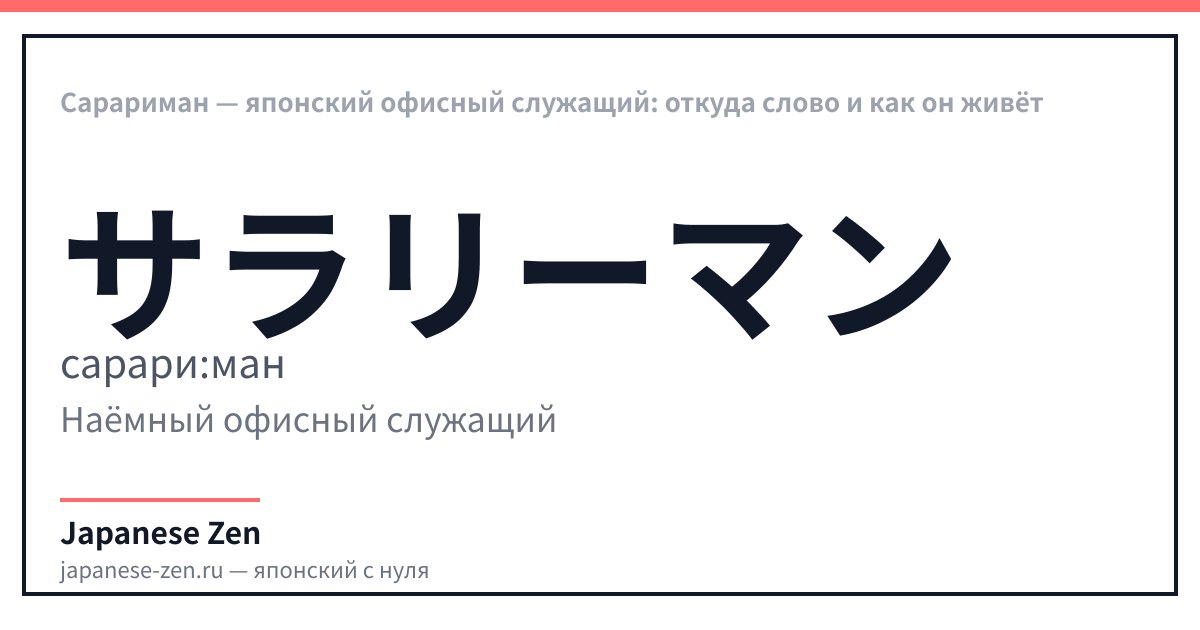
The word is familiar even to those who don't study Japanese, but its meaning is narrower than it seems: it's not "any working person" but a salaried employee with a recognizable way of life. Let's look at where "salaryman" came from, why forms use 会社員 instead, and what this life looks like in practice — without the clichés of office comedies.
What "salaryman" means
サラリーマン is a Japanese word from the English "salary" and "man": it refers to a hired worker on a fixed salary, most often an office clerk rather than a doctor, lawyer, or business owner. Japan's official occupation classifier has no such category — it's not a job title but a way of life: a suit, the commuter train, job transfers without family. Women are traditionally called something else — "office lady" (OL) or "career woman."
Why "sararīman," not "salaryman"
Japanese has no separate "l" sound: the same syllable in the ら row represents both "ra" and "la." That's why English "salary" became サラリー — and it can be transliterated back in two ways. "Sararīman" is closer to the Japanese pronunciation, "salaryman" to the original English word; both spellings appear in English texts.
| Japanese | Reading | Translation |
|---|---|---|
| サラリーマン | sararīman · sararīman | Salaried office worker |
| 会社員 | kaishain · kaishain | Company employee — the neutral word on forms |
| 正社員 | seishain · seishain | Regular full-time employee |
| 社畜 | shachiku · shachiku | "Corporate livestock" — a self-mocking name for a salaryman |
| OL | ōeru · ōeru | Office lady — a term for female employees |
社 in the word 会社員: what salarymen are called on forms
社 — значение: company, society, shrine, employee (in compound words) — онъёми: シャ — кунъёми: やしろ — 7 штрих(ов). サラリーマン is written in katakana, without a single kanji, but on forms and documents the same thing is called 会社員 — "company employee," and the main character in it is 社. 社 — "company, society; shrine" — appears in 会社 "company," 社員 "employee," and the ironic 社畜 "corporate livestock."
From the shrine of the earth spirit to the word "company"
The character 社 is analyzed as 示 "altar" and 土 "earth": its original meaning is a shrine of the earth spirit, as in 神社 (jinja) "Shinto shrine." Later the character came to mean both a community of people and an association around a common cause — hence 会社 "company." And 社畜 is a combination of 会社 "company" and 家畜 "domestic livestock." The word was coined by the writer Azuchi Satoshi, and in 1990 it made the list of buzzwords of the year.
Write 社 along the guides — the character for "company," which a salaryman calls his place of work even if the word itself is written in katakana.
A salaryman's daily life: from business cards to transfers without family
Behind the word is not a joke but a set of enduring practices — some are weakening, others have held for decades.
- Lifetime employment (終身雇用) and seniority-based promotion (年功序列) were the norm at large companies from the postwar decades until the 1990s. Today both practices are weakening — companies more often hire on contract and pay for results, not just seniority.
- Exchanging business cards (名刺交換) at the start of a business meeting is part of the hierarchy, not a formality: the card is offered and received with both hands and read carefully, not pocketed immediately.
- Rush-hour crowding on commuter trains is a familiar part of the route for millions of salarymen in big cities: at major stations there are even workers who help close the doors of packed cars neatly.
- Corporate after-work gatherings (飲み会) with the boss and colleagues are an informal part of a career: there you can say what you wouldn't say in the office, and refusing to join them doesn't always go unquestioned.
- A job transfer to another city without family (単身赴任) is a common practice with promotion: the husband lives separately while the wife and children stay behind for school and her own work.
Salarymen in manga: from section chief to Kintaro
"Section Chief Shima Kosaku" (課長島耕作, Hirokane Kenshi, in Morning since 1983) shows the career of a clerk who eventually rises to top management. "Salaryman Kintaro" (サラリーマン金太郎, Motomiya Hiroshi, in Weekly Young Jump since 1994) is about a former biker who became an employee and stayed himself. "Fishing Fool Diary" (釣りバカ日誌, script by Yamasaki Juzo, art by Kitami Kenichi, in Big Comic Original since 1979) is about a salaryman for whom fishing matters more than his career.
Three myths about the word "salaryman"
- "Salaryman is a borrowed English word." No: it's a Japanese word assembled from English parts (和製英語). Before that, the same employee was called in Japanese — 勤め人 "employee" or 月給取り "monthly wage earner."
- "Salaryman is any working Japanese person." No: doctors, lawyers and other specialists, company executives, farmers, shopkeepers and the self-employed are usually not called this. Even among hired workers, regular clerks are only part: alongside them are part-timers, contract workers and agency workers (パート, 契約社員, 派遣).
- "Salaryman is always a man." Dictionaries differ here: some define the word as "a man working at a company," while Daijisen and Daijirin define it as anyone who lives on a salary. The masculine connotation is still strong. On television, to avoid excluding women, people more often say 会社員. And the comic-verse contest "Salaryman Senryu," held since 1985, was renamed in 2023 — because of the diversity of work styles.
FAQ
- What does the word "salaryman" mean?
- A salaryman is a hired employee on a fixed salary, usually an office clerk. The word is assembled from the English "salary" and "man" within Japanese itself and describes not a job title but a way of life: a suit, the commuter train, working at one company for years.
- How should it be written — "sararīman" or "salaryman"?
- Closer to the Japanese sound is "sararīman": that's how Japanese people pronounce the word, with a long "i" in the middle. "Salaryman" comes from the English word and also appears in English texts. Neither spelling is considered wrong, but in a Japanese lesson they will say "sararīman."
- When did the word "salaryman" appear?
- The word came into use around 1920, in the Taisho era: it referred to university graduates who worked at private companies in a jacket and tie. It was widely popularized by the book "Sarariman Monogatari" (サラリマン物語, 1928), written by Maeda Hajime, an employee of a coal company in Hokkaido.
- Is it true that the word "salaryman" sounds insulting?
- In some contexts, yes: it has a slightly derogatory shade of an impersonal cog in the system, so sometimes people say "businessman" instead. In everyday speech, however, the word is neutral and simply names an office employee.
- What is the word 社畜, which salarymen call themselves?
- 社畜 (shachiku) literally means "the company's livestock" — an ironic self-designation of an employee whose life depends entirely on the employer: overtime, transfers and vacations according to the boss's schedule, not one's own choice.
- Is the word "salaryman" used in English?
- Yes, it has established itself as a borrowing from Japanese. Unlike the original Japanese word, in English texts "salaryman" refers not to any hired worker but specifically to a Japanese office employee in a suit — with the whole set of habits, from business cards to overwork.
Sources
Updated: 2026-09-13