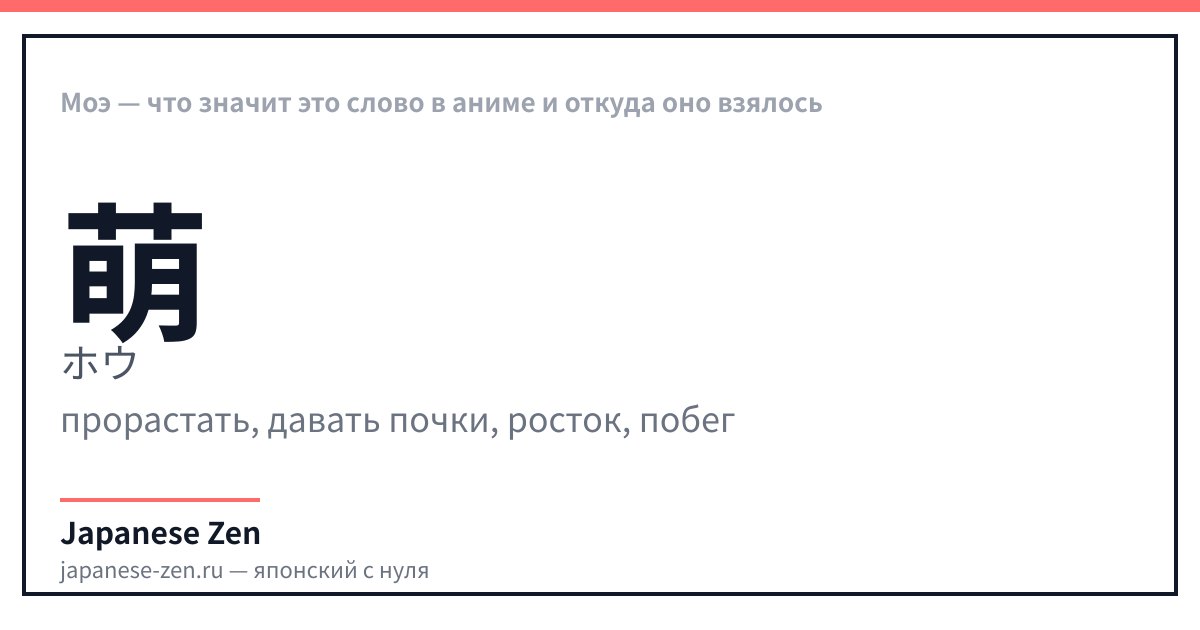
Moe — what this word means in anime and where it came from
Moe (萌え) is a tender, almost affectionate fondness for a character, usually fictional: an anime heroine, a mascot, even a robot. The word grew out of the verb 萌える, "to sprout," and has lived in otaku fan slang since the late 1980s. In 2005, "moe" made the top 10 of the Word of the Year award — a sign that the jargon had become mainstream.
The word is short, but there's plenty of debate around it: some consider moe a genre, others just a viewer's reaction, and people used to be embarrassed to use it in front of others. Let's look at where moe came from, what origin theories circulate among fans, what its kanji is made of, and why it's not the same as kawaii.
What "moe" means and where the word came from
萌え is read もえ, moe: it's a form of the verb 萌える, "to sprout, to bud" — said of a bud that's about to open. In otaku slang, the word denotes not romantic love but a warm, almost puppyish fondness for a character — fictional far more often than a real person.
Dictionaries call the exact origin unclear: the term took hold among manga and anime fans around the turn of the 1980s–1990s. Among the theories is a typo for the homophone 燃える, "to burn." Anime heroines are also cited: Moe, the heroine of the series Dinosaur Planet (恐竜惑星, 1993, Junio studio), and Tomoe Hotaru from the third season of Sailor Moon (美少女戦士セーラームーンS, 1994) — her surname contains the same root. No single version is recognized as the only correct one.
From the same root come 萌えキャラ (moe kyara, "moe character"), 萌え絵 (moe-e, art in that style), and 萌え袖 (moe-sode) — long sleeves that cover the palms: a clothing detail fans find especially endearing.
Moe and kawaii are not the same thing
可愛い (kawaii) is an ordinary adjective meaning "cute," which works for anything: a kitten, a gift, a child. 萌え is specifically a fan's reaction to a character, colored by affection and involvement in their story, not just an assessment of appearance.
萌 — the sign of a sprout that gave the word its name
萌 — значение: to sprout, to bud, sprout, shoot — онъёми: ホウ — кунъёми: も.える、きざ.す、めばえ、きざ.し — 11 штрих(ов). 萌 — the same character as in the word moe: "to sprout, to bud," as a spring bud does.
| Japanese | Reading | Translation |
|---|---|---|
| 萌え | moe · moe | Fondness, warm affection for a character |
| 萌える | moeru · moeru | To sprout; in slang — to feel fondness |
| 萌えキャラ | moe kyara · moe kyara | Moe character |
| 萌え袖 | moesode · moesode | Sleeves that cover the palms |
| 燃える | moeru · moeru | To burn (homophone candidate in theories of moe's origin) |
| 萌芽 | hōga · hōga | Sprout, germ of something |
Write 萌 along the guides — the "sprout" character that makes moe mean fondness specifically, and not something else.
What the character 萌 is made of
On top is 艹, a shortened form of the "grass" radical (艸): almost all kanji related to plants begin with it. Below is 明, "bright, clear" (itself made of 日 "sun" and 月 "moon"). Together they create the image of a sprout reaching toward the light — hence the literal meaning "to sprout."
Moe is not lewdness, not a genre, and not kawaii
- "Moe is about lewdness." No: the word describes fondness and warm attachment, not something explicit. Confusing it with erotic content is a mistake that annoys even those who don't care for moe at all.
- "Moe is a genre." It's more an aesthetic and a viewer's reaction: moe elements appear in all sorts of genres, from comedy to sports, and don't form a separate shelf in the catalog.
- "Moe and kawaii are the same thing." Kawaii is an assessment of appearance, applicable to anything. Moe is a more personal, fan's reaction specifically to a character and their story.
FAQ
- What does "moe" mean in anime?
- A tender, warm affection for a character — usually fictional, not a real person. The word 萌え comes from the verb 萌える, "to sprout," and has lived in manga and anime fan slang since the late 1980s, denoting fondness rather than romantic love.
- What is the moe style?
- Not a genre, but a loose name for art and characters designed to evoke fondness in the viewer: big eyes, soft features, endearing details like long 萌え袖 sleeves. There is no separate "moe" genre in anime catalogs.
- How does moe differ from kawaii?
- Kawaii (可愛い) is an ordinary adjective meaning "cute," suitable for anything. Moe is a fan's reaction specifically to a character, colored by affection and involvement in their story, not just an assessment of appearance.
- How is "moe" written in kanji?
- 萌え, the first character is 萌, "to sprout, to bud": on top the "grass" radical 艹, below the character 明, "bright." The second symbol え is an ending left over from the verb 萌える in its slang, "fondness" form, not a separate kanji.
- Where did the word "moe" come from?
- Dictionaries call the exact origin unclear: the term took hold among manga and anime fans around the turn of the 1980s–1990s. Among the theories are a typo for the homophone 燃える, "to burn," and the names of anime heroines with the same root in their name.
Sources
Updated: 2026-09-14