Shōjo — what the word means and when it's used
Shōjo (少女) means 'girl, young woman': in everyday use it refers not to a genre but to the age demographic of manga and anime, 12–18 years old, and everything made for it—from school romance to magical girls. The word is written with two characters, 少 'young' and 女 'woman', and it predates any magazine: you can call your neighbor a girl, but only a character in a story for her can be a shōjo heroine.
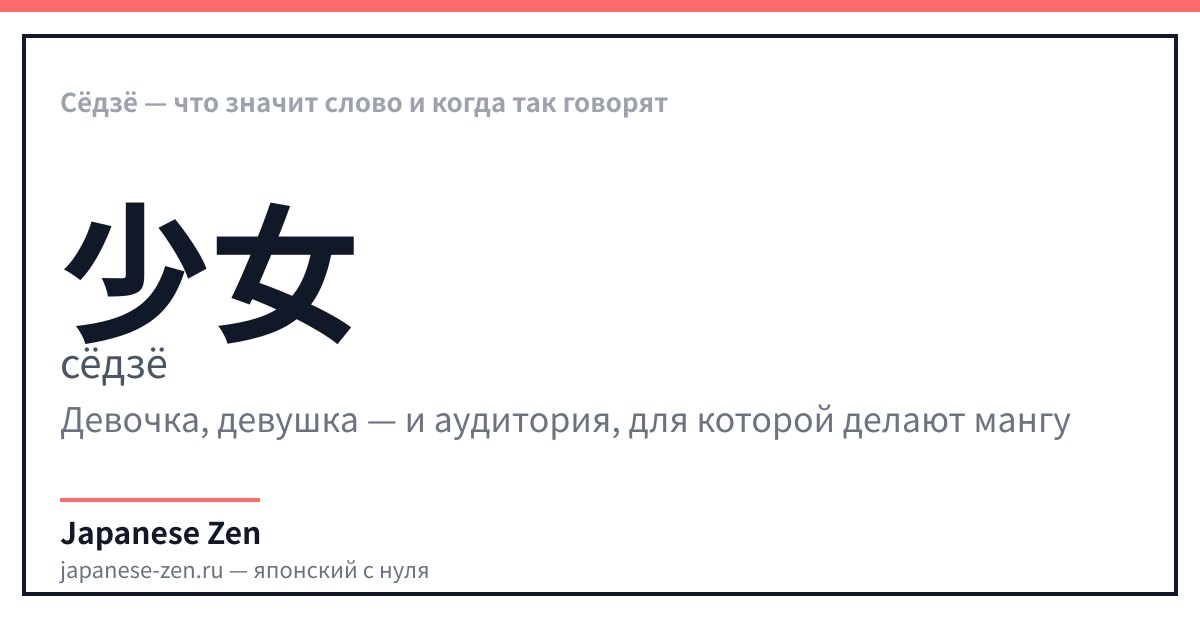
Shōjo is confused with a genre as often as age is confused with character: in fact, it's a 'for whom' category, not a 'what about' one—inside it coexist tearful romance and a thriller about a killer with a scythe.
What does 'shōjo' mean
| Japanese | Reading | Translation |
|---|---|---|
| 少女 | shōjo · shōjo | Girl, young woman—and the audience for which manga is made |
| 少女漫画 | shōjo manga · shōjo manga | Manga for girls |
| 乙女 | otome · otome | Maiden—a more poetic synonym for 'shōjo' (more often in titles than in conversation) |
| 魔法少女 | mahō shōjo · mahō shōjo | Magical girl—a popular subgenre of shōjo |
| 少年 | shōnen · shōnen | Boy—the mirror term for the male audience (same character 少 'young') |
How to pronounce 少女
少女 is read しょうじょ, shōjo—the two syllables merge into one elongated sound, so in Russian spelling 'сёдзё' has become standard, though strictly according to Polivanov 'сёдзе' is closer. In everyday Japanese speech, the word is used without any manga context: simply 'girl' in news, announcements, or talk about someone else's child.
When the word is appropriate and when it's not
- Appropriate: when discussing manga or anime by demographic—'this is shōjo, meaning the audience is older than Naruto's, not by age but by story focus.'
- Appropriate: as a self-description of a fan of the genre—'I grew up on shōjo' sounds fine both in Russian and in correspondence with Japanese people.
- Inappropriate: as a characteristic of a real adult—shōjo is not about behavior but about the target audience of a publication.
- Inappropriate: as a synonym for 'cute girl'—outside a conversation about manga, the word will just sound strange.
| Word | Meaning | Target audience |
|---|---|---|
| 少女 shōjo | girl, young woman | manga and anime, 12–18 years old |
| 少年 shōnen | boy, young man | manga and anime, 12–18 years old |
| 乙女 otome | maiden | poetic synonym, more often in game genre titles |
Why it's not a genre
Within shōjo, romance, comedy, fantasy, and even dark thrillers coexist—what they have in common is not a plot device but the editorial department that publishes them. Formally, belonging to shōjo is determined by the original magazine, not by content: the same vampire story can be published in both shōjo and seinen editions, just with a different emphasis in presentation.
少女 — 'young woman'
女 — значение: woman, female — онъёми: ジョ、ニョ、ニョウ — кунъёми: おんな、め — 3 штрих(ов). 女 — 'woman': the second character of the word 少女. The first, 少 'little, young', is not yet marked with a separate card in the stroke order database.
Listen to the word shōjo and related terms—the app will evaluate your pronunciation.
How the word is known in Russia
- Sailor Moon taught Russian-speaking viewers of the nineties the formula 'an ordinary schoolgirl suddenly saves the world'—with it began the fashion for shōjo as a phenomenon, not just a genre shelf.
- Fruits Basket and Cherry Waltz entered fan colloquial speech as exemplary 'tearjerker' shōjo stories.
- Assassination Classroom and Fullmetal Alchemist remind us that 'for girls' does not mean 'without drama and action': they are formally considered shōjo, though they feel tougher than the stereotype.
FAQ
- What does 'shōjo' mean?
- Literally 'girl, young woman'—少女. In the context of manga and anime, it refers not to a genre but to an age demographic: stories for girls and young women aged 12–18, regardless of their plot.
- How is 'shōjo' written in Japanese?
- 少女, read しょうじょ. The first character 少 means 'little, young', the second 女 means 'woman'; together—'young woman, girl'.
- When is it used?
- When discussing the demographic of manga or anime, not the plot: shōjo is a 'for whom' category, not a genre label. It is usually not said about a real person.
- How is shōjo different from hikikomori?
- These are terms from different fields: shōjo describes the target audience of manga, hikikomori describes people in voluntary social isolation. They have nothing in common except that both words came into Russian from Japanese through anime.
- Is it polite?
- The word is neutral, but only applicable to the topic of manga and anime: calling a specific person that is neither an insult nor a compliment, but simply an incorrect use of the term out of context.
Sources
Updated: 2026-08-29