Kamikaze — what the word means and who they are
Kamikaze (神風) — 'divine wind': first the word referred to the typhoons of 1274 and 1281 that twice destroyed the Mongol fleet off the coast of Japan, and from autumn 1944 — to Japanese pilots who directed explosive-laden planes into enemy ships. In Russian slang, it is used for a person who acts without regard for consequences.
The word lived two different lives before becoming an international label for recklessness: for the first six and a half centuries it meant gratitude to the gods for the weather.
What the word 'kamikaze' means
The word has three successive meanings. The first and oldest is a typhoon that destroyed the enemy fleet and saved the country without the army's involvement. The second, most famous one — Japanese pilots of the final months of World War II who directed planes loaded with explosives straight into enemy ships: they were officially called tokkōtai, 'special attack units', while the word kamikaze remained more of a popular nickname. The third meaning is later and colloquial: a 'kamikaze person' is someone who takes risks without regard for their own safety, from a reckless driver to a gambler going all-in.
- 神風 — 'divine wind': the literal meaning from which all others grew.
- 特別攻撃隊 (tokubetsu kōgekitai) — the official name of the special attack flying units of 1944–1945.
- kamikaze as an adjective — in colloquial speech describes a risky, self-destructive style of action regardless of war.
- historical kamikaze typhoon — two instances, 1274 and 1281, long before the military meaning of the word appeared.
How the word entered other languages
The word entered international usage through Allied war correspondents, who already in 1944–1945 wrote about the new type of attacks and used the Japanese word as is, without translation. After the war it became established in English and then in Russian precisely in a figurative sense — as a designation for any suicidally risky act, not just the military episode of the mid-20th century.
神風 — 'divine wind'
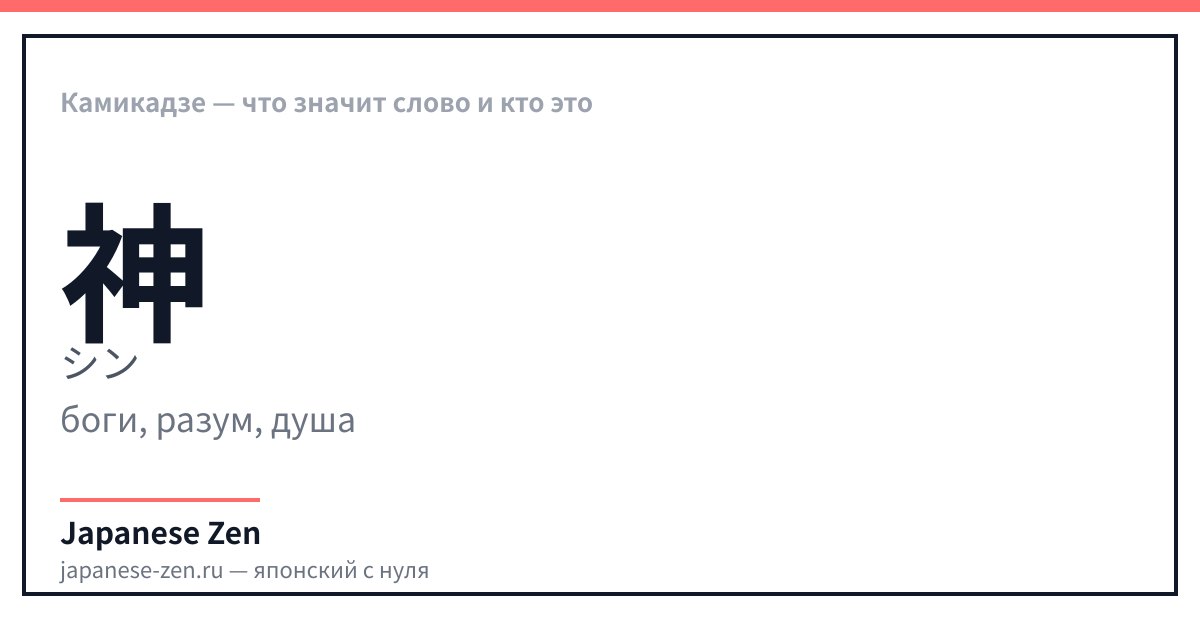
神 — значение: gods, mind, soul — онъёми: シン、ジン — кунъёми: かみ、かん-、こう- — 9 штрих(ов). 神 — 'god, spirit': the first character of the word 神風. The second, 風 'wind', is not yet marked with a separate card in the stroke order database.
| Japanese | Reading | Translation |
|---|---|---|
| 神風 | kamikaze · kamikaze | Divine wind — typhoon, later suicide pilots |
| 特別攻撃隊 | tokubetsu kōgeki tai · tokubetsu kogeki tai | Special attack units — official military name |
| 特攻 | tokkō · tokko: | Special attack — abbreviated form of the term (used in historical texts more often than 'kamikaze') |
| 神 | kami · kami | God, spirit (first character of the word) |
| 風 | kaze · kaze | Wind (second character of the word) |
Kamikaze or shinpū: two readings of one word
神風 is read in two ways, and the difference is not accidental. In everyday usage and in films, the kun reading かみかぜ, kamikaze, became established — it was also historically applied to the typhoons of the 13th century. In 1944, the navy chose the more bookish on reading しんぷう, shinpū, for its own units: the formal name sounded 神風特別攻撃隊, shinpū tokubetsu kōgekitai. The press and the pilots themselves in conversation more often used the familiar 'kamikaze' — and that is how it spread around the world.
Listen to the word kamikaze and related terms — the app will evaluate your pronunciation.
Origin: the typhoon of 1274
The word was born six hundred and sixty years before World War II. Khan Kublai twice attempted to land troops in Japan: in 1274, a Mongol-Korean fleet of up to thirty-seven thousand men, in 1281 — already two fleets, Mongol, Korean and Chinese, totaling about one hundred thousand. Both times, off the coast of Kyushu, a typhoon caught the fleet and destroyed most of the ships before the landing was completed. Contemporaries considered this divine intervention and called the wind divine — 神風.
- 1274: first invasion, fleet of 23–37 thousand men, storm at Hakata.
- 1281: second invasion, about 100 thousand men, two fleets almost completely destroyed by storm.
- After 1281, no major attempts at sea invasion of Japan were made until the 20th century.
- The word 'kamikaze' itself during this period meant only a weather phenomenon, without military connotations.
How the word gained new meaning in 1944
The military meaning appeared in autumn 1944: after the losses of the Japanese fleet in the Battle of Leyte Gulf, Vice Admiral Takijirō Ōnishi proposed forming flying units that would attack ships by ramming. Initially recruitment was voluntary, closer to the end of the war — already virtually forced, instructions recommended taking eighteen-to-twenty-five-year-olds without serious flight experience. According to the data of the Tokyo Kannon temple, where the names of the dead are inscribed, the count is 4,615 people, about two-thirds from naval aviation and a third from army aviation. The practice ceased with Japan's surrender in August 1945.
Kamikaze in anime and in Russian slang
There are few direct film adaptations about kamikaze pilots in anime: the topic is too heavy for an entertainment format. However, the word has firmly established itself outside the historical context — both in war films, games, and in everyday speech of fans.
- 'Space Battleship Yamato' is built around the real battleship 'Yamato': in 1945 it was sent on a final voyage with no chance of return — historians classify this operation in the same class of special attacks as air sorties.
- In strategy games and fighting games, a move where a character sacrifices themselves for damage to the enemy is called a 'kamikaze attack' by commentators and players — regardless of the game's setting.
- In sports and esports broadcasts, 'playing kamikaze' means taking a risky trade without a backup plan.
What is simplified in films and games
Mass culture usually reduces the pilots' motivation to blind fanaticism. Surviving letters and diaries show a more varied picture: alongside sincere patriotism there are fear, resignation to fate, and direct pressure from command, and some pilots doubted or openly resisted the order. Wartime propaganda presented it as universal readiness — and it is precisely this simplified image that has moved into films and games.
FAQ
- What does the word 'kamikaze' mean?
- Literally 'divine wind', 神風. First it referred to the saving typhoons of 1274 and 1281, from 1944 — to Japanese pilots who attacked ships by ramming, and today in colloquial speech — to anyone who takes risks without regard for consequences.
- Where did the word 'kamikaze' come from?
- From the typhoons that twice destroyed the Mongol fleet of Khan Kublai off the coast of Japan — in 1274 and 1281. Contemporaries considered the storm divine intervention and called it 神風, 'divine wind'.
- Who were the kamikaze in World War II?
- Japanese pilots who, from autumn 1944, directed planes loaded with explosives into enemy ships. Officially the units were called tokkōtai, 'special attacks'; 'kamikaze' is a later popular and journalistic nickname.
- How is 'kamikaze' written in Japanese?
- 神風, read かみかぜ (kamikaze). The navy used the bookish reading shinpū for its own formal unit name: 神風特別攻撃隊.
- Was kamikaze a profession?
- No, there was no permanent class: the special attack flying units were formed in October 1944 and disbanded with the surrender in August 1945. Less than a year of history, not a stable occupation.
- Why does 'kamikaze' mean 'reckless person' in Russian?
- The meaning expanded after the war: journalists and translators transferred the word to any act without regard for one's own safety. Thus 'kamikaze' became a common noun far beyond military history.
Sources
Updated: 2026-08-29