Kosupure — what does the word mean and when is it used
Kosupure means dressing up in a costume of a character from anime, manga, game, or film and recreating their look down to the hairstyle and gestures. The word comes from the Japanese コスプレ, kosupure — a contraction of the English costume play. The term was coined by journalist Nobuyuki Takahashi in the early 1980s after a trip to the American Comic-Con, and it became established in Japan in the nineties.
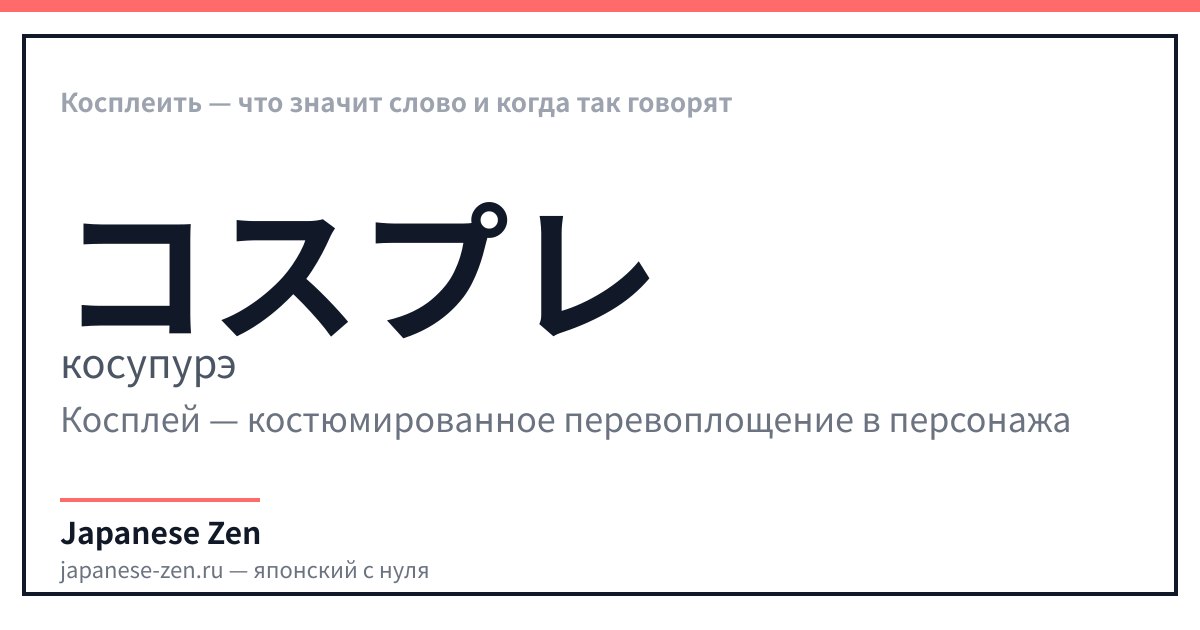
The word looks purely English, but it originates from Tokyo: the Japanese took two English words, shortened them in their own way — and returned a ready-made term to the world.
What does “kosupure” mean
| Japanese | Reading | Translation |
|---|---|---|
| コスプレ | kosupure · kosupure | Cosplay — costumed transformation into a character |
| コスプレイヤー | kosupureiyā · kosupureiyaa | Cosplayer — someone who does cosplay |
| 衣装 | ishō · ishoo | Costume, outfit (what is sewn or bought for cosplay) |
| 変身 | henshin · henshin | Transformation, metamorphosis (the very feeling that people cosplay for) |
| 同人誌即売会 | dōjinshi sokubaikai · doojinshi sokubaikai | Fan convention — where cosplay usually happens |
How コスプレ sounds in Japanese
コスプレ is read as kosupure and written in katakana — the alphabet for borrowed words, like almost all Japanese slang about anime and games. It is a contraction of costume play: 「コス」 from costume, 「プレ」 from play. The Russian verb “kosp Leit” is formed from the English form cosplay, not from the Japanese original.
When to use it and when not
- Appropriate: about dressing up as a specific character with recognizable details — “cosplay as Naruto,” “go to a convention to cosplay.”
- Appropriate: as a self-description of a hobby — “I’ve been cosplaying for three years” sounds normal in the Russian fandom too.
- Inappropriate: for any bright outfit without a character reference — an evening dress or a carnival animal costume is not cosplay.
- Inappropriate: as a mockery of costume quality — the community takes it badly, they value the effort and money put into the look.
| Situation | Is the word appropriate |
|---|---|
| Anime character costume at a convention | yes |
| Halloween costume without a specific character | no, it’s just a masquerade |
| Historical costume reconstruction | no, there’s a separate term for that |
Is it only about anime
No: people cosplay characters from games, comics, films, and even music videos — the common feature is not the source but the recognizability of the look. It’s just that historically the term and subculture grew out of anime conventions, so the connection to anime is still the first thing that comes to mind for most.
コスプレ — katakana and the character 服
服 — значение: clothing, to obey, to submit, to dismiss — онъёми: フク — 8 штрих(ов). 服 — “clothing”: the term コスプレ itself is written in katakana without kanji, but in words about costume and outfit, such as 衣服 (ifuku), this character appears.
Listen to the word kosupure and related terms — the app will evaluate your pronunciation.
How the word entered Russian
- The term was introduced by journalist Nobuyuki Takahashi in the early 1980s after a visit to the American Comic-Con — he described the costumed fans he saw with a new word upon returning to Tokyo.
- In the nineties, the phenomenon appeared on television and in magazines, and the word became firmly established in Japanese colloquial lexicon.
- Cosplay came to the Russian-speaking internet with the wave of anime conventions in the early 2000s and has remained part of the fandom’s festival culture ever since.
FAQ
- What does “kosp Leit” mean?
- Dressing up as a character from anime, manga, game, or film and recreating their look. The word comes from the Japanese コスプレ — a contraction of the English costume play.
- How do you write “kosp Leit” in Japanese?
- The term itself is written in katakana as コスプレ, kosupure. There is no separate verb calqued in the Russian manner in Japanese — only the borrowed noun and the derived verb コスプレする.
- When is it used?
- When talking about dressing up as a specific recognizable character with details of the look. An ordinary bright outfit without a character reference is not called cosplay.
- How is “kosp Leit” different from “shōjo”?
- These are terms from different areas: cosplay is about dressing up as a character, shōjo is about the target audience of manga. What they share is only their path into Russian through the anime fandom.
- Is it polite?
- The word is neutral and in the fandom is perceived as a normal name for a hobby, without a negative connotation. It is more disrespectful to criticize someone else’s costume than the fact of cosplaying itself.
- From which language did the word “cosplay” come?
- The word was coined in Japan in the early 1980s as a contraction of two English words, costume and play. Formally, it is a Japanese invention using English material, not a direct borrowing from English.
Sources
Updated: 2026-08-29