Suffix sama — what does the word mean and when is it used
The suffix sama (様) is the highest level of politeness among name suffixes: it is used for deities, important clients, letter recipients, and characters of high status. It is the written and ceremonial version of the colloquial san, and in everyday life it is almost never applied to ordinary people — but any address like “o-kyaku-sama,” esteemed guest, sounds emphatically ceremonial.
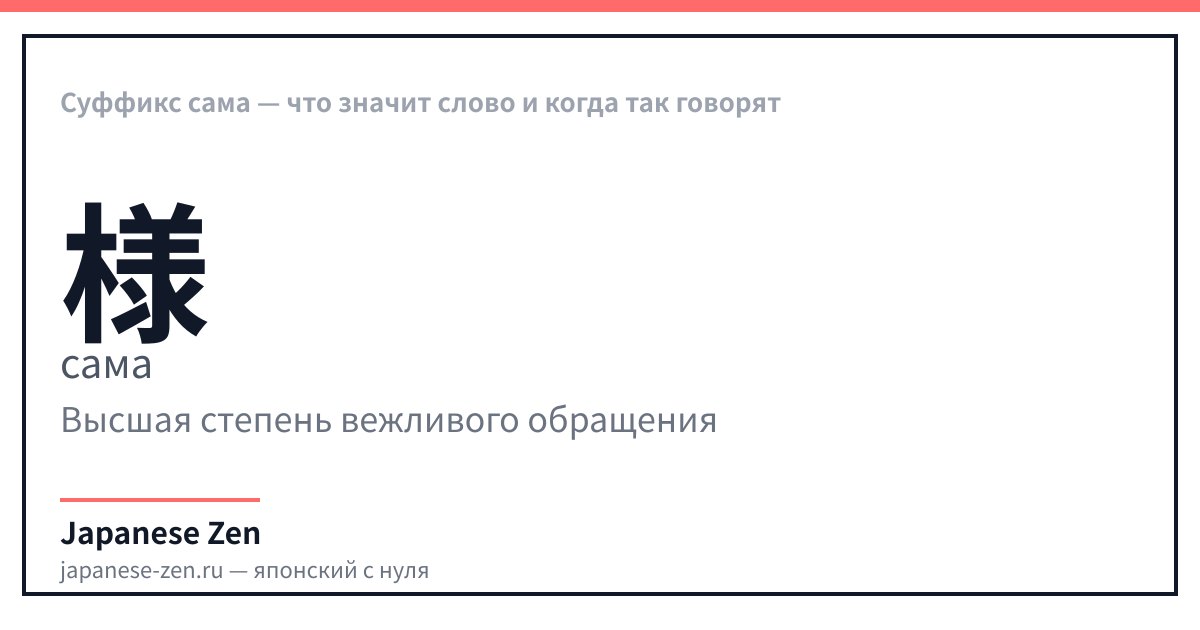
Sama is a suffix that says “you are the boss here,” and anime knows this: as soon as a character hears sama directed at them, everyone around understands who holds the power.
Who is addressed with “sama”
| Japanese | Reading | Translation |
|---|---|---|
| 様 | sama · sama | Highest degree of polite address |
| お客様 | o-kyaku-sama · o-kyaku-sama | Respected guest, customer (standard of Japanese service) |
| 神様 | kami-sama · kami-sama | God, deity |
| 王様 | ō-sama · ō-sama | King |
| さん | san · san | More neutral, colloquial neighbor of sama (basic level of politeness) |
How to read the character 様
様 is read さま, sama, and unlike the suffix san, it has its own kanji. The colloquial san is derived from it — a historical simplification and shortening of the older, more ceremonial form.
様 — the sign of highest politeness
様 — значение: esquire, way, manner, situation, polite suffix — онъёми: ヨウ、ショウ — кунъёми: さま、さん — 14 штрих(ов). 様 — “lord, appearance”: from it comes the colloquial さん, san. In words like お客様 “respected guest” and 神様 “god,” this same character sets the maximum degree of respect.
Listen to the suffix sama and related words — the app will evaluate your pronunciation.
Why anime uses it left and right
- In stories about demons and deities, sama is heard constantly — “Sadonobu-sama,” “Kami-sama” — the suffix immediately marks a character’s non-human or authoritative status.
- Servant characters or fanatically devoted companions address their master with sama — this is a stable device for showing hierarchy without extra words.
- In Russian translations, sama is sometimes rendered as “gospodin” or “povelitel,” and sometimes kept as is — the choice depends on the translator and the tone of the scene.
FAQ
- What does “suffix sama” mean?
- The highest degree of polite address in Japanese: 様, sama, is placed next to the names of deities, important customers, and characters of high status. It is the ceremonial version of the ordinary san.
- How is “suffix sama” written in Japanese?
- 様, read as さま. Unlike the suffix san, sama has its own kanji, which also appears in words like “god” and “king.”
- When is it used?
- For deities, customers in the service industry, recipients of formal letters, and characters of high status. It is almost never used for an ordinary acquaintance in everyday life — it would sound too ceremonial.
- How does the suffix sama differ from the suffix kun?
- They are opposite poles of politeness: sama is the highest and most ceremonial form, kun is an informal address for juniors and peers. Between them sits the neutral san.
- Is it polite?
- Yes, maximally polite — so much so that it is almost never used for an ordinary person in conversation, to avoid sounding mockingly exaggerated.
- Which anime did the word come from?
- The suffix is part of regular Japanese grammar, not an anime invention. It entered pop culture along with any title about gods, demons, or noble characters — there are hundreds of them.
Sources
Updated: 2026-08-29