What does the suffix -kun mean
The suffix -kun (君) is added to the names of younger boys, male peers in informal settings, or subordinates at work — it is softer than the neutral -san, but not as warm as -chan. Among classmates and male colleagues, -kun sounds friendly, but it is better not to use it with unfamiliar older people.
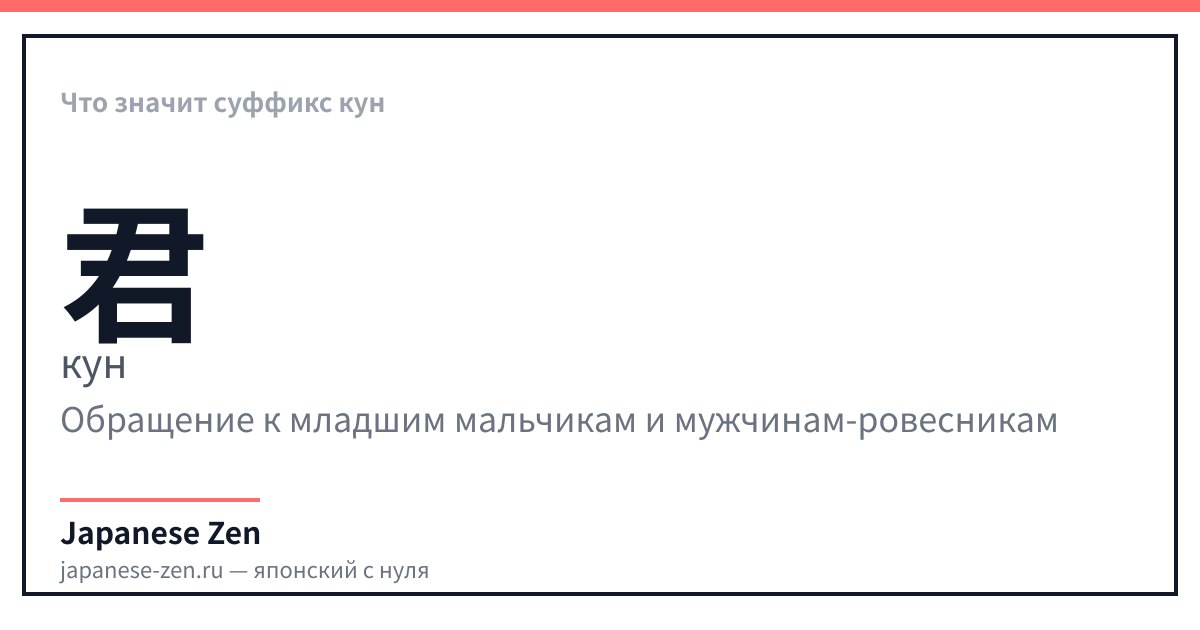
-Kun is the suffix that gets confused most often: sometimes taken as a diminutive, sometimes as rude. In fact, it is simply about status and age, not about affection.
Who is called '-kun'
| Japanese | Reading | Translation |
|---|---|---|
| 君 | kun · kun | Addressing younger boys and male peers |
| 田中君 | Tanaka-kun · Tanaka-kun | 'Tanaka' with the suffix -kun — by surname, informally |
| 君は | kimi wa · kimi wa | 'You...' — the same character 君, but as a pronoun (reading changes from くん to きみ) |
| さん | san · san | Neutral polite suffix (more formal neighbor of -kun) |
| ちゃん | chan · chan | Affectionate suffix for children and close people (warmer than -kun, often for girls) |
How to read the character 君
The character 君 is read differently depending on its role: as a suffix after a name — くん, kun; as an independent pronoun 'you' — きみ, kimi. It is the same word with the common meaning 'lord, you', just in different grammatical positions.
君 — both a suffix and a pronoun
君 — значение: mister, you, ruler, male name suffix — онъёми: クン — кунъёми: きみ、-ぎみ — 7 штрих(ов). 君 — 'you, lord': the same character in the address きみ, 'you', and in the old meaning 'ruler'. The suffix -kun is a less polite but not rude use of the same character.
Listen to the suffix -kun and related words — the app will evaluate your pronunciation.
Where it is heard most often
- In school anime, -kun is the standard way classmates address each other, especially from a girl to a boy: 'Naruto-kun' sounds friendly and slightly patronizing.
- Teachers use -kun for male students in class — the address emphasizes both care and the status of the younger one.
- At work, a boss may call a younger male subordinate that way — it creates a sense of soft hierarchy without the formality of -san.
FAQ
- What does the suffix -kun mean?
- An informal address to younger boys, male peers, or subordinates — softer than the neutral -san, but without the warmth of -chan. It is written 君 and read くん.
- What does 'kunem' mean?
- A form of the suffix -kun in colloquial Russian fan speech — 'to call someone -kun' means to address someone with this suffix. The meaning is the same: informal address to a younger person or peer.
- What does 'suffix -kun' mean?
- The name suffix 君, which is added after a name or surname, indicating an informal, slightly patronizing attitude toward a younger boy or male peer.
- How is 'suffix -kun' written in Japanese?
- 君, read くん. The same character in another reading, きみ, means the pronoun 'you' — both words are connected by the common meaning of respectful closeness.
- When is it used?
- For younger boys, male peers in informal settings, or subordinates at work. -kun is usually not suitable for unfamiliar older people or those of higher status.
- How is the suffix -kun different from the suffix -san?
- -San is a universal polite suffix for any gender and age, while -kun is narrower and more informal, often used for younger males. -San is appropriate even for strangers, but -kun is only for those with whom there is already some closeness.
Sources
Updated: 2026-08-29