What does 'kisama' mean in Japanese
'Kisama' (貴様) means a contemptuous 'you' — almost 'scoundrel'. The characters actually mean 'noble lord': four centuries ago it was used respectfully, but the politeness wore off, leaving only anger. In anime, the word is said before a fight; in real speech it is not used at all.
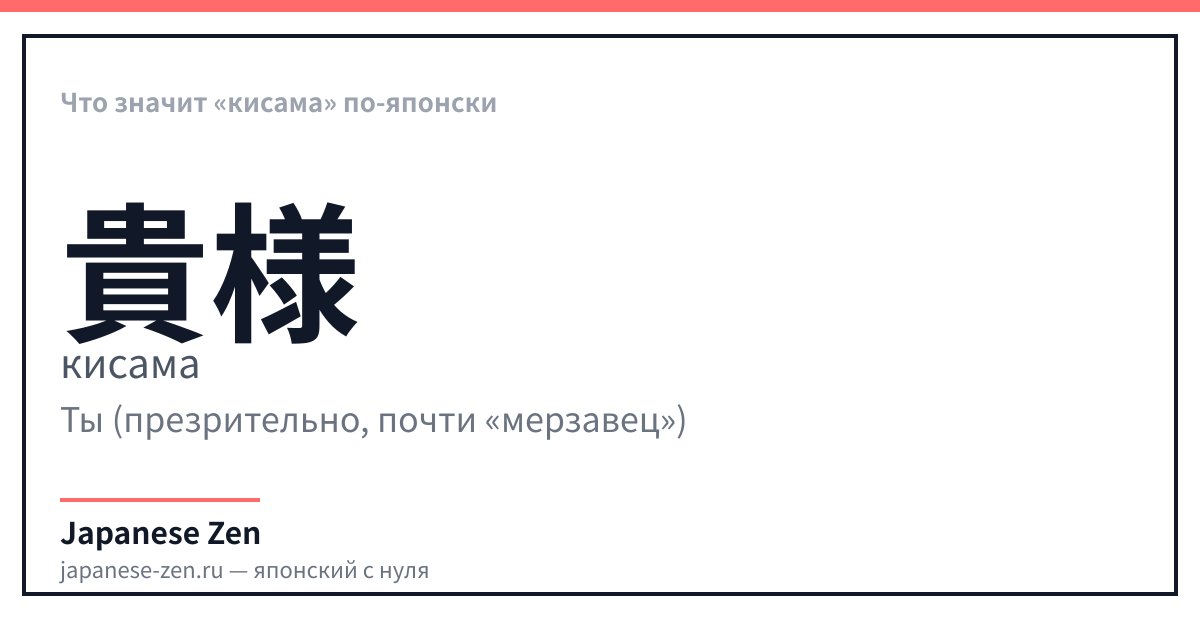
A rare case where the characters say one thing and the word means the opposite. This example shows how Japanese politeness erodes from frequent use — and why today it is safest not to say 'you' at all.
What 'kisama' means and how the word deteriorated
貴 — 'noble', 様 — a respectful suffix, the same as in お客様 ('respected customer'). In the 16th–17th centuries, 貴様 was a written polite address. The more it was used, the weaker the respect became — and by the 19th century the word flipped into an insult.
| Japanese | Reading | Translation |
|---|---|---|
| 貴様 | kisama · kisama | You (contemptuous, almost 'scoundrel') |
| お前 | omae · omae | You (rude, condescending) (softer than kisama, but still harsh) |
| てめえ | temee · temee | You, bastard (corrupted form of 手前, fight speech) |
| あなた | anata · anata | You (neutral) (and even this is rarely used in real speech) |
| 田中さん | Tanaka-san · Tanaka-san | Tanaka-san (the normal Japanese way to say 'you') |
| お客様 | okyaku-sama · o-kyaku-sama | Respected customer (the same 様, but politeness is intact) |
Why Japanese people almost never say 'you'
Any second-person pronoun in Japanese carries an evaluation of the relationship, so the language prefers to do without them: the interlocutor is called by surname with ‑さん or the subject is simply omitted. Even the neutral あなた between acquaintances sounds cold, and from a wife to her husband it means 'dear'. That is why 貴様 and お前 are so noticeable: they break the habit of avoiding direct address.
貴 — значение: noble, precious, respected — онъёми: キ — кунъёми: たっと.い、とうと.い、たっと.ぶ、とうと.ぶ — 12 штрих(ов). 貴 — the very 'noble' one, 12 strokes. Click 'Show order': at the bottom is 貝, the ancient 'shell-money'.
How to translate and what to use instead
- In subtitles, 貴様 is usually rendered as 'you scoundrel', 'you...' — in Russian, all the anger goes into the intonation.
- A similar story with 奴 (yatsu) — 'guy, that one': contemptuous, but not as rude.
- Another example of worn-out politeness: お前 — literally 'the one before me', once neutral.
- What not to do: do not try 貴様 in conversation with a Japanese person even as a joke — it is a direct challenge.
- A safe replacement in any situation is the surname plus ‑さん.
Three even syllables without stretching
'Ki-sa-ma', three even syllables, all vowels short. In anime, the word is often pronounced with a drawl and a growl — that is the actor's play, not the reading norm.
Say 'kisama' aloud — three even syllables, without the growl that actors add.
FAQ
- What does 'kisama' mean in Japanese?
- 貴様 is a contemptuous 'you', close to 'scoundrel'. The characters mean 'noble lord', but the meaning of the word has flipped.
- Why are the characters polite but the word is an insult?
- From frequent use, the politeness wore off: in the 16th century 貴様 was respectful, by the 19th it became abusive.
- Which is ruder: 'kisama' or 'omae'?
- 貴様 is ruder. お前 is harsh and condescending, but acceptable between close male friends, while 貴様 is almost always a challenge.
- How to say 'you' in Japanese safely?
- Call the person by surname with ‑さん or omit the subject altogether. Japanese tries to avoid second-person pronouns.
Updated: 2026-07-25