Isekai — what this anime genre is and why the hero gets hit by a truck
Isekai anime is anime where the hero ends up in another world: a magical kingdom, a video game, or someone else's body. In Japanese, 異世界 (isekai) literally means "another world." Some heroes are transported there alive, while others first die in our world — hence the joke about the truck that hits the hero in the first minutes of the story.
The genre has three clear plot patterns for moving to another world and dozens of series for every taste — from action fantasy to slice-of-life comedy. Let's break down the difference between transfer, reincarnation, and summoning, honestly explain where the habit of killing the hero with a truck in the very first episode came from, and put together a table of titles worth starting with to get to know the genre.
What "isekai" means and what kinds of transfers to another world exist
異世界 is read いせかい, isekai: 異 "different, other" plus 世界 "world" — literally "another world." This term refers both to the plot device itself, when a hero is transported to another reality, and to the entire genre of stories built on this move.
- 異世界転生 (isekai tensei) — reincarnation: the hero dies in our world and is reborn in another, usually with memories of their past life.
- 異世界転移 (isekai ten'i) — transfer: the hero ends up in another world alive, often by accident, sometimes pulled in by a portal or a game.
- 異世界召喚 (isekai shōkan) — summoning: the hero is deliberately called to another world, usually to save it from trouble.
"Truck-kun"
The joke about the truck that hits the hero in the first minutes of the story is called トラック転生 ("reincarnation via truck") and トラックくん, Truck-kun. This name is known in both Japanese and English-speaking fandoms. The most frequent example is the light novel "Mushoku Tensei: Jobless Reincarnation," which began publication in 2012: the hero dies after pushing people out of the path of a truck. The device has become so recognizable that authors themselves joke about it: in "KonoSuba," the hero dies not from impact but from fright, mistaking an ordinary farm tractor for a deadly threat.
異世界 — literally "another world"
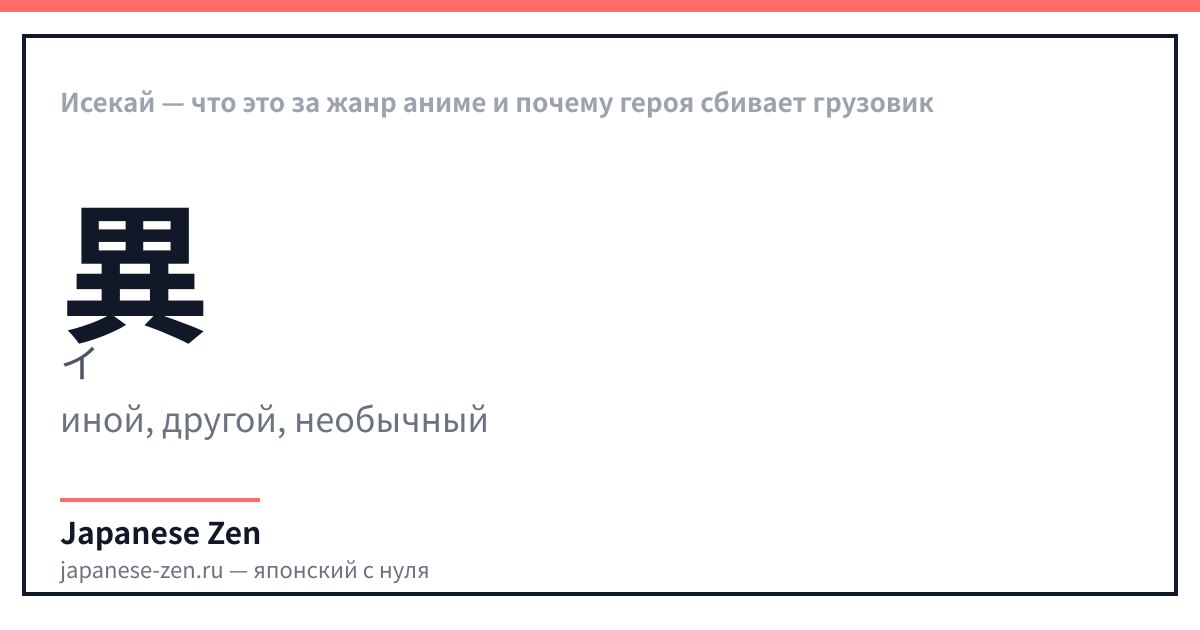
異 — значение: different, other, unusual — онъёми: イ — кунъёми: こと、こと.なる、け — 11 штрих(ов). 異 — the first character of 異世界: "different, other," the same as in 異なる, "to differ." The second character, 世界 "world," is an ordinary Japanese word with no specifically gaming meaning.
| Japanese | Reading | Translation |
|---|---|---|
| 異世界 | isekai · isekai | Another world — and the genre of stories about being transported there |
| 転生 | tensei · tensei | Reincarnation, rebirth |
| 転移 | ten'i · ten'i | Transfer, translocation |
| 召喚 | shōkan · shōkan | Summoning, calling |
| 異なる | kotonaru · kotonaru | To differ, to be different (the same character 異 as in isekai) |
Write 異 along the guides — the character of "other," which is why the world in this genre is called 異世界.
転生 — not an anime invention, but a Buddhist term
転生 (tensei) existed in Japanese long before the genre — it is the Buddhist concept of "reincarnation," part of the teaching of the wheel of rebirth 輪廻転生 (rinne tensei). In it, the soul passes through new bodies and worlds depending on actions in a past life. The isekai genre simply took a ready-made word and substituted a fantasy kingdom for Buddhist cosmology.
Where to start: eight titles and three ways to get to another world
| Title | Anime year | Studio | Subgenre |
|---|---|---|---|
| "Fushigi Yūgi" | 1995 | Studio Pierrot | Transfer — schoolgirls end up in the world of an ancient book |
| "Inuyasha" | 2000 | Sunrise | Transfer — the heroine falls through a well into the Sengoku era |
| "Sword Art Online" | 2012 | A-1 Pictures | A disputed case — the heroes are stuck in a video game, not literally another world |
| "Overlord" | 2015 | Madhouse | Transfer — the player remains in his avatar's body after the server shuts down |
| "KonoSuba: God's Blessing on This Wonderful World!" | 2016 | Studio Deen | Reincarnation — a comedic parody of the genre's tropes |
| "Re:Zero - Starting Life in Another World" | 2016 | White Fox | Transfer — the hero arrives in the world alive and after each death rewinds time |
| "That Time I Got Reincarnated as a Slime" | 2018 | 8-bit | Reincarnation — the hero dies at the hands of a robber and is reborn as a slime |
| "Mushoku Tensei: Jobless Reincarnation" | 2021 | Studio Bind | Reincarnation — the quintessential "Truck-kun" |
Where the isekai boom came from
The modern wave was launched not by the anime market but by the amateur novel site "Shōsetsuka ni Narō" (小説家になろう, "Let's Become Novelists"): it opened in 2004 and allowed free publication of texts. By the early 2010s, thousands of similar stories about transfer to a fantasy world with game elements had accumulated there. Publishers began turning the most popular ones into light novels, then manga and anime — that's how the genre went from amateur text to television screen.
Isekai, fantasy, and the "new genre of the 2010s": three misconceptions
- "Isekai is only anime." In fact, the genre began with text: amateur novels on "Shōsetsuka ni Narō" appeared before most anime adaptations, and the TV version is a secondary product.
- "Isekai and fantasy are the same thing." Fantasy describes a world: magic, dragons, kingdoms. Isekai describes a plot device — the transfer of a hero from our reality to another. A hero who was simply born in a magical kingdom is fantasy without isekai.
- "Isekai was invented in the 2010s." The device of transferring a hero to another world appeared on screen earlier: in "Fushigi Yūgi" (1995) the heroines end up in the world of an ancient book, in "Inuyasha" (2000) — in the past through a well. The term and the fashion for it took hold later, along with the web novel boom.
FAQ
- What is isekai?
- A genre of anime, manga, and light novels where the hero ends up in another world — a fantasy kingdom, a video game, or someone else's body. In Japanese, 異世界 means "another world": 異 "other," 世界 "world." There are three ways to get there — reincarnation, transfer, and summoning — and each has its own Japanese name.
- Which isekai anime should I watch first?
- It's worth starting with "KonoSuba" — a comedy with recognizable genre tropes — and "Re:Zero - Starting Life in Another World" — with a more serious plot. Both came out in 2016 and are aimed at newcomers to the genre.
- How is isekai different from ordinary fantasy?
- Fantasy is about a setting with magic and magical creatures. Isekai is about a plot device: the hero is transported there from our world. Many isekai stories do unfold in fantasy settings, but that is not a mandatory condition of the genre.
- What does "reincarnation in another world" mean?
- One of the three ways to get into isekai: the hero dies in our world and is reborn in another, usually retaining memories of their past life. In Japanese this is 異世界転生, isekai tensei — from the Buddhist word for "reincarnation."
- Why does a truck hit the hero in isekai?
- This is a fan joke: トラックくん, Truck-kun — death under the wheels is a ready-made and recognizable reason for reincarnation. The most famous example is the light novel "Mushoku Tensei: Jobless Reincarnation," where the hero dies saving passersby.
- How is "isekai" written in Japanese?
- 異世界, read いせかい. 異 means "different, other," 世界 means "world": together they give "another world," from which the genre got its name. The most frequent word of the reincarnation genre is 異世界転生, from which terms ending in -転生, "reincarnation," are also formed.
Sources
Updated: 2026-09-14