NEET in Japan — who the "nīto" are and how they differ from freeters
NEET (Not in Education, Employment or Training) refers to young people who are not studying, not working, and not looking for work. Japan adopted the term in the mid-2000s and counts such people separately from the unemployed and freeters. According to official statistics, in 2024 there were 610,000 NEETs aged 15–34 — 20,000 more than the year before.
Three Japanese words — NEET, freeter, and hikikomori — at first glance seem to be about the same thing: young people without stable employment. In reality, each has its own strict criteria, and they should not be confused. Let's look at where the abbreviation NEET came from, how it differs from neighboring concepts, how many such people there are in Japan today, and what all three words have in common with the kanji for "work."
NEET: an acronym not coined in Japan
NEET stands for Not in Education, Employment or Training. The term entered British political language in 1999, along with the government report "Bridging the Gap" by the Social Exclusion Unit: it was proposed as a label for teenagers and young adults who had fallen out of school, work, and any training programs.
How the word took hold in Japan in the mid-2000s
In Japan, the word became widely known after the book by economist Genda Yūji and journalist Maganuma Mie, "NEET: Not Freeter, Not Unemployed" (『ニート―フリーターでもなく失業者でもなく』, 2004). Since then, ニート (nīto) has been written in katakana as a loanword and used as a separate statistical category alongside freeters and the unemployed.
NEET, freeter, and hikikomori: who is who
These three words are most often confused, although they describe different things: one is about employment, another about its unstable form, and the third is not about work at all but about withdrawing from home.
| Term | Who this is by definition | Key criterion |
|---|---|---|
| NEET (ニート) | Aged 15–34, not in the labor force, not doing housework, and not studying | Employment and education — not about residence or reason |
| Freeter (フリーター) | Aged 15–34, working or looking for part-time work — "arubaito," "part-time" | Formally employed, just not in a permanent position |
| Hikikomori (引きこもり) | A person who hardly leaves home and does not interact with people outside the family for six months or more | Social isolation, not employment or age |
Where these categories overlap
The categories are not mutually exclusive: a young hikikomori usually also meets the NEET criterion, but a NEET does not necessarily stay at home — the person may be socially active, just not studying or working. A freeter, unlike both, is formally employed — it's just that this employment is unstable and not considered a regular job.
How many NEETs there are in Japan according to official statistics
According to the Ministry of Health, Labour and Welfare, in 2024 (令和6年) the number of NEETs aged 15–34 was 610,000 — 20,000 more than the year before. The official criterion: a person of this age who is not in the labor force, not doing housework, and not enrolled in an educational institution.
NEETs compared to freeters: both figures are below the peak of two decades ago
For comparison, freeters in the same year 2024 numbered 1.36 million — noticeably fewer than in the mid-2000s, when statistics recorded about 2 million. The number of NEETs rose noticeably in 2020, the first year of the pandemic, then declined, and in 2024 rose slightly again.
働 — a kanji invented in Japan
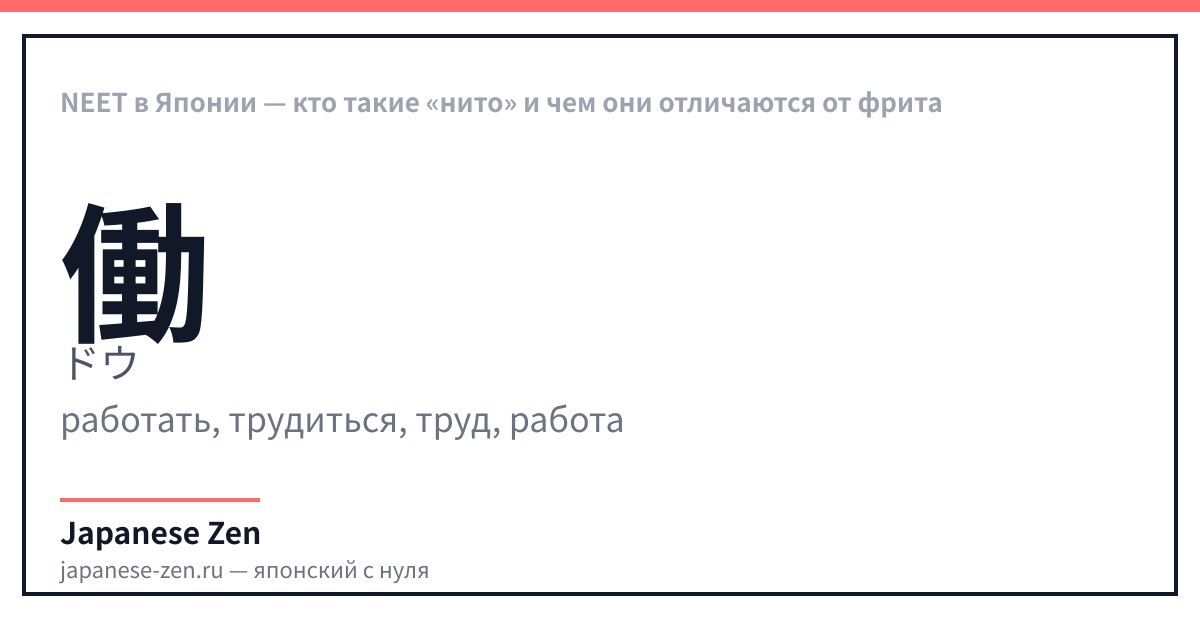
働 — значение: to work, to labor, labor, work — онъёми: ドウ — кунъёми: はたら.く — 13 штрих(ов). 働 — "to work": a kokuji, that is, a kanji invented in Japan itself, not borrowed from China. It is composed of "person" (亻) and "to move" (動) — a person who labors. The same character appears in 労働 (rōdō) "labor" and 共働き (tomobataraki) "both spouses work."
Kokuji — a character born in Japan itself
Most kanji came to Japan from China along with texts, but 働 is an exception: the Japanese themselves combined the character for "person" with the character for "movement" to get "one who labors." All three concepts — NEET, freeter, and hikikomori — are defined in one way or another through a person's relationship to work, which is exactly what 働 denotes.
| Japanese | Reading | Translation |
|---|---|---|
| ニート | nīto · nīto | A young person not in education, employment, or training |
| 働く | hataraku · hataraku | To work, to labor |
| フリーター | furītā · furītā | Freeter — part-time jobs instead of a permanent position |
| 就職 | shūshoku · shūshoku | To get a permanent job |
| 仕事 | shigoto · shigoto | Work, job, occupation |
Write 働 along the guides — the character for "to work," invented in Japan itself.
FAQ
- Who are NEETs in Japan?
- NEET comes from the English abbreviation Not in Education, Employment or Training: young people who are not studying, not working, and not undergoing vocational training. According to the official criterion of Japanese statistics, these are people aged 15–34 who are not in the labor force, not doing housework, and not enrolled in an educational institution.
- How do NEETs differ from freeters?
- A freeter is formally working or looking for part-time work — "arubaito" or "part-time" — just not in a permanent position. A NEET, unlike a freeter, is not working and not looking for work at all. Both categories are counted within the same age group of 15–34, but their employment status is different.
- Are all hikikomori NEETs?
- Not all: hikikomori can be older than 34 and can be among those doing housework — they do not fall under the statistical NEET criterion. But young hikikomori are usually NEETs. A NEET, however, does not necessarily stay at home: they may socialize with friends, just not study or work. Hikikomori is defined by isolation, NEET by employment.
- How many NEETs are there in Japan according to official data?
- According to Japanese statistics, in 2024 the number of NEETs aged 15–34 was 610,000 — 20,000 more than the year before. For comparison, freeters in the same year numbered 1.36 million — noticeably below the level of the mid-2000s.
- When did the term NEET appear in Japan?
- The abbreviation itself entered British political language in 1999, along with the government report "Bridging the Gap." In Japan, the word became widely known in the mid-2000s — after the book by economist Genda Yūji and journalist Maganuma Mie, "NEET: Not Freeter, Not Unemployed" (2004).
- How do you write and read NEET in Japanese?
- The word is written in katakana — ニート, pronounced "nīto" with a long "i": it is a transliteration of the English abbreviation, not a Japanese word with its own kanji. Related terms — freeter (フリーター) and hikikomori (引きこもり) — also describe the situation of young people, but by different criteria.
Sources
Updated: 2026-09-15