Sumo wrestlers — who rikishi are, how ranks work, and how they live
Sumo wrestlers, rikishi (力士), are professional athletes of the Japan Sumo Association: they live and train in a heya under a master oyakata, climb through six divisions from jonokuchi to makuuchi, and compete not under their own name but under a shikona. Only wrestlers in the top two divisions, sekitori, receive a salary; the rest get housing, meals, and small payments for each tournament.
Everyone knows the word "sumo wrestler," but what stands behind it is less clear: a rikishi is not just a large man in a mawashi, but a professional with his own hierarchy, salary, and daily life scheduled to the hour. We look at how the six divisions from jonokuchi to makuuchi are structured, who the sekitori with personal attendants are, why wrestlers enter the dohyo not under their own name, and what happens to them when their career ends.
Who rikishi are and how ranks work
Rikishi (力士) are professional sumo wrestlers belonging to the Japan Sumo Association (日本相撲協会) and assigned to one of the heya — stable-schools where they live, train, and eat together with their colleagues under a master oyakata. There are formally no weight categories in sumo: a wrestler just over one hundred kilograms and an opponent nearly twice as heavy can meet in a single bout. A rikishi's position is decided by only one thing — the banzuke, the tournament ranking table, which is revised after each basho.
| Division | What it is |
|---|---|
| Makuuchi (幕内) | The top division: within it are yokozuna, ozeki, sekiwake, komusubi, and ordinary maegashira |
| Juryo (十両) | The second-strongest division — together with makuuchi, its wrestlers are called sekitori |
| Makushita (幕下) | The third division — no salary yet |
| Sandanme (三段目) | The fourth division |
| Jonidan (序二段) | The fifth division, the most numerous |
| Jonokuchi (序ノ口) | The starting division for newcomers after the exam |
Sekitori is the collective name for wrestlers in the top two divisions, makuuchi and juryo: only they receive an official salary and personal attendants from the lower ranks, tsukebito. Everyone below has no salary: the heya provides housing and food, and the association pays a small allowance for each tournament (場所手当).
How one becomes a sumo wrestler
The path into sumo begins with the newcomer exam, shindeshi-kensa (新弟子検査): one must have completed compulsory education, be under 23 years old — or 25 if one has achievements in amateur sumo — and pass a medical examination on the recommendation of a master. The height and weight requirements, 167 cm and 67 kg, were effectively abolished by the association in September 2023 — for the first time since they were written into the rules in 1932. Since 2024, those who fall short of them are accepted based on a physical fitness test.
The word and the kanji: 力士
A sumo wrestler has a whole set of names, and almost none of them matches the one given at birth. In the dohyo he competes under a shikona (四股名) — a pseudonym assigned by his master upon joining the heya, which he may change more than once during his career. In conversation, a wrestler is called more simply: お相撲さん (o-sumō-san, "Mr. Sumo wrestler") or 相撲取り (sumōtori). The highest title within makuuchi is 横綱 (yokozuna), literally "horizontal rope": at the ceremony of entering the dohyo, the yokozuna wears a thick white rope.
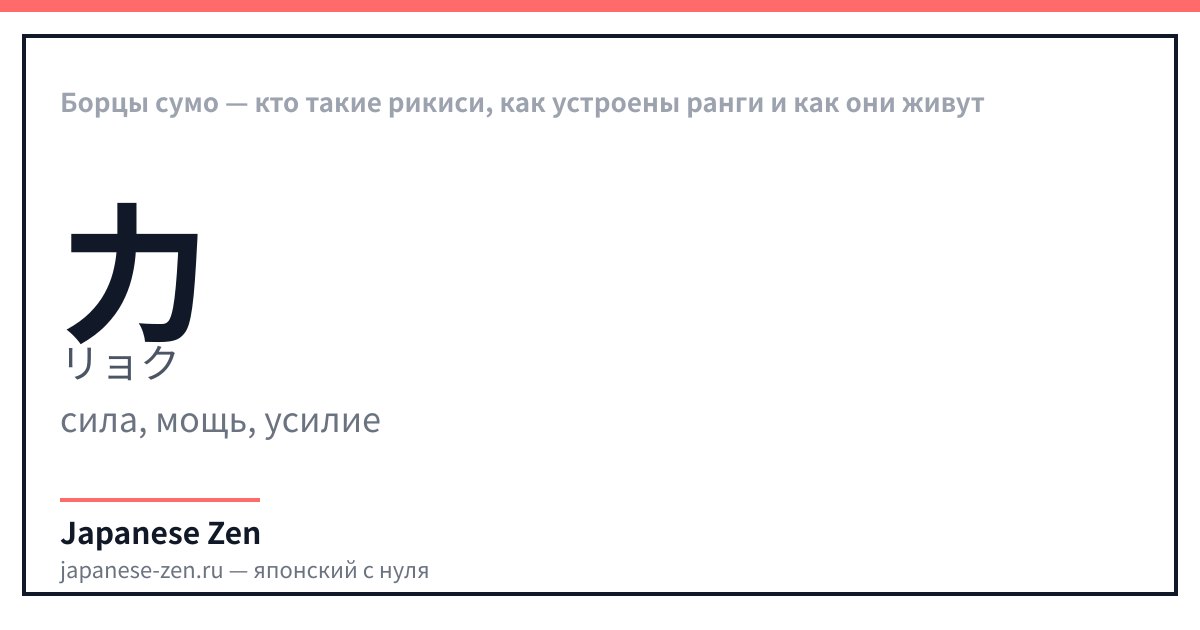
力 — значение: strength, power, effort — онъёми: リョク、リキ、リイ — кунъёми: ちから — 2 штрих(ов). 力 — "strength, power": 2 strokes. The same root is in 力士 (rikishi, "strongman-warrior") and in 力持ち (chikaramochi, "strongman").
| Japanese | Reading | Translation |
|---|---|---|
| 力士 | rikishi · rikishi | Professional sumo wrestler |
| 相撲取り | sumōtori · sumōtori | Sumo wrestler — a colloquial word |
| お相撲さん | o-sumō-san · o-sumō-san | Mr. Sumo wrestler — a polite address |
| 関取 | sekitori · sekitori | A wrestler in one of the top two divisions |
| 横綱 | yokozuna · yokozuna | The highest title in sumo |
| 四股名 | shikona · shikona | A wrestler's name instead of his real one |
Listen to how rikishi, sekitori, and other words of the topic sound, and repeat them aloud.
What 力士 means literally
The term 力士 itself breaks down into two characters: 力 "strength, power" and 士 "man, warrior, specialist" — together it comes out roughly as "strongman-warrior." The same second character appears in 武士 (bushi, "warrior, samurai"): sumo has long been linked not only to sport but also to the warrior tradition.
How sumo wrestlers live today
A rikishi's day begins before dawn: first a long training session on an empty stomach, and only then a hearty lunch of chanko-nabe, a rich soup with meat, fish, and vegetables, which the junior wrestlers prepare in the heya. After eating comes sleep, so that the calories turn into weight rather than being burned off in training. In public, all rikishi must appear in traditional clothing — they even go to the store in a yukata — and with their hair gathered in a topknot. At tournaments, sekitori tie it into an elaborate knot, the oicho (大銀杏).
Since 1985, active rikishi have been forbidden to get behind the wheel: the association introduced the rule after accidents involving wrestlers, and one may drive only after finishing one's career. The career itself is ended by a hair-cutting ceremony, danpatsu-shiki (断髪式): friends and masters take turns cutting a lock from the topknot, and the final cut is made by the master himself. After that there are two paths: an ordinary life outside sumo, or a place as an oyakata in the association and work with the next generation of wrestlers.
Foreigners among sumo wrestlers
The number of foreigners in each heya is limited: since 2002, a stable has been allowed to keep no more than one foreigner, and since 2010, those who have taken Japanese citizenship also count toward this limit. The first yokozuna not from Japan was Hawaii-born Akebono (曙太郎) — the 64th, who received the highest rank in January 1993. A native of Russia also reached makuuchi: Roga (狼雅), born in Tuva, from the Futagoyama stable, first competed in the top division in November 2023.
Sumo wrestlers in anime and dramas
- "Hinomaru Sumo" (火ノ丸相撲) — a manga and anime by studio GONZO about a schoolboy who dreams of becoming a yokozuna despite his small stature; the 24-episode anime aired in 2018–2019.
- "Sumo Do, Sumo Don't" (シコふんじゃった, 1992) — a comedy about a student persuaded to save a university sumo club from disbandment; the film won the Japan Academy Prize for Best Picture.
- "Sanctuary" (サンクチュアリ -聖域-, 2023) — a Netflix drama series about a young rikishi's rise; the actors were physically trained for a whole year so that the bouts on screen would look real.
What films and series exaggerate
The screen usually paints rikishi as heavier and more aggressive than the sport itself requires. According to Japan Sumo Association data for the Autumn 2024 tournament, the average weight of a makuuchi wrestler was 161.8 kg with an average height of 184.8 cm, and among them there are noticeably lighter technicians. Films and series also exaggerate the harshness of life in the heya for the sake of drama: scandals involving violence have real precedents in sumo history, but these are violations investigated by the association, not the everyday norm of training.
FAQ
- Who are sumo wrestlers?
- Sumo wrestlers, rikishi (力士), are professional athletes assigned to one of the heya, the stable-schools of the Japan Sumo Association. They live and train together under a master oyakata and climb through six ranking divisions — from jonokuchi to makuuchi — based on the results of basho tournaments.
- How do sumo wrestlers earn a living?
- Only sekitori — wrestlers in the top two divisions, makuuchi and juryo — receive an official salary. The rest have no salary: the heya provides them with housing and food, and the association pays a small allowance for each tournament (場所手当). Real money appears only upon reaching juryo.
- How does one become a sumo wrestler?
- Through the newcomer exam, shindeshi-kensa: one must have completed compulsory education, be under 23 years old (or 25 — with achievements in amateur sumo), and pass a medical examination. The height and weight requirements were effectively abolished by the association in September 2023: since 2024, those who fall short of them are accepted based on a physical fitness test.
- Why don't sumo wrestlers use their own names?
- They compete under a shikona (四股名) — a wrestling pseudonym assigned by their master upon joining the heya. The pseudonym may sound lofty or refer to the wrestler's native places, and during a career it is sometimes changed more than once — for example, upon promotion in rank.
- Are there foreigners among sumo wrestlers?
- Yes, but with a restriction: since 2002, each heya may have no more than one foreigner, and since 2010, those who have taken Japanese citizenship also count toward the limit. The first yokozuna not from Japan was Hawaii-born Akebono in January 1993. A native of Tuva, Roga, also reached makuuchi — in November 2023.
- In which anime and series are sumo wrestlers shown?
- "Hinomaru Sumo" (2018, studio GONZO) — the story of a schoolboy who dreams of the title of yokozuna. The comedy "Sumo Do, Sumo Don't" (1992) — about a university sumo club on the verge of disbandment. The Netflix series "Sanctuary" (2023) shows a young rikishi's rise with real bouts on screen.
Sources
Updated: 2026-09-13