Japanese Male Names and Their Meanings: From Ichiro to Haruto
Japanese male names, like female ones, are built from the meanings of kanji: Ichiro (一郎) — "first son", Hiroshi (広) — "wide, vast", Makoto (誠) — "sincerity". Many male names end in -ro (郎) or indicate birth order. Today short names are in fashion: Haruto, Minato, Ren.
A male name in Japan is assembled from meaningful pieces just like a female one, only with a different set of characters and a special logic of readings — nanori, which you can't always guess from the sound. Let's go through a table from classic Ichiro and Taro to modern Haruto and Minato, see which kanji male names are made of, and what is true about them and what is a myth about "Naruto" and "patronymics".
Meanings of Japanese male names
Every male name also has a literal meaning — the one carried by the chosen kanji, not the one suggested by the sound. Takashi is written 隆 ("prosperity, rise") or 貴 ("precious, noble") — the general meaning is similar, but the characters are different. The table below shows the specific spelling for each name and the meaning of those exact characters.
| Name | Kanji | Reading | Meaning |
|---|---|---|---|
| Haruto | 陽翔 | はると | "sun, warmth" + "to soar" |
| Ren | 蓮 | れん | "lotus" |
| Minato | 湊 | みなと | "harbor, wharf" |
| Sota | 颯太 | そうた | "gust of wind" + "great, strong" |
| Hiroshi | 広 | ひろし | "wide, vast" |
| Takashi | 隆 | たかし | "prosperity, elevation" |
| Kenji | 健二 | けんじ | "health, strength" + "second" |
| Ichiro | 一郎 | いちろう | "first" + "son" |
| Taro | 太郎 | たろう | "great, strong" + "son" |
| Jiro | 次郎 | じろう | "next" + "son" |
| Saburo | 三郎 | さぶろう | "three" + "son" |
| Daiki | 大輝 | だいき | "great" + "to shine" |
| Yuto | 悠斗 | ゆうと | "leisurely, eternal" + "ladle, stars" |
| Kaito | 海斗 | かいと | "sea" + "ladle, stars" |
| Riku | 陸 | りく | "land, earth" |
| Sora | 空 | そら | "sky" |
| Akira | 明 | あきら | "clear, bright" |
| Kenta | 健太 | けんた | "healthy, strong" + "great" |
| Sho | 翔 | しょう | "to soar, to fly" |
| Takumi | 匠 | たくみ | "master, artisan" |
| Makoto | 誠 | まこと | "sincerity, truth" |
| Isamu | 勇 | いさむ | "bravery, courage" |
| Hayato | 隼人 | はやと | "falcon" + "person" |
| Yamato | 大和 | やまと | "great harmony" (also an ancient name for Japan) |
The reading of a name is not always derived from the characters (nanori, 名乗り)
Many male names are read differently from the same characters in ordinary words — this is nanori (名乗り), special name readings. The most common example is Haruto (陽翔): 陽 in words is read "yo" or "hi", but in the name it is "haru"; 翔 in words is "sho" or "kakeru", but here it gives "to". Such a reading cannot be guessed from the kanji alone, which is why Japanese people ask again how a name is read.
Which characters male names are made of
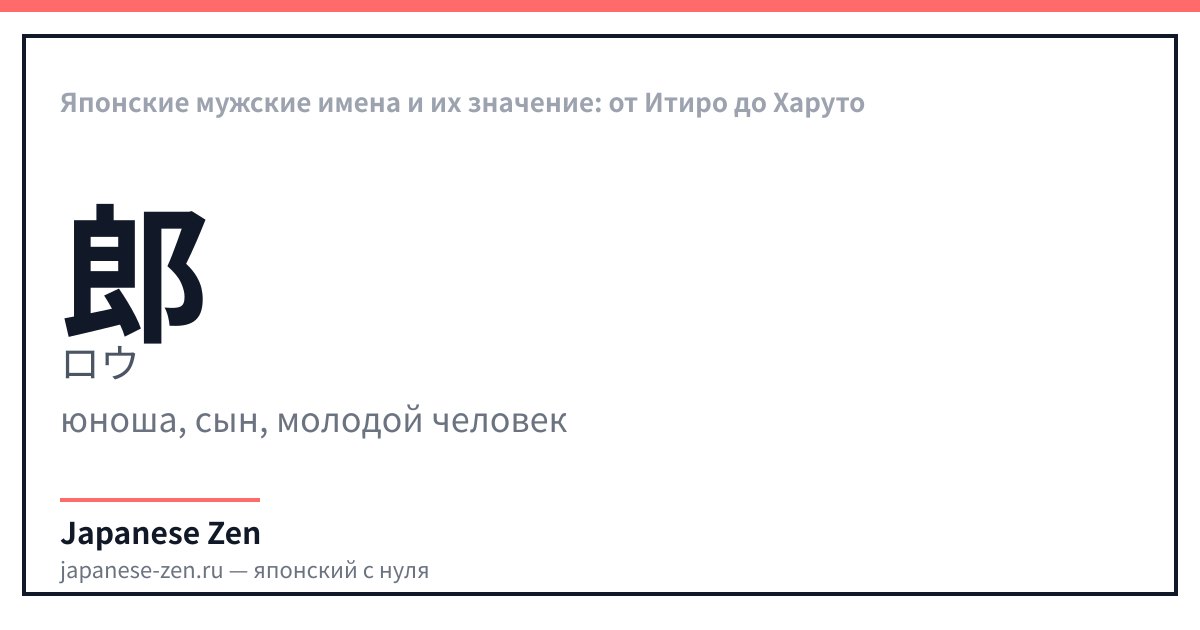
郎 — значение: young man, son, young person — онъёми: ロウ、リョウ — кунъёми: おとこ — 9 штрих(ов). 郎 — "young man, son": a frequent final character in male names, as in 太郎 (Taro) or 次郎 (Jiro).
| Japanese | Reading | Translation |
|---|---|---|
| 郎 | rō · rō | ending of many male names: "young man, son" |
| 太 | ta · ta | "great, strong", as in the name Taro (太郎) |
| 介 | suke · suke | "helper, mediator" — a frequent element of male names |
| 翔 | to · to | "to soar, to fly" — the most frequent kanji in boys' names for five years in a row (Meiji Yasuda, 2025) |
| 大 | dai · dai | "great, big", as in the name Daiki (大輝) |
Names by birth order: Ichiro, Jiro, Saburo
The classic way to name sons is by count: 一郎 (Ichiro) — "first son", 次郎 (Jiro) — "second son", 三郎 (Saburo) — "third son". Today this is used less often, but the meaning is clear to any Japanese person: the character 郎 is read "-ro" and means "son, young man".
Write 郎 along the guides — the character that ends many male names: Taro, Jiro, Saburo.
How a name for a boy is chosen today
According to the annual survey by the Meiji Yasuda insurance company, among newborn boys in 2025 the most frequent kanji spelling of a name was 湊 (Minato), and the most frequent reading was Haruto: it has held first place for seventeen years in a row. The character 翔 ("to soar") remains the most used character in male names for the fifth year in a row.
- As with girls, the law allows only characters from official lists for a boy's name — about 3000 as of 2025.
- Classic Ichiro and Taro do not make the top 10 of 2025 — it features short modern names like Minato, Haruto and Ren.
- Tanjuro (炭治郎), the hero of "Demon Slayer", is also a name ending in -ro: 炭 "charcoal" (the Kamado family made a living selling charcoal), 治 "to heal, to govern", 郎 "son".
How an anime hero's name differs from a name given in real life
Tanjuro sounds like an ordinary male name of the old style. But the characters are chosen to fit the plot: 炭 "charcoal" echoes the craft of the hero's family. Parents in real life also choose characters with meaning, only that meaning is a wish for the child, not a hint at his future craft.
Common myths about male names
- "Naruto is a real Japanese name" — no: Naruto (鳴門) is the name of a sea strait in Tokushima Prefecture and of the fish cake narutomaki, rolled into a spiral in honor of the whirlpools there. As a personal name it is almost never found — it is an association from anime, not a Japanese tradition.
- "Japanese people have patronymics" — no: an official name consists of a surname and a personal name; the category of "patronymic" simply does not exist in Japanese anthroponymy.
- "The ending -ko was always purely female" — not quite: in the Asuka period (6th–7th centuries) men were also named this way, for example the diplomat Ono no Imoko (小野妹子). The character 子 was then an honorific for learned men, as in the name of Confucius (孔子).
- "Ichiro is always the eldest son" — not necessarily: baseball player Suzuki Ichiro (鈴木一朗) is the second son in the family. The character 一 was given to him in honor of his grandfather, and the second character is not 郎 but 朗 "bright, clear".
FAQ
- What do Japanese male names mean?
- Like female ones, they are composed of the meanings of specific kanji: Makoto (誠) means "sincerity", Isamu (勇) — "bravery". Many male names end in -ro (郎, "son") or indicate the child's birth order — Ichiro, Jiro, Saburo: "first", "second", "third" son.
- What was the most popular name for Japanese boys in 2025?
- In the Meiji Yasuda ranking for 2025, the top spelling is 湊 (Minato), while the leading reading is Haruto: this reading has been first for seventeen years in a row. The most frequent kanji in boys' names remains 翔 ("to soar") for the fifth year.
- What do the names Ichiro, Jiro and Saburo mean?
- These are names by seniority: 一郎 — "first son", 次郎 — "second", 三郎 — "third". The character 郎 is read "ro" and means "young man, son". Today this is rarely used, but any Japanese person understands the meaning — just as in old times names like First or Third were understood.
- Is Naruto a real Japanese name?
- No. Naruto (鳴門) is the name of a sea strait in Tokushima Prefecture and of the fish cake narutomaki, which is made in a spiral in honor of the whirlpools there. As a personal name for a boy it is almost never found — it is an association from anime, not a Japanese tradition.
- Is it true that the ending -ko was once used by men too?
- Yes. In the Asuka period, the character 子 was also part of male names — as an honorific for a learned man, like Confucius (孔子). An example is the diplomat Ono no Imoko (小野妹子). In the Heian period the ending became fixed for the names of noble women, and it became the most widespread female ending only in the 20th century.
- What is the name of the main character of "Demon Slayer" in Japanese?
- Tanjuro Kamado (also written "Tanjirou" in search), in kanji 竈門炭治郎: 竈門 is the surname Kamado ("hearth"), 炭治郎 is the given name. Here 炭 "charcoal" refers to the family trade of charcoal burning, 治 "to heal, to govern", and 郎 is the same ending "-ro" as in the names Ichiro or Taro.
Sources
Updated: 2026-09-13