Japanese Surnames and Their Meanings: The Most Common Ones and Where They Came From
Japanese surnames and their meanings is a trick question: there is no separate "male" form of Japanese surnames — husband and wife write the surname with the same kanji. The meaning comes from the characters themselves: Tanaka (田中) literally means "in the middle of the field," Suzuki (鈴木) is "bell" and "tree." The top of the 2024 ranking is Sato, Suzuki, and Takahashi.
The surname Tanaka has no "female" counterpart in Japan: the wife of Tanaka Hiroshi is also registered as Tanaka. Let's look at the twelve most common surnames in the country with their kanji and the exact meaning of the characters, and why names ending in -tō and -ta (藤, 田) are so widespread. We'll also cover when commoners were allowed, and then required, to have surnames: it happened only about 150 years ago.
Meanings of the Most Common Japanese Surnames
Every Japanese surname has the same form for men and women: the law does not provide for separate male and female endings. The meaning of a surname is set by the specific kanji, not by the sound — just like personal names. The table shows the twelve most common surnames according to the Japanese service Myoji-Yurai.net for 2024: with the spelling, reading, and meaning of those exact characters.
| Surname | Kanji | Reading | What the characters mean |
|---|---|---|---|
| Sato | 佐藤 | さとう | "assistant, help" + "wisteria" (according to one version, a reference to the Fujiwara clan) |
| Suzuki | 鈴木 | すずき | "bell" + "tree" |
| Takahashi | 高橋 | たかはし | "high" + "bridge" |
| Tanaka | 田中 | たなか | "field" + "middle" — "in the middle of the field" |
| Ito | 伊藤 | いとう | a character without a fixed meaning, taken for its sound from the province name Ise (伊勢) + "wisteria" (according to one version, "Fujiwara from Ise") |
| Watanabe | 渡辺 | わたなべ | "to cross" + "vicinity, shore" — "at the crossing" |
| Yamamoto | 山本 | やまもと | "mountain" + "base, root" — "at the foot of the mountain" |
| Nakamura | 中村 | なかむら | "middle" + "village" |
| Kobayashi | 小林 | こばやし | "small" + "forest" |
| Kato | 加藤 | かとう | "to add" (from the province name Kaga, 加賀) + "wisteria" (according to one version, "Fujiwara from Kaga") |
| Yoshida | 吉田 | よしだ | "happiness, good fortune" + "field" |
| Yamada | 山田 | やまだ | "mountain" + "field" |
Women's Surnames: Why They Don't Exist
A woman in Japan has no separate form of surname: the wife of Tanaka Hiroshi is also listed as Tanaka in the family register. Article 750 of the Civil Code requires spouses to choose one shared surname — either the husband's or the wife's. In 2024, according to the Cabinet Office of Japan, 94% of couples took the husband's surname (456,453 out of 485,092), and only 6% took the wife's. Separate surnames for spouses (夫婦別姓) have been discussed in parliament for about thirty years, but the law has not yet been changed: the Supreme Court in 2015 and 2021 ruled that the current rule does not contradict the constitution.
What Characters Surnames Are Made Of
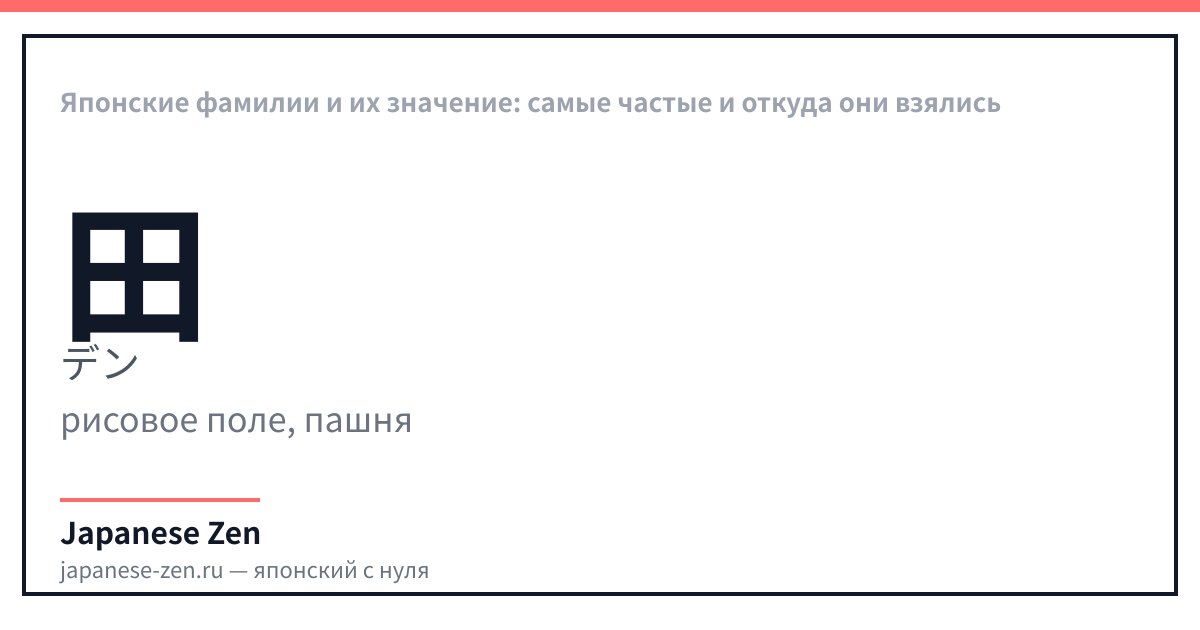
田 — значение: rice field, cultivated field — онъёми: デン — кунъёми: た — 5 штрих(ов). 田 — "rice field": 5 strokes, one of the most common characters in Japanese surnames — along with 山 "mountain" and 藤 "wisteria."
| Japanese | Reading | Translation |
|---|---|---|
| 名字 | myōji · myōji | surname — the main word for this concept |
| 姓 | sei · sei | surname, lineage — a more formal, bureaucratic word |
| 田 | ta · ta | "field" — at the end of surnames it often becomes voiced as "da": Yamada, Yoshida |
| 山 | yama · yama | "mountain" — a common element of surnames: Yamamoto, Yamada |
| 藤 | tō · tō | "wisteria" — on its own it is read "fuji," but in surnames ending in -tō it is "tō": Sato, Kato, Ito |
| 井 | i · i | "well" — as in the surname Inoue (井上) |
Why So Many Surnames End in -tō and -ta: 藤 and 田
According to a widespread version, many surnames ending in -tō trace back to the Fujiwara clan (藤原): distant branches of the clan added a second character to the kanji 藤 "wisteria" — after a position or province. This is how the origins of the surnames Sato (佐藤), Kato (加藤, "Fujiwara from the lands of Kaga"), and Ito (伊藤, "Fujiwara from the lands of Ise") are explained. This cannot be proven for each individual family, but the frequency of such surnames explains the version well. The character 田, "rice field," is widespread in surnames for a different reason: in an agrarian country, a surname was often taken from what the family owned or where it lived — a field, a mountain (山), or a forest (林).
Write 田 along the guides — "rice field," one of the most common characters in Japanese surnames.
Common Myths About Surnames
- "Japanese people always had surnames, they are very ancient" — not quite: until the Meiji era, only samurai and nobility could have and openly use a surname. Commoners were allowed to publicly use a surname by the 1870 decree (平民苗字許可令), and required to by the 1875 decree (平民苗字必称義務令).
- "In Japan the surname comes after the given name, as in English" — no, the opposite: Japanese people say the surname first, then the given name — Tanaka Hiroshi, not Hiroshi Tanaka. The order "given name, then surname" in translations is a concession to the foreign reader.
- "If a surname sounds beautiful or is rare, then the family is noble" — no: most common surnames describe the place where the family lived — a field, a mountain, a bridge, a forest — not the merits of ancestors.
FAQ
- Do Japanese surnames have a male and female form?
- No: the law does not provide for a separate "female" version of a surname — husband and wife, if they share a surname, write and read it the same way. What changes is not the form of the word, but which of the two surnames the family chooses upon marriage.
- What is the most common surname in Japan?
- According to the Myoji-Yurai.net ranking for April 2024, first place is held by Sato (佐藤) — about 1.83 million people, second is Suzuki (鈴木, 1.77 million), and third is Takahashi (高橋). Kato (加藤) rounds out the top ten.
- Why do so many Japanese surnames end in -tō (藤)?
- According to a widespread version, the character 藤 "wisteria" in such surnames is a trace of the Fujiwara clan (藤原): a second character was added to it based on location or position, as in Sato (佐藤), Kato (加藤), and Ito (伊藤). This cannot be proven for each family individually, but the frequency of such surnames indirectly confirms the version.
- When did ordinary Japanese people get surnames?
- Commoners were allowed to publicly use a surname by the 1870 decree (平民苗字許可令), and the 1875 decree (平民苗字必称義務令) made it mandatory for all citizens. Before that, a surname was officially a privilege of samurai and nobility.
- Do spouses in Japan have to take one shared surname?
- Yes, Article 750 of the Civil Code requires it — but the law does not specify whose surname it must be. In practice, in 2024, 94% of couples took the husband's surname, according to the Cabinet Office of Japan; the debate over the right to separate surnames for spouses (夫婦別姓) has been going on in parliament for about thirty years.
- Which kanji appears most often in Japanese surnames?
- There is no precise nationwide statistics for individual characters. In the counts cited by the publisher Taishukan, the leaders are 田 "rice field," 山 "mountain," and 藤 "wisteria," but researchers use different samples, and they do not name a single "most common" character.
Sources
Updated: 2026-09-13