Flags of Japan Throughout History: What They Are and Where They Came From
The flags of Japan throughout history are, above all, the Hinomaru, the sun disc that was used as far back as the shogunate but was only recognized as the official national flag in 1999. Besides it, the country has known the Rising Sun flag with sixteen rays for the army and navy, the family crests (mon) on the banners of samurai houses, and, since the 20th century, separate flags for each of the 47 prefectures.
It seems that the flag of such an ancient country should have a long legal history — yet in fact the law on the national flag was passed only in 1999, less than thirty years ago. Before that, the country had only custom and scattered decrees. We look into how the Hinomaru became the official flag, what the Rising Sun flag has to do with it, and what banners troops marked themselves with long before all of this.
What flags Japan has had throughout history
The Hinomaru (日の丸, "sun circle"), officially known as the Nisshōki (日章旗, "sun-mark flag"), was used as a symbol long before it received legal status. In 1854 the Tokugawa shogunate ordered it to be raised on Japanese ships to distinguish them from foreign ones; in 1870 the new Meiji government established it as the flag of merchant vessels — but not yet as the flag of the state as a whole. The Hinomaru received full status as the national flag only on August 13, 1999, with the passage of the Law on the National Flag and Anthem. The impetus for the law was a tragic incident at a school, where a principal came under pressure because of contradictory instructions regarding the flag-raising ceremony.
| Flag | Years of use | Status |
|---|---|---|
| Hinomaru / Nisshōki (日章旗) | since 1854 as a mark on ships, officially since 1999 | National flag of Japan |
| Rising Sun flag (旭日旗) | since 1870 in the army, since 1889 in the navy, since 1954 — the Maritime Self-Defense Force | Flag of the Maritime Self-Defense Force; in Korea and China it is perceived as a symbol of militarism |
| Mon banners (家紋) | since the time of the samurai, flourishing in the Sengoku period | Family crests on battle banners, not state symbols |
| Sashimono (指物) | no earlier than 1485 | A small flag worn on the back of an ordinary samurai bearing his daimyo's crest |
| Prefectural flags | mostly 20th century, after 1945 | Each of the 47 prefectures has its own flag without the status of a state symbol |
The Rising Sun flag: how it differs from the Hinomaru
The Rising Sun flag (旭日旗, kyokujitsuki) is not an alternative to the Hinomaru but its military variant: the same red circle, but with sixteen rays radiating from it. The army adopted it in 1870, the navy in 1889, and after World War II Japan's new Maritime Self-Defense Force brought it back in 1954 — it serves as their flag to this day. In South Korea and China this flag is associated with Japanese militarism of the first half of the 20th century and compared to Nazi symbolism. In Japan itself such a comparison is rejected: there it is considered a traditional depiction of the sun that predates any war.
Name and kanji: 日章旗
日章旗 is read にっしょうき: 日章 "sun disc" (日 "sun", 章 "sign, emblem"), 旗 "flag". This is the official legal name; in everyday speech the same flag is almost always called more simply — 日の丸 (Hinomaru, "sun circle").
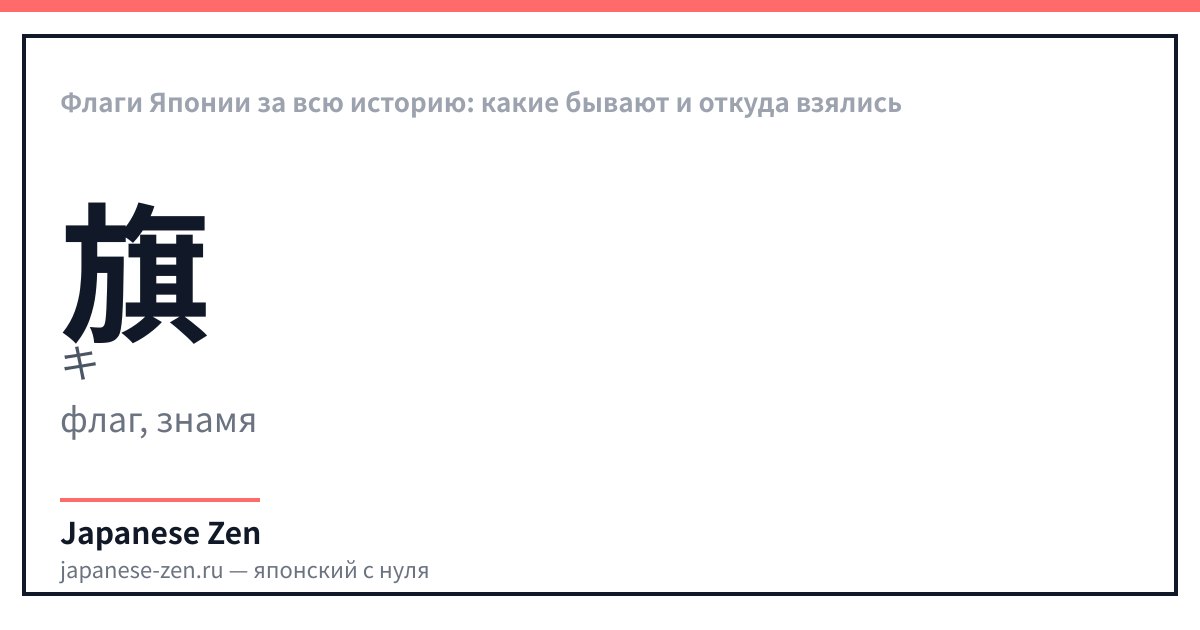
旗 — значение: flag, banner — онъёми: キ — кунъёми: はた — 14 штрих(ов). 旗 — "flag, banner": 14 strokes, an N1-level character. The same root appears in 国旗 (kokki, "national flag") and 旗艦 (kikan, "flagship").
| Japanese | Reading | Translation |
|---|---|---|
| 日章旗 | Nisshōki · Nisshōki | Official name of the flag of Japan |
| 日の丸 | Hinomaru · Hinomaru | Colloquial name for the same flag — "sun circle" |
| 国旗 | kokki · kokki | National flag |
| 旭日旗 | kyokujitsuki · kyokujitsuki | Rising Sun flag — the military variant |
| 家紋 | kamon · kamon | Family crest, including on battle banners |
| 赤 | aka · aka | Red — the color of the sun disc on the flag |
Write 旗 along the guides — the character for "flag" from 日章旗.
Where else the character 章 appears
章 in 日章旗 is read しょう and by itself means "sign, emblem, chapter of a text". In everyday life you will encounter it more often in words like 文章 (bunshō, "text, article") or 勲章 (kunshō, "order, decoration") rather than in discussions of flags — there people almost always say simply 日の丸.
Where Japanese flags appear in anime and games
Flags rarely become the main theme of a plot, but they appear on screen often — especially where the action is tied to military history.
- Zipang (2004, Studio Deen, 26 episodes) — the crew of a modern Maritime Self-Defense Force destroyer is transported to the time of World War II and encounters the Japanese fleet under the Rising Sun flag.
- Total War: Shogun 2 — a strategy game where troops on the battlefield are distinguished precisely by sashimono flags bearing the daimyo's crest on the back of each infantryman.
- Golden Kamuy — a manga and anime about a veteran of the Russo-Japanese War in early 20th-century Hokkaido, whose setting is dotted with flags of the young imperial army.
FAQ
- What flags has Japan had throughout history?
- The main one is the Hinomaru, the sun disc, the official national flag since 1999. Besides it, the country has known the military Rising Sun flag with sixteen rays, the family crests (mon) on samurai banners, and, since the 20th century, the flags of the 47 prefectures.
- When did the flag of Japan become official?
- On August 13, 1999, with the passage of the Law on the National Flag and Anthem. Before that, the Hinomaru had been used for a century and a half by custom and separate decrees — since 1854 on ships, since 1870 as the flag of the merchant fleet.
- How does the Rising Sun flag differ from the Hinomaru?
- The Hinomaru is simply a red circle on a white field, the national flag of the country. The Rising Sun flag is its military variant with sixteen radiating rays; today it is the flag of the Maritime Self-Defense Force, and in Korea and China it is perceived as a symbol of militarism.
- How is "flag of Japan" written in kanji?
- 日章旗, read にっしょうき — the official legal name of the flag. It is made up of 日章 "sun disc" and 旗 "flag". In conversation the flag is almost always called more simply — 日の丸 (Hinomaru), "sun circle".
- What are mon and sashimono?
- Mon (家紋) is the family crest of a Japanese house, applied to clothing, tableware, and battle banners. Sashimono (指物) is a small flag with the daimyo's crest that each ordinary samurai of the Sengoku period wore on his back for identification.
- Where do Japanese flags appear in anime?
- In Zipang, the crew of a modern ship encounters the Japanese fleet of World War II under the Rising Sun flag. In games like Total War: Shogun 2, troops on the battlefield are distinguished precisely by sashimono flags bearing the daimyo's crest.
Sources
Updated: 2026-09-11