The Japanese Imperial Seal: Why the Chrysanthemum Became a National Symbol
Japan has no coat of arms established by law — and that is itself a direct answer to the question about Japan's national emblem. The place of a state symbol is taken by the 16-petaled chrysanthemum — the personal mark of the imperial house — while the government uses a different emblem, the paulownia flower. The difference is visible even on the passport: it bears not the imperial version but a simplified single-layer variant of the same chrysanthemum.
It seems that a country with such a long history should have its coat of arms enshrined in the constitution — yet in reality the chrysanthemum on passports and medals rests on centuries-old custom, not law. Let's look at where the imperial flower came from, what the paulownia on coins has to do with it, and why the chrysanthemum was subjected to legal control as early as the Meiji era.
Chrysanthemum, Paulownia, and the Coat of Arms That Doesn't Exist by Law
Japan has no legislatively defined national coat of arms: no current law names the chrysanthemum or anything else as the official symbol of the country. By custom, the place of the coat of arms is taken by the 十六葉八重表菊 — a 16-petaled, double-layered chrysanthemum, the personal mark of the emperor and the imperial family. The government, meanwhile, has its own separate emblem — the paulownia flower 五七桐: it is used by the cabinet, the government, and the prime minister's office.
| Symbol | Who uses it | Where it appears |
|---|---|---|
| 16-petaled chrysanthemum (菊の御紋) | The Emperor and the imperial family | Residences of Japanese diplomatic missions abroad, orders and medals |
| 16-petaled single chrysanthemum | The state — as a mark on documents | Cover of the passport since 1926 |
| Paulownia (五七桐) | Cabinet, government, prime minister's office | Official government symbols, 500-yen coin |
The Chrysanthemum on the Passport Is Not the Imperial Version
On the cover of a Japanese passport is not the same mark as the emperor's, but a simplified version: a single, not double-layered, 16-petaled chrysanthemum. The design appeared in 1926 as a technical solution: the 1920 International Passport Conference required printing the state coat of arms on the cover. And Japan simply had no established coat of arms then, just as it has none now.
From Emperor Go-Toba to the Edicts of the Meiji Era
The chrysanthemum was known in Japan for decorations and clothing since the Nara period, when it was brought from China. It became a personal mark under the retired Emperor Go-Toba at the turn of the 12th–13th centuries: he loved the flower and marked his personal belongings with it, and the next several sovereigns adopted the custom. Over time, it was precisely the 16-petaled, double-layered chrysanthemum that became associated with the imperial house — not by decree, but by long-standing court habit. Hence the metonymy 'Chrysanthemum Throne' for the throne of the Japanese emperors, used in both English and other languages.
- 1868–1869 — edicts of the new Meiji government for the first time officially assigned the 16-petaled chrysanthemum to the imperial house and restricted its use by others.
- 1871 — a separate edict forbade the chrysanthemum to everyone except the imperial family, and ordered junior branches to use a reduced 14-petaled version.
- 1926 — these rules were reinforced by an edict on court ceremonial, which remained in force until its abolition after the war.
- December 31, 1947 — all pre-war restrictive edicts lost force along with the system of court edicts itself.
The Order of the Chrysanthemum
In 1876, Japan established its highest state award — the Order of the Chrysanthemum, and in 1888 added a senior degree — the Collar of the Order of the Chrysanthemum. Nothing ranks higher than this award in the Japanese honors system to this day.
菊 — A Flower with a Single Reading
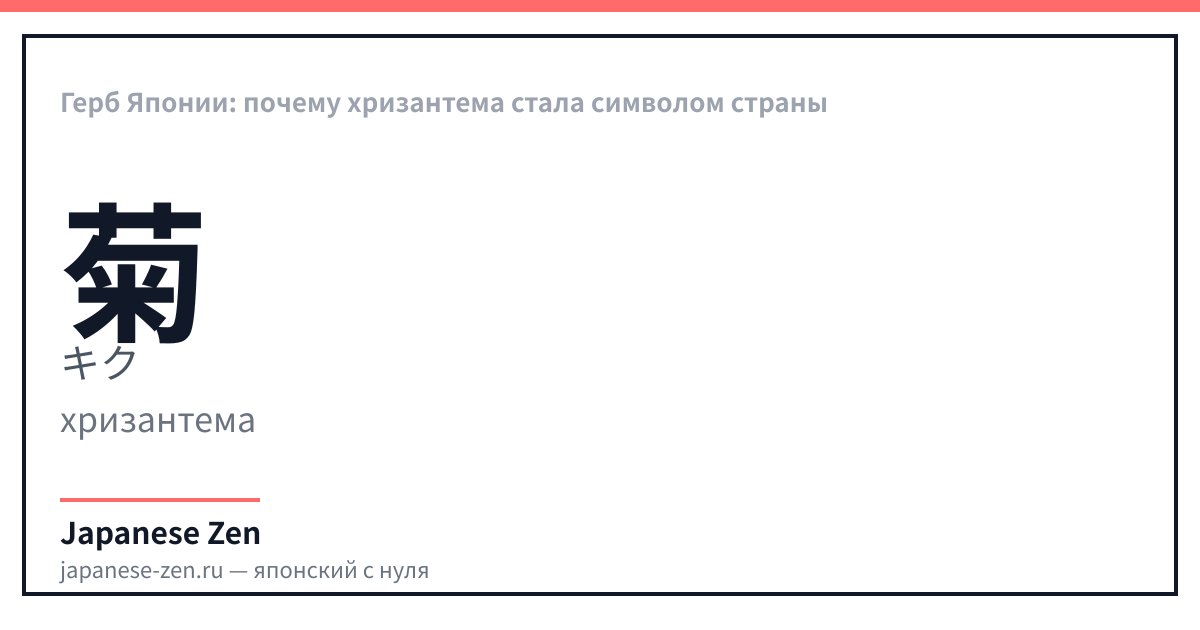
菊 — значение: chrysanthemum — онъёми: キク — 11 штрих(ов). 菊 — 'chrysanthemum': this character does not appear in any other meaning, and its current association with the imperial house goes back to the personal tastes of Emperor Go-Toba.
菊花紋章 — 'chrysanthemum flower emblem': 菊花 (kikka) — 'chrysanthemum flower', 紋章 (monshō) — 'coat of arms, emblem'. The family crests of individual Japanese families are called by a similar word — 家紋 (kamon), while the character 紋 (mon) itself simply means 'pattern, crest' and is used in dozens of similar words.
How 菊 Is Read
菊 is read in only one way — キク (kiku), the on'yomi reading with no native Japanese alternative. The word sounds so natural that it seems like a native word, but this character simply has no separate kun reading.
| Japanese | Reading | Translation |
|---|---|---|
| 菊花紋章 | kikka monshō · kikka monshō | The chrysanthemum emblem — the mark of the imperial house |
| 菊 | kiku · kiku | Chrysanthemum |
| 桐 | kiri · kiri | Paulownia — the flower on the government emblem |
| 家紋 | kamon · kamon | Family crest of a Japanese family |
| 紋 | mon · mon | Crest, pattern |
| 菊の御紋 | kiku no gomon · kiku no gomon | Colloquial name for the imperial chrysanthemum |
Write 菊 along the guides — the character for the chrysanthemum that became a symbol of Japan.
Law, Sun, and Prohibition: Three Mistakes About the Coat of Arms
What the Law Actually Says
- 'The chrysanthemum is the state coat of arms by law.' No: no current Japanese law names it the country's coat of arms — it is a custom, not a legal norm, unlike, for example, the flag and anthem, which received a separate law in 1999.
- 'Japan's coat of arms is the sun.' The red solar disk — the Hinomaru — is a flag, not a coat of arms: two different symbols with different histories and different legal status.
- 'Using the chrysanthemum is still forbidden by law.' The pre-war edicts that punished unauthorized use of the chrysanthemum lost force back in 1947. Today the mark is protected differently — as a trademark: a similar emblem simply cannot be registered as a trademark, and since 1967 this rule has applied in other countries party to the Paris Convention.
FAQ
- Does Japan have a coat of arms?
- Formally, no — no Japanese law declares any symbol to be the country's coat of arms. Instead, for many centuries the 16-petaled chrysanthemum, the personal symbol of the imperial house, has served that role, and the government additionally uses its own separate emblem — the paulownia flower.
- Why is the chrysanthemum a symbol of Japan?
- The retired Emperor Go-Toba chose the chrysanthemum as his personal mark at the turn of the 12th–13th centuries, and subsequent sovereigns adopted the custom. Over time, the 16-petaled flower became associated with the imperial house simply by virtue of centuries-old court tradition, not a separate decree.
- What is depicted on Japan's coat of arms?
- The de facto coat of arms shows a stylized chrysanthemum with 16 petals arranged in two rows. The government, meanwhile, has a separate emblem — the paulownia flower, used by the cabinet and the prime minister's office.
- What is the flower on the Japanese passport?
- The same 16-petaled chrysanthemum, but in a simplified, single-layer form — not the imperial version, but a stylized national mark. It was adopted in 1926 to comply with an international requirement to print the state coat of arms on the passport cover.
- How does the coat of arms differ from the Japanese flag?
- The Hinomaru flag is a red solar disk, officially established by law in 1999. The chrysanthemum is a mark of the imperial family without a separate law, playing the role of a coat of arms only by custom. These are two different symbols with different histories.
- How do you say 'chrysanthemum' in Japanese?
- 菊, read as きく (kiku). This character has only one reading — it is so familiar that it sounds like a native Japanese word, although formally it is a reading borrowed from Chinese. The same character appears in the name of the emblem 菊花紋章, which is associated with the imperial house.
Sources
Updated: 2026-09-14