Japanese Fans: Sensu, Uchiwa and Tessen — What's the Difference
A Japanese fan is not one object but several different things: the folding sensu (扇子), the flat non-folding uchiwa (団扇), and the combat tessen (鉄扇) are built and named differently. The general word for a fan is 扇 (ōgi). Many historians consider Japan the birthplace of the folding fan: written sources and finds more often point to it than to China or Korea, though the debate has been going on for a long time.
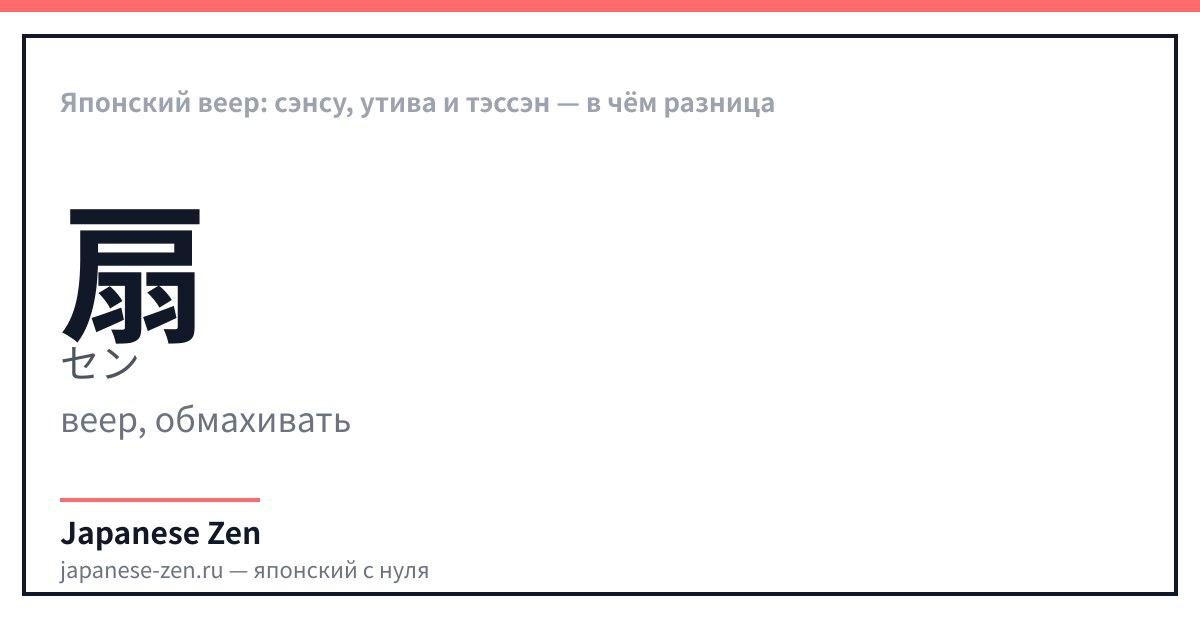
The folding fan in the hand of a rakugo storyteller and the heavy combat fan of a samurai have almost nothing in common except one root — the kanji 扇. Let's look at exactly how Japanese fans differ from one another, where the word "ōgi" came from, and why the myth of the "fan language" actually came from Europe, not Japan.
Sensu, uchiwa, gunbai and others — how they differ
| Type | Writing | Construction | Where it is used |
|---|---|---|---|
| Sensu (ōgi) | 扇子 / 扇 | Folding, on thin ribs | Everyday use, etiquette, rakugo |
| Uchiwa | 団扇 | Flat, on a handle, does not fold | Summer festivals, fanning away the heat |
| Gunbai | 軍配 | Rigid, paddle-shaped, does not fold | Commander's signals in battle; today — the sumo referee's fan |
| Mai-ōgi | 舞扇 | Folding, weighted | Japanese dance nihon-buyō, kabuki |
| Hiōgi | 檜扇 | Hinoki cypress slats on a cord | Ceremonial fan of the Heian-era nobility |
A separate topic is the combat fan tessen (鉄扇) with an iron frame inside an ordinary-looking fold: it is a weapon disguised as a peaceful accessory.
Is the folding fan a Japanese invention?
The flat non-folding uchiwa fan was invented in China before the Common Era, and this is not disputed. But the folding fan has been debated for centuries between the Japanese, Korean, and Chinese versions. The arguments in favor of Japan are stronger: the earliest folding fan found, a hiōgi, is dated to 877, and the Chinese chronicle "Song Shi" describes how in 988 a Japanese envoy presented twenty folding hiōgi fans to the Song emperor. Some 16th-century Chinese authors wrote directly that before the Song era China had no folding fans of its own.
Where fans are still needed today
Uchiwa are handed out at summer matsuri festivals as a light souvenir against the heat. The sensu is the working tool of a rakugo storyteller: with the same folded fan he depicts on the fly now chopsticks, now a letter. The weighted mai-ōgi is held by nihon-buyō dancers and kabuki actors, and in Noh theater the fan is an obligatory part of the costume for almost any role. Today the gunbai is recognized primarily from big sumo: with this rigid fan the referee-gyōji announces the start and the outcome of a bout.
The fan as a gift
In the old days, a white fan was given to loved ones at New Year — a custom known since the Edo period. A ceremonial folding fan is still appropriate as a gift for a wedding or other celebration.
扇 — the door that became a fan
扇 — значение: fan, to fan — онъёми: セン — кунъёми: おうぎ — 10 штрих(ов). 扇 — "fan": the same character stands first in the word 扇風機 (senpūki), "electric fan," literally "fan-wind-machine."
扇 is composed of 戸 "door, leaf" and 羽 "feathers": according to the idea of the character, a light door leaf flaps like a wing. Originally the kanji really did denote a light door, and only later, by similarity, came to mean a fan — first a non-folding one, and after that a folding one as well.
Why an electric fan is a "fan-wind-machine"
扇風機 (senpūki) — an electric fan — literally breaks down into three characters: 扇 "fan," 風 "wind," and 機 "mechanism, machine." The word appeared when the device was still perceived as a mechanical replacement for hand fanning.
| Japanese | Reading | Translation |
|---|---|---|
| 扇子 | sensu · sensu | Folding fan |
| 団扇 | uchiwa · uchiwa | Flat non-folding fan |
| 扇 | ōgi · ōgi | Fan — the general word |
| 扇風機 | senpūki · senpūki | Electric fan |
| 軍配 | gunbai · gunbai | Rigid fan of a commander and a sumo referee |
| 舞扇 | maiōgi · maiōgi | Fan for Japanese dance |
Write 扇 along the guides — the character for "fan," in which a door became a wing.
A woman's thing, folding only, and the "fan language": myths
Who actually used a fan
- "A fan is a woman's thing only." In fact, a white folding fan was part of formal men's attire, the combat fan was carried by male commanders, and the sumo referee today is always a man with a rigid gunbai fan in his hand.
- "All Japanese fans fold." Uchiwa and gunbai are built quite differently: both have a rigid, non-folding form on a handle, and this is not a rare exception but separate, widely spread types of fan.
- "Geisha talked to each other with fans." A whole language of conventional fan gestures is a real tradition, but a European one, from the 18th–19th centuries. Japan has its own fan etiquette, but these are rules of politeness, not a secret alphabet.
FAQ
- What is a Japanese fan called?
- In Japanese a fan has a general name — 扇 (ōgi), but in everyday speech more specific names for each type are heard more often. A folding fan is called sensu, a flat and rigid one is uchiwa, and one with a hidden iron frame is tessen. These are different objects, not variants of one word.
- How does sensu differ from uchiwa?
- Sensu folds and fits in a sleeve or behind a belt; uchiwa is flat, rigid, and held on a handle, not folding at all. In summer at festivals it is usually uchiwa that is handed out as a disposable souvenir, while sensu is carried around constantly, like an ordinary accessory.
- What is the fan used for in rakugo?
- A rakugo storyteller uses the same folded sensu fan to depict, as the story goes, now chopsticks, now a letter, now another object — it is the only prop he has besides a handkerchief. There are no other stage sets or costume changes.
- What is a combat fan?
- Tessen (鉄扇) is a fan with an iron frame inside, indistinguishable from an ordinary one on the outside: it was taken where a sword was not allowed. A separate rigid fan, the gunbai, was used by commanders for signals on the battlefield.
- How is "fan" written in Japanese?
- 扇, read おうぎ (ōgi). The character is composed of 戸 "door" and 羽 "feathers": a light door leaf that flaps like a wing — hence the shift in meaning to a fan. The same character also stands in the first syllable of the word "electric fan" — 扇風機.
Sources
Updated: 2026-09-14