Rakugo — the Japanese storyteller with a fan and a towel: what kind of genre is this
Rakugo is a Japanese comic solo genre: a single storyteller in a kimono, seated on a zabuton cushion, plays all the characters of the story at once, using only a sensu folding fan and a tenugui towel. The genre took shape in the 17th century in three cities — Kyoto, Osaka, and Edo — and today it is performed in dedicated yose halls across Japan.
A rakugo storyteller never leaves the cushion and never changes costume, yet within ten minutes he can play feuding neighbors, a couple in love, and a hapless servant — using only his voice, a turn of the head, and a gesture. Let's look at where the word "rakugo" comes from, how Edo rakugo differs from Osaka rakugo, and which anime to start with if the genre has caught your interest.
One person, a cushion, and a dozen voices
The rakugo storyteller, or rakugoka (落語家), sits on a zabuton cushion and tells the story alone: by changing the pitch of his voice and the angle of his body, he plays all the characters at once, without makeup or scenery. His props are a sensu folding fan (扇子), which before the audience's eyes turns into chopsticks or a letter, and a tenugui towel (手ぬぐい) — now a wallet, now a book.
The genre traces its lineage to the monk Anrakuan Sakuden: in 1623 he published in Kyoto a collection called "Laughter Through Sleep" with a thousand short stories, each with an unexpected twist. The profession took shape a little later, in the Genroku era at the end of the 17th century, in three cities at once: in Kyoto street stories were told by Tsuyu-no Gorobei, in Osaka by Yonezawa Hikohachi, and in Edo by Shikano Buzaemon. Within the profession there are three ranks: the beginner zenza (前座), then futatsume (二つ目), and finally shinuchi (真打) — a status that grants the right to close the evening program.
Edo rakugo and Kamigata rakugo: how Tokyo and Osaka differ
Yose halls (寄席) for paid performances appeared at the end of the 18th century in both Edo and Osaka, but the style of storytelling diverged. Osaka rakugo, kamigata, uses a small kendai table, wooden clappers, and music during the story. Edo — Tokyo — rakugo relies on the bare voice and restraint, without extra props.
落語 — a story that "falls" into its punchline
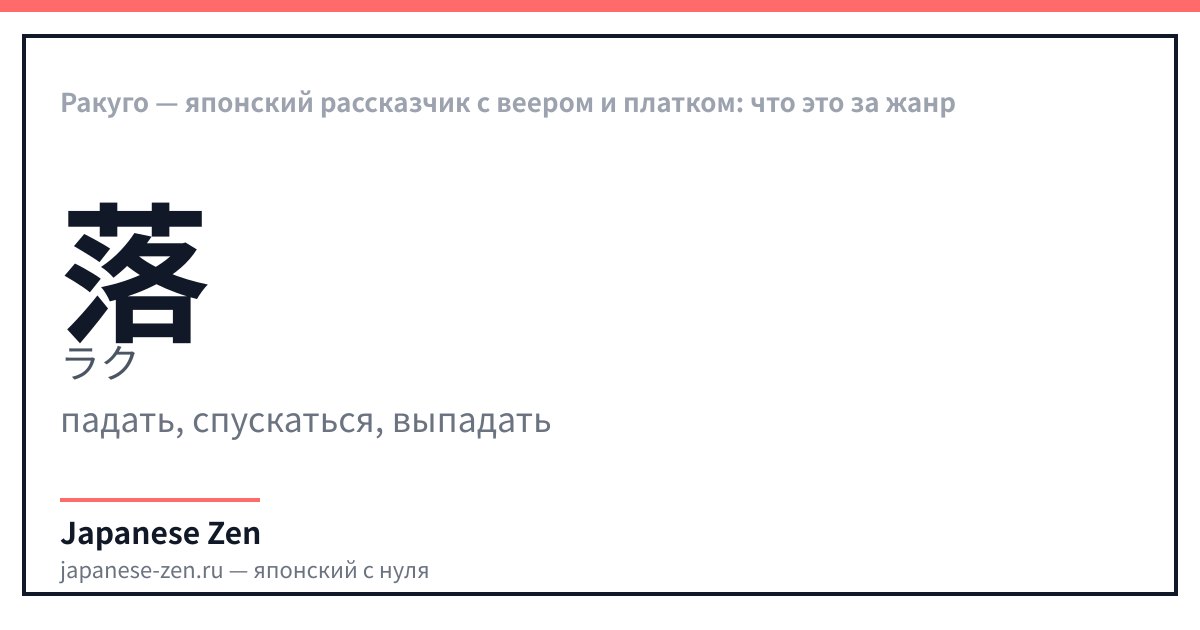
落 — значение: to fall, to descend, to drop — онъёми: ラク — кунъёми: お.ちる、お.ち、お.とす — 12 штрих(ов). 落 — "to fall": the same character appears in the ordinary verb 落ちる (ochiru) "to fall, to descend." In the word 落語 it refers to how the story "falls" into an unexpected ending.
Rakugo literally means "falling story": 落 "to fall" plus 語 "story, speech." The story "falls" into its punchline — the ochi (落ち), a short and unexpected twist in the final phrase that changes the meaning of everything heard before. The word "rakugo" itself became established as the name of the genre only in the Meiji era, although stories with an ochi had been told for centuries before.
What is an "ochi"
Ochi are constructed in different ways: through wordplay, through an unexpected logical reversal, or through absurdity that pushes the situation to the point of nonsense. The listener does not know until the final phrase how it will end — and that is what holds all the attention to the story.
| Japanese | Reading | Translation |
|---|---|---|
| 落語 | rakugo · rakugo | Rakugo |
| 落語家 | rakugoka · rakugoka | Rakugo storyteller |
| 落ち | ochi · ochi | Punchline, final twist of the story |
| 寄席 | yose · yose | Hall for rakugo performances |
| 扇子 | sensu · sensu | Folding fan, the storyteller's prop |
| 手ぬぐい | tenugui · tenugui | Cotton towel, the second prop |
Write 落 along the guides — the character "to fall" from the word 落語.
Rakugo in anime and manga
- "Showa Genroku Rakugo Shinju" — a manga by Kumota Haruko, serialized in the magazine "ITAN" from 2010 to 2016. The anime by studio Deen aired in two seasons, in 2016 and 2017, and shows in detail the behind-the-scenes life of the profession — from zenza to shinuchi.
- "Akane-banashi" — a manga by Suenaga Yuki and artist Bajo Takamasa, running in "Weekly Shōnen Jump" since 2022; the anime by studio Zexcs aired in 2026. The heroine follows her rakugoka father's path toward the rank of shinuchi.
Where to start listening
A classic story for a first encounter is "Jugemu" (寿限無): a father gives his son one absurdly long tongue-twister of a name made of good-luck wishes, and the whole story then builds on the fact that this name has to be said in full again and again.
FAQ
- What is rakugo?
- A Japanese comic solo genre: a storyteller in a kimono sits on a zabuton cushion and alone plays all the characters of the story, using only a fan and a towel as props. The ending is built around the ochi — an unexpected, witty punchline.
- Which anime about rakugo should I watch?
- "Showa Genroku Rakugo Shinju" by studio Deen (2016–2017) — a drama about the lives of two storytellers within the profession, from zenza to shinuchi. "Akane-banashi" by studio Zexcs (2026) tells of a girl who pursues the same rank following in her father's footsteps.
- What does the word "rakugo" mean?
- Literally "falling story": 落 "to fall" and 語 "story." The story "falls" into the ochi punchline — an unexpected twist in the final phrase, for the sake of which the whole tale was told. The name of the genre became established in the Meiji era.
- What does a rakugo storyteller hold in his hands?
- A sensu folding fan and a tenugui cotton towel — from these two objects the storyteller improvises chopsticks, a letter, a wallet, or a book, without leaving the zabuton cushion or changing costume. There are no other props on stage: no scenery, no makeup, no change of clothes during the story.
- Who is considered the founder of rakugo?
- The monk Anrakuan Sakuden, author of the collection of short stories with punchlines "Laughter Through Sleep" (1623). Professional storytellers appeared a little later, at the end of the 17th century, in Kyoto, Osaka, and Edo at once: Tsuyu-no Gorobei, Yonezawa Hikohachi, and Shikano Buzaemon.
Sources
Updated: 2026-09-14