Daimyo — who they were and what they did
Daimyo were major military landowners of medieval and early modern Japan: the right to the title came from a domain yielding at least 10,000 koku of rice a year — enough rice to feed 10,000 people for a year. The word 大名 literally means "great name"; the usual English spelling is daimyo, and the form does not change between singular and plural. The class evolved from appointed shugo governors and self-made Sengoku daimyo to Tokugawa-controlled Edo lords, and was abolished in 1869–1871.
When the word "daimyo" appears in chronicles or a strategy game, it stands for one of several hundred men who divided among themselves all the rice-growing land of Japan. The meaning of the word changed over four centuries — from appointed governors through self-made conquerors like those who led the country to the Battle of Sekigahara, to lords obliged to bow to the shogun twice a year. We look at who the daimyo were in each era and where the class went when Japan became a Western-style empire.
Who the daimyo were and what they did
Daimyo (大名) were major military landowners of Japan whose domain yielded at least 10,000 koku of rice a year: that was enough to feed 10,000 people for a year. The usual English spelling is daimyo, and the form does not change between singular and plural. The daimyo stood at the top of the bushi warrior class — below the shogun but above ordinary samurai and hatamoto vassals. Over four centuries the rules of succession changed three times: from appointed governors to self-made warlords of the age of war, and then to Tokugawa-controlled lords.
- Duties — to govern the domain (han), maintain an army of samurai vassals, oversee the collection of the rice tax from peasants, and in the Edo period also serve at the shogun's court.
- Income — measured in koku of rice: a minimum of 10,000 for the title of daimyo, and orders of magnitude more for the wealthiest houses.
- Status — the top of the bushi class: above ordinary samurai and hatamoto vassals, but below the shogun, to whom they swore allegiance.
How one became a daimyo
Over four centuries the word "daimyo" meant different things depending on how a man gained power over land — by appointment from above, by force from below, or by confirmation from the shogun.
| Era | Period | How they came to power |
|---|---|---|
| Shugo daimyo | Muromachi, 14th–15th centuries | Military governors (shugo) appointed by the Ashikaga shogunate secured provinces for themselves and passed them on by inheritance. |
| Sengoku daimyo | 1467 — late 16th century | Seized power by force, often overthrowing their own overlords — gekokujo, "the low overcome the high." |
| Edo daimyo | 1603–1868 | Confirmed by the Tokugawa shoguns; divided into shimpan, fudai, and tozama, and obliged to observe sankin kotai. |
In the Sengoku period weak overlords often lost their lands to their own vassals — gekokujo (下剋上), "the low overcome the high." The Edo daimyo, by contrast, were built into the Tokugawa system: shimpan (relatives of the shogun), fudai (vassals from before Sekigahara), and tozama (those who swore allegiance later, often the wealthiest — like the Maeda house with an income of over a million koku in Kaga). From 1635, under Shogun Iemitsu, all daimyo were obliged to observe sankin kotai — to live alternately in their domain and in Edo, leaving their families there during absences.
The word and the kanji: 大名
How it is read and what it literally means
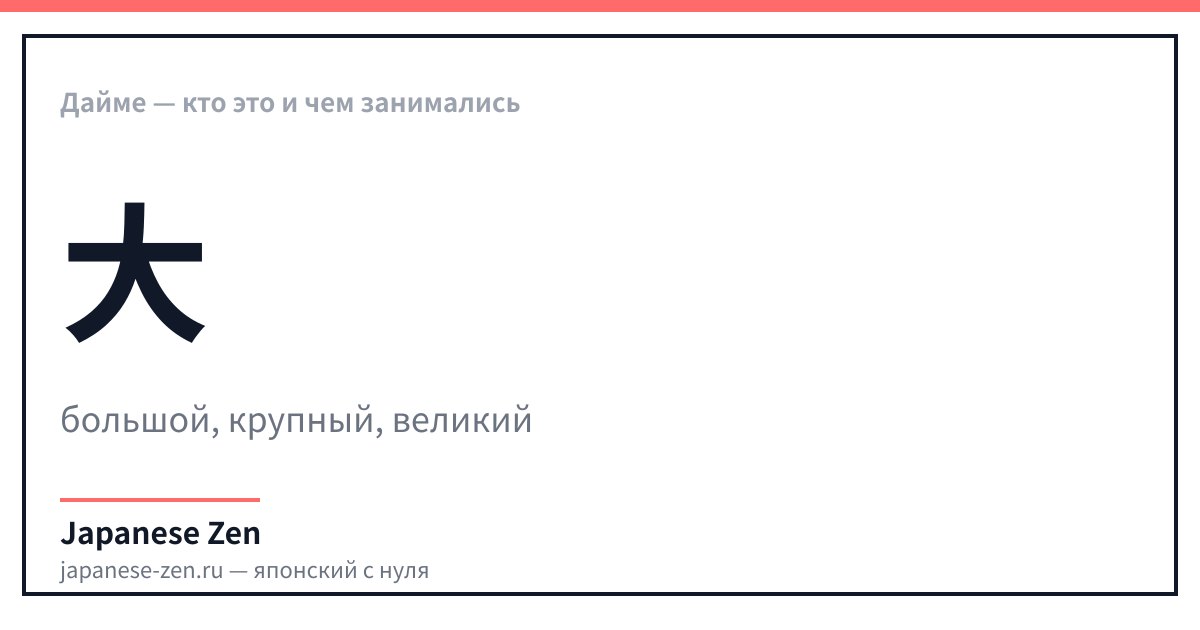
大名 is read だいみょう (daimyō) and is made up of two characters: 大 (dai, "big," N5) and 名 (myō, "name," N5) — literally "great name," as opposed to small holdings, which were called 小名 (shōmyō, "small name").
大 — значение: big, large, great — онъёми: ダイ、タイ — кунъёми: おお-、おお.きい、-おお.いに — 3 штрих(ов). 大 — "big": 3 strokes. The same character appears in 大丈夫 (daijōbu, "all right") and 大学 (daigaku, "university").
Headlines and search queries use the spelling "daimyo" — that is how people most often search. The more precise form is daimyō: the word is not inflected, and there is no separate plural form — "one daimyo" and "several daimyo" are written the same way, like "kimono" or "karate."
| Japanese | Reading | Translation |
|---|---|---|
| 大名 | daimyō · daimyō | The word this page is about |
| 将軍 | shōgun · shōgun | The supreme military ruler to whom the daimyo were subordinate |
| 旗本 | hatamoto · hatamoto | A vassal of the shogun with an income of less than 10,000 koku |
| 家臣 | kashin · kashin | A samurai vassal in the service of a daimyo |
| 藩 | han · han | A daimyo's domain in the Edo period |
Listen to how daimyo and related words sound, and repeat them aloud.
Are there daimyo today?
The class ended in two legal steps. In 1869 came hanseki hokan (版籍奉還) — the daimyo returned their lands and population registers to the emperor. In 1871 the decree haihan chiken (廃藩置県) abolished the domains themselves: 261 han were replaced by prefectures with governors from Tokyo, and former daimyo moved to the new capital.
Former daimyo and court nobility made up the kazoku (華族) — a new Japanese peerage. It lasted until 1947, when it was abolished by the postwar constitution: since then there have been no hereditary titles in Japan. Individual houses left behind museums and descendants' collections — for example, the Tokugawa Museum in Nagoya holds the collection of the Owari-Tokugawa family.
Daimyo in games and anime
- Nobunaga no Yabou ("Nobunaga's Ambition," since 1983) — a long-running Koei strategy series in which the player takes on the role of a daimyo and manages a domain: economy, army, and diplomacy in pursuit of unifying the country.
- Total War: Shogun 2 — a Creative Assembly strategy game in which the player leads a samurai clan as its daimyo, combining a turn-based campaign map with real-time battles of the Sengoku period.
- Gintama — a comedic anime and manga about samurai in a Japan invaded by aliens; among its grotesque characters are parodies of historical daimyo and shogunate officials.
What games and anime embellish
Strategy games turn domain management into the player's personal feat, whereas real Edo daimyo spent years settling bureaucracy and observing sankin kotai, and made decisions together with advisers and the clan. Parodies like Gintama play on contrast: the more absurd the daimyo, the funnier the joke, and they promise no accuracy.
FAQ
- Who were the daimyo?
- Daimyo were major military landowners of medieval and early modern Japan. The right to the title came from a domain yielding at least 10,000 koku of rice a year — enough rice to feed 10,000 people for a year. The daimyo stood at the top of the bushi class, subordinate only to the shogun.
- What did the daimyo do?
- The daimyo governed their own domain (han): they collected the rice tax, maintained an army of samurai vassals, and were responsible for order on their land. In the Edo period this was joined by service at the shogun's court and sankin kotai — living alternately in Edo and in their domain.
- How is the word "daimyo" written in Japanese?
- 大名, read だいみょう (daimyō). The character 大 (dai) means "big," and 名 (myō) means "name" — together, "great name," as opposed to small holdings — 小名 (shōmyō).
- Are there daimyo now?
- No. The class was abolished in 1869–1871: first the daimyo returned their lands to the emperor, then their domains were replaced by prefectures. Former daimyo became kazoku — a new peerage, which was also abolished in 1947. Today museums and descendants' collections keep their memory alive.
- How did the daimyo differ from the shogun?
- Tokugawa Ieyasu (1543–1616) was himself a daimyo until 1603, when he became shogun — the supreme ruler to whom the other daimyo were subordinate. After that he and his descendants decided which category each house belonged to and who was obliged to observe sankin kotai.
- How are the daimyo shown in games and anime?
- The player takes on the role of a daimyo in the strategy games Nobunaga no Yabou and Total War: Shogun 2, managing a domain and an army. In the comedy anime Gintama there are parodies of historical daimyo and shogunate officials.
Sources
Updated: 2026-09-11