Tokugawa Ieyasu — who he was and what he is famous for
Tokugawa Ieyasu was a Japanese military commander and statesman (1543–1616), the third and last of the unifiers of a Japan torn apart by war. After defeating his rivals at Sekigahara in 1600, he became shogun in 1603 and founded a system of government that ruled the country until 1868. As early as 1615, after the siege of Osaka and the death of the Toyotomi heirs, the unification of Japan was finally complete.
Of the three unifiers of Japan, Tokugawa Ieyasu ultimately gained the most — not because he was luckier, but because he outlived both rivals and knew how to wait longer. He had to wait not only for his competitors' deaths: in 1579, to secure an alliance with Nobunaga, Ieyasu forced his own eldest son to commit seppuku. The shogunate he eventually founded lasted more than two and a half centuries — longer than any other military government in Japanese history.
Who Tokugawa Ieyasu really was
Tokugawa Ieyasu (徳川家康, 1543–1616) was a military commander and statesman, the third and last of the unifiers of a Japan torn apart by war, following Oda Nobunaga and Toyotomi Hideyoshi. He spent his childhood as a hostage at the courts of the Oda and Imagawa, as an adult was an ally of Nobunaga, and after the deaths of both rivals defeated their heirs at Sekigahara in 1600. In 1603 he received the title of shogun from the emperor, and in 1605 formally passed it to his son Hidetada, but continued to rule the country as ōgosho until his death in 1616.
| Year | Event |
|---|---|
| 1543 | Birth in Okazaki, birth name — Matsudaira Takechiyo |
| 1547–1560 | Hostage of the Oda and Imagawa clans |
| 1560 | Okehazama: death of Imagawa Yoshimoto, alliance with Oda Nobunaga |
| 1573 | Defeat by Takeda Shingen at Mikatagahara |
| 1582 | Death of Nobunaga at Honnōji; beginning of rivalry with Toyotomi Hideyoshi |
| 1584 | Komaki and Nagakute — campaign against Hideyoshi |
| 1590 | Transfer to Kantō, headquarters moved to Edo |
| 1600 | Victory at Sekigahara, October 21 |
| 1603 | Title of shogun, founding of the Tokugawa shogunate |
| 1605 | Title passed to son Hidetada; rule as ōgosho |
| 1614–1616 | Sieges of Osaka, death of Hideyori; death of Ieyasu, deification as Tōshō Daigongen (Nikkō Tōshō-gū mausoleum) |
What he built after the victory
Ieyasu was not only concerned with war. In 1579, to preserve his alliance with Nobunaga, he ordered the death of his wife Tsukiyama-dono and forced his son Matsudaira Nobuyasu to commit seppuku. Both were suspected of secret dealings with the Takeda clan, but historians still dispute the degree of their guilt. Already having stepped back from direct rule, in 1615 Ieyasu as ōgosho dictated codes of law for the daimyo and for the court — the Buke Shohatto and the Kinchū Narabini Kuge Shohatto — which cemented the shogunate's control for two and a half centuries. He was also seriously interested in pharmacology: he studied Chinese medical texts and made his own remedies, with which he once cured his seriously ill grandson Iemitsu.
Name and kanji: 徳川家康
The full name 徳川家康 is read とくがわいえやす (Tokugawa Ieyasu) and splits into the clan name 徳川 (Tokugawa) and the personal name 家康 (Ieyasu). He was born a Matsudaira and only in 1566 changed his surname to Tokugawa, claiming descent from the Nitta clan — a branch of the ancient Minamoto clan: without such kinship, by tradition one could not lay claim to the title of shogun. Historians consider this genealogy most likely a later political construct rather than an accurate lineage.
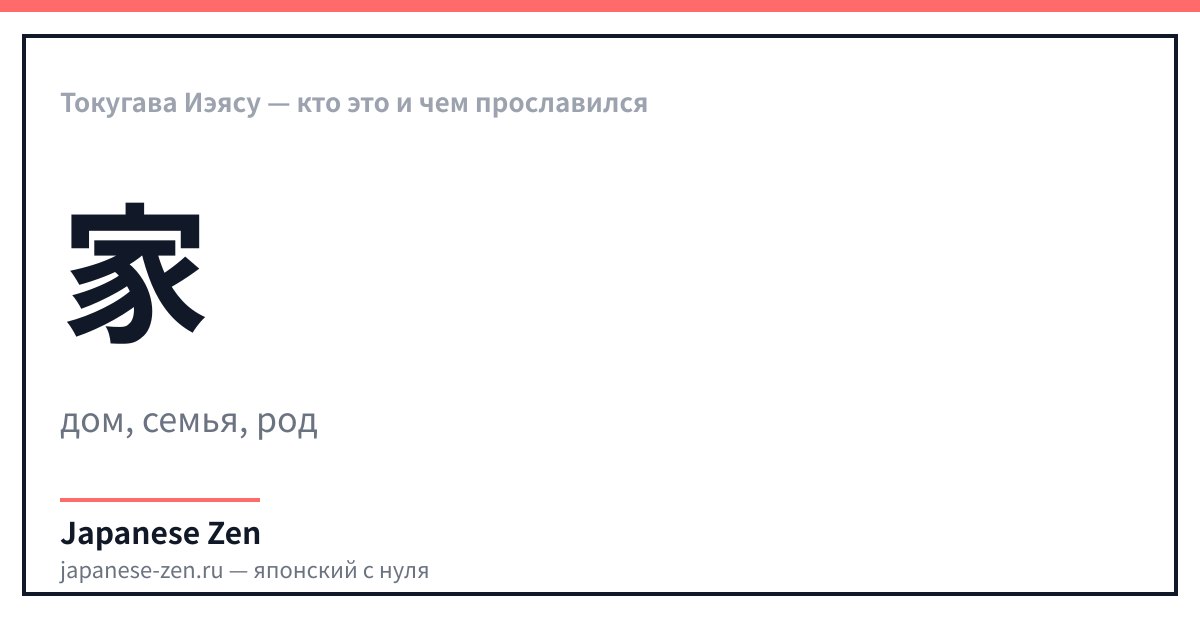
家 — значение: house, family, clan — онъёми: カ、ケ — кунъёми: いえ、や、うち — 10 штрих(ов). 家 — 'house, family, clan': 10 strokes. The same character is the first in Ieyasu's personal name (家康), and also in the words 家臣 (kashin, 'vassal', literally 'servant of the house') and 武家 (buke, 'samurai clan').
Why he had four different names
At birth he was named Matsudaira Takechiyo. As a vassal of Imagawa he became Matsudaira Motoyasu — the 'moto' came from the name of his overlord Imagawa Yoshimoto. After breaking his vassalage around 1563, he changed his personal name to Ieyasu, and in 1566 his clan name to Tokugawa. Changing one's name with a change in status was common practice among the samurai nobility, but Ieyasu had a remarkably large number of such changes.
| Japanese | Reading | Translation |
|---|---|---|
| 徳川家康 | Tokugawa Ieyasu · Tokugawa Ieyasu | Name of the page's subject |
| 将軍 | shōgun · shōgun | Supreme military commander, head of the military government |
| 大御所 | ōgosho · ōgosho | Title of one who has stepped back from direct rule but not from the shogun's power |
| 幕府 | bakufu · bakufu | The shogun's military government |
| 江戸 | Edo · Edo | Fortress city that became the capital of his state; today Tokyo |
Listen to the name of the first Tokugawa shogun and words of his time.
Tokugawa Ieyasu in anime, manga and games
- Nobunaga no Yabou ('Nobunaga's Ambition') — Koei's strategy series, where Ieyasu is one of the playable daimyo, not just Nobunaga's rival.
- Samurai Warriors (Sengoku Musou) — Koei Tecmo's action series, where Ieyasu is playable from the first installment and is usually portrayed as a reserved tactician.
- Sengoku Basara — Capcom's series, where Ieyasu is one of the main characters: emphatically calm and level-headed in contrast to his wild allies.
- Nioh — Team Ninja's action game, where Ieyasu is a notable historical figure and guides a foreign protagonist modeled on the real navigator William Adams.
- Nobunaga Concerto — manga, anime and TV drama about a time traveler in Nobunaga's place, where Ieyasu is one of the few characters who visibly ages over the course of the story.
Why he is portrayed as boring
The supernatural threat in Nioh is artistic fiction: the historical Ieyasu had nothing to do with the paranormal. His foreign adviser in the game is modeled on the real navigator William Adams (Miura Anjin), who taught the Japanese shipbuilding and navigation, not fighting yokai. The image of the imperturbable sage who simply waits out the storm in Koei and Capcom games is also a simplification of Ieyasu's real, far harsher politics.
What was attributed to the victor
People remember a saying about a cuckoo that does not want to sing: Nobunaga, according to legend, orders it killed, Hideyoshi will make it sing, and Ieyasu will wait until it sings on its own. These verses are not the actual words of the commanders: they were first recorded in texts of the late 18th to early 19th century, almost two centuries after the death of all three. The image of the 'patient schemer' who simply waits, born from the saying, is also a simplification. Ieyasu's patience meant not inaction but a readiness for harsh decisions — for example, forcing his own son Matsudaira Nobuyasu to commit seppuku in 1579 for the sake of an alliance with Nobunaga.
A similar story surrounds the portrait after Mikatagahara. According to legend, Ieyasu, defeated by Takeda Shingen, fled in fear to Hamamatsu and commissioned his portrait disfigured by fright — the 'shikamizō' (顰像) — to remember the shame of arrogance. The defeat and retreat in 1573 are historical fact, but the connection of this particular portrait with Mikatagahara is not confirmed by sources: in early records it is simply called 'the revered image of Tōshō-gū'. Some historians consider the painting a later icon of worship of the deified Ieyasu, not a reminder of flight.
- True: childhood as a hostage, the victory at Sekigahara, the two sieges of Osaka and the death of Hideyori are documented in chronicles and the Tokugawa Jikki.
- True, but under duress: the death of his wife Tsukiyama-dono and the seppuku of his son Nobuyasu in 1579 — the exact degree of their guilt is disputed by historians.
- Late saying: the verses about the cuckoo concerning Nobunaga, Hideyoshi and Ieyasu are an anonymous composition of the late 18th to early 19th century, not their actual words.
- Simplification: death from tempura is a nice detail, but about three months passed between the feast and his death; the modern version is stomach cancer.
FAQ
- Who was Tokugawa Ieyasu?
- Tokugawa Ieyasu was a Japanese military commander and statesman (1543–1616), the third and last of the unifiers of a fragmented Japan. After defeating his rivals at Sekigahara in 1600, he became shogun in 1603 and founded the Tokugawa shogunate, which lasted until 1868.
- What is Tokugawa Ieyasu famous for?
- Tokugawa Ieyasu is famous as the founder of Japan's longest-lasting military government. The victory at Sekigahara in 1600, the title of shogun in 1603 and the defeat of the Toyotomi clan at the sieges of Osaka in 1614–1615 secured his family's power for two and a half centuries.
- How is the name Tokugawa Ieyasu written in Japanese?
- The name is written 徳川家康 and read とくがわいえやす (Tokugawa Ieyasu). 徳川 (Tokugawa) is the clan name adopted in 1566 in place of the former Matsudaira; 家康 (Ieyasu) is the personal name made up of the characters for 'house, family' (家) and 'peace, well-being' (康).
- Was Tokugawa Ieyasu a real person or a legend?
- Tokugawa Ieyasu was a real historical figure; his life is documented in detail in chronicles of the Edo period. Legends grew up around his posthumous reputation: the verses about the cuckoo, the story of the portrait after Mikatagahara and the image of the impassive schemer are later accretions, not facts.
- How is Tokugawa Ieyasu portrayed in games and anime?
- Tokugawa Ieyasu appears in anime and games about the Sengoku period: the Nobunaga no Yabou and Samurai Warriors series, in Sengoku Basara and in the game Nioh, where he is a notable character. He also appears in the TV drama and anime 'Nobunaga Concerto', where he ages along with the story — unlike most of the characters.
- Where can I read a detailed biography of Tokugawa Ieyasu?
- A biography of Tokugawa Ieyasu by dates: childhood as a hostage of the Oda and Imagawa, alliance with Nobunaga after Okehazama, defeat at Mikatagahara in 1573. Then the victory at Sekigahara in 1600, the title of shogun in 1603 and the sieges of Osaka in 1614–1615. The primary source on his rule is the chronicle Tokugawa Jikki.
Sources
Updated: 2026-09-11