Nikkō — "sunlight" and Tōshō-gū Shrine in the Mountains of Tochigi
Nikkō is a city in the mountains of Tochigi Prefecture, famous for Tōshō-gū, the mausoleum of shogun Tokugawa Ieyasu. The name 日光 means "sunlight," but legend traces it back to the old name of Mount Futara, reinterpreted in 820 by the monk Kūkai. The shrine complex took its current lavish form in 1636, and in 1999 it was added to the UNESCO World Heritage list.
We'll look at how "Futara" became "Nikkō" and what the monk Kūkai had to do with it. We'll find out why the modest 1617 mausoleum became a lavish complex only under Tokugawa Ieyasu's grandson, and what the famous Yōmeimon Gate, the three monkeys, and the sleeping cat mean. We'll also learn where the saying about Nikkō and the word "kekko" come from, and what the surrounding mountains are famous for.
Nikkō: "Sunlight" That Came from "Futara"
日光 is read にっこう (Nikkō) and literally means "sunlight": 日 is "sun," 光 is "light." But according to a widely told version, the place was originally called something else — 二荒 (Futara), after Mount Nantai, which was also called Futarasan. It is said that in 820 the Buddhist monk Kūkai, known as Kōbō Daishi, read these characters in the Chinese manner as "Niko," and later this reading was written with the more pleasing characters 日光 — "sunlight."
Mount Kannon and the Monk Who Climbed It First
Where "Futara" itself came from is debated. The best-known version traces it to Fudaraku (補陀洛), the mountain of the bodhisattva Kannon in Buddhist sutras. The first to climb these mountains was the monk Shōdō: in 766–767, according to legend, he founded a Buddhist temple here, which began the history of Nikkō's sacred sites.
Tōshō-gū: Ieyasu's Mausoleum, Rebuilt by His Grandson
Tōshō-gū Shrine was built in 1617 as a mausoleum for Tokugawa Ieyasu, the first shogun of his line — modest, by his own wish. The complex took its current lavish form only in 1636, when the third shogun, Ieyasu's grandson Tokugawa Iemitsu, completely rebuilt the shrine for the 21st anniversary of his death — this large-scale reconstruction is called the "Great Kan'ei Rebuilding."
The Gate, the Three Monkeys, and the Sleeping Cat
The complex's main gate, Yōmeimon, is decorated with more than five hundred carved figures and earned a second name — "the gate at which one can spend the whole day until dusk," it is so beautiful. On the Shinkyūsha stable are carved three monkeys — "see no evil, hear no evil, speak no evil" — and by the neighboring gate is the famous carved sleeping cat, attributed to the master Hidari Jingorō.
Kegon Falls and Lake Chūzenji in the Mountains Above the Shrine
A few kilometers from Tōshō-gū, by Lake Chūzenji, roars Kegon Falls, about 97 meters high — one of Japan's three famous waterfalls along with Nachi in Wakayama and Fukuroda in Ibaraki. According to legend, it was discovered by the same monk Shōdō, who climbed these mountains at the end of the 8th century.
"Don't Say 'Beautiful' Until You've Seen Nikkō"
Even today, people in Japan use the saying "Nikkō o mizushite, kekkō to iu nakare" — "don't say 'kekkō' ('beautiful') until you've seen Nikkō." The wordplay is based on the similar sound of "Nikkō" and "kekkō," and the saying praises above all the lavish decoration of Tōshō-gū.
陽 — the Sun in the Gate's Name, Not the City's
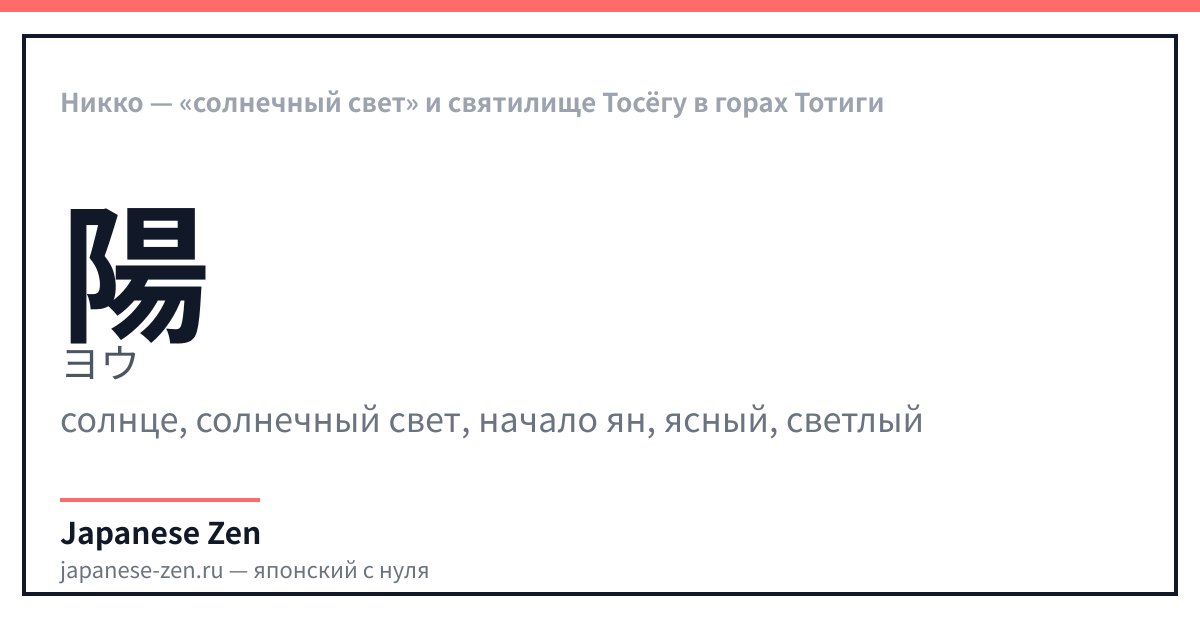
陽 — значение: sun, sunlight, yang principle, clear, bright — онъёми: ヨウ — кунъёми: ひ — 12 штрих(ов). 陽 — "sun, light": the same character appears in the name of the shrine's main gate, 陽明門 (Yōmeimon), and in the ordinary word 太陽 (taiyō) "sun."
Why the City's Name Uses Other Characters, but the Gate Uses This One
The name Nikkō itself is written with the characters 日 "sun" and 光 "light," not 陽. But it is 陽 that stands in the name of the complex's most famous gate, Yōmeimon, carrying the same image of light around which the whole city's name is built.
| Japanese | Reading | Translation |
|---|---|---|
| 日光 | Nikkō · Nikkō | Nikkō — the city's name itself |
| 東照宮 | Tōshō-gū · Tōshō-gū | Tōshō-gū — the shrine-mausoleum of Tokugawa Ieyasu |
| 二荒山 | Futarasan · Futarasan | Futarasan — the old name of the mountain and the whole area |
| 華厳の滝 | Kegon no taki · Kegon no taki | Kegon Falls near Lake Chūzenji |
| 太陽 | taiyō · taiyō | Sun — an ordinary word with the same character 陽 |
| 眠り猫 | nemuri neko · nemuri neko | Sleeping cat — a carving by the shrine's gate |
Write 陽 along the guides — the "sun" character from the name of Yōmeimon Gate in Nikkō.
FAQ
- What is Nikkō and why is the place called that?
- Nikkō is a city in the mountains of Tochigi Prefecture, famous for Tōshō-gū, the mausoleum of shogun Tokugawa Ieyasu. The name 日光 means "sunlight," but legend traces it back to the older name of Mount Futara, which the monk Kūkai is said to have reinterpreted in 820.
- Where did the name "Nikkō" come from?
- Originally the place was called 二荒 (Futara), after Mount Nantai. According to legend, in 820 the monk Kūkai read these characters in the Chinese manner as "Niko," and later this reading was written with the more pleasing characters 日光, "sunlight" — that is how today's "Nikkō" was born.
- When was Tōshō-gū Shrine built?
- The first, modest mausoleum was built in 1617, shortly after Tokugawa Ieyasu's death. The complex took its current lavish form in 1636, when his grandson, shogun Tokugawa Iemitsu, completely rebuilt the shrine for the 21st anniversary of his grandfather's death.
- What does the saying about Nikkō and "kekkō" mean?
- "Don't say 'kekkō' ('beautiful') until you've seen Nikkō" — this is how people in Japan praise the decoration of Tōshō-gū. The saying is based on the similar sound of the words "Nikkō" and "kekkō."
- What natural sights are there near Nikkō?
- Lake Chūzenji and Kegon Falls, about 97 meters high — one of Japan's three famous waterfalls along with Nachi and Fukuroda. According to legend, these places were discovered by the monk Shōdō, who founded the first Buddhist temple in the Nikkō mountains.
- How do you write "Nikkō" in kanji?
- 日光, read にっこう. 日 means "sun," 光 means "light." The characters were chosen for their meaning to match the already established sound of the name, which legend traces back to the earlier name of Mount Futara, written with the characters 二荒.
Sources
Updated: 2026-09-15