Miyajima and Itsukushima Shrine: the torii standing in the water
Miyajima is an island in Hiroshima Bay whose official name is Itsukushima: "Miyajima," "shrine island," is the common name taken from Itsukushima Shrine that stands here. At high tide the torii at the entrance and the shrine buildings themselves seem to stand in the water, and the current gate, 16.6 meters tall, is the eighth since the 12th century, when the shrine was rebuilt by the military commander Taira no Kiyomori.
The island with the gate in the water is most often photographed at high tide — and a few hours later people walk to the same torii across the exposed sand: the whole meaning of the place rests on the difference between high and low tide. Let's look at why the island has two names, what the current torii are made of and what holds them up, and how the character 潮, "tide," connects the island's name to the sea itself.
An island with two names in Hiroshima Bay
Miyajima lies in Hiroshima Bay and administratively belongs to the city of Hatsukaichi. The island's official name is Itsukushima (厳島), while "Miyajima" is the common name, "shrine island": 宮 here means "shrine," 島 means "island," and the whole combination points to the Shinto shrine Itsukushima that stands here. A person arriving on the island first of all sees it — the complex of buildings on stilts at the water's edge and the large torii some distance from the shore.
High and low tide change the picture twice a day
At high tide the water comes in under the shrine buildings and up to the torii, and it seems that both the gate and the shrine stand right in the sea. At low tide the water recedes, exposing the sandy bottom of the bay, and one can walk to the same torii. This difference is not a decoration but the reason the shrine was built on stilts at all: the layout is designed for the sea to come and go twice a day.
A 60-ton torii that is not sunk into the seabed
The great torii of Itsukushima stands about 200 meters from the shrine and is visible in almost every photograph of the island. The current gate is the eighth since the shrine was rebuilt by Taira no Kiyomori in the mid-12th century: that is the count given by Japanese reference works, though there may have been more rebuildings. The gate received its present form in 1875; its height is 16.6 meters, and the width between the pillars is 10.9 meters.
Why the torii does not fall without a foundation in the ground
The pillars of the torii are not sunk deep into the seabed but are held up by their own weight. They stand on a compacted cushion of pine piles filled with concrete and faced with stone, and inside the hollow upper beam about seven tons of stone are laid as ballast. The total weight of the structure is about 60 tons, and that is enough to withstand wind and waves without deep penetration into the ground.
Taira no Kiyomori and the shrine on stilts
The present appearance of Itsukushima Shrine was established by Taira no Kiyomori: around 1168, as governor of Aki Province, he rebuilt the buildings on a scale close to what stands here today. The shrine itself had already existed for several centuries by then, but it was under Kiyomori that the recognizable ensemble of pavilions on stilts, connected by covered galleries, took shape.
Fires and later rebuildings
The present main buildings are younger than Kiyomori's design: the shrine burned in 1207 and 1223, and the buildings seen today mostly date from the rebuilding after 1241. In 1996 "Itsukushima Shinto Shrine" was inscribed on the UNESCO World Heritage List — the same year as the Genbaku Dome in neighboring Hiroshima.
潮 — tide: the character that explains both the island and the gate
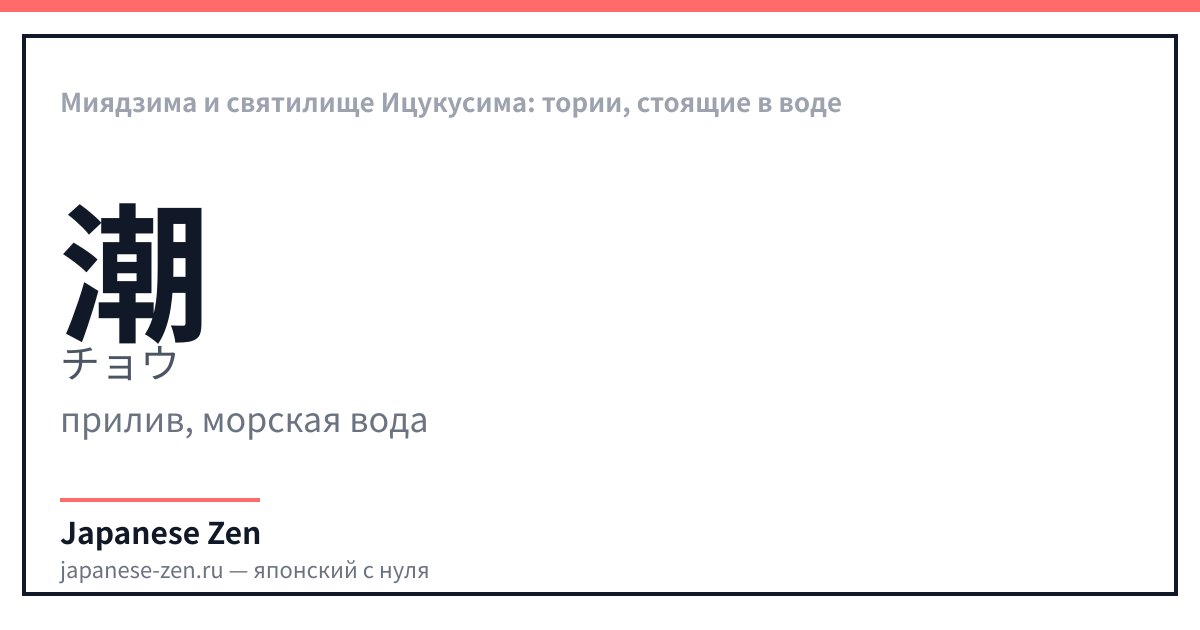
潮 — значение: tide, seawater — онъёми: チョウ — кунъёми: しお、うしお — 15 штрих(ов). 潮 — "tide, seawater": the whole meaning of the place rests on the difference between high and low tide, because of which the shrine and the torii are sometimes in the water and sometimes on dry land.
In compound words 潮 is read chō, and on its own shio. 満潮 (manchō) means "high tide" in the sense of the highest point of the water, 干潮 (kanchō) means "low tide," and 潮風 (shiokaze) means the "sea, salty wind" that blows from the bay onto the island.
Why 厳島 is read "Itsukushima"
宮島 is read みやじま (Miyajima) by simply combining the kun readings: 宮 "shrine" plus 島 "island." But the island's official name, 厳島, is read quite differently from the usual rules — いつくしま (Itsukushima). According to one theory, it goes back to the verb 斎く (itsuku) — "to purify oneself and serve a deity" — plus the same character 島 "island."
| Japanese | Reading | Translation |
|---|---|---|
| 厳島 | Itsukushima · Itsukushima | Official name of the island |
| 宮島 | Miyajima · Miyajima | Common name of the island |
| 厳島神社 | Itsukushima-jinja · Itsukushima-jinja | Itsukushima Shrine |
| 満潮 | manchō · manchō | High tide |
| 干潮 | kanchō · kanchō | Low tide |
| 潮風 | shiokaze · shiokaze | Sea, salty wind |
Write 潮 along the guides — the character for "tide," which defines the life of the island.
FAQ
- What is the island of Miyajima famous for?
- An island in Hiroshima Bay, known for Itsukushima Shrine and its torii gate, which at high tide stands right in the water. The island's official name is Itsukushima, while "Miyajima" is the common name taken from the shrine itself.
- Why does the island have two names?
- Officially the island is called Itsukushima (厳島) — the same as the Shinto shrine on it. "Miyajima" (宮島), "shrine island," is a later common name that over time became better known than the official one and took hold in speech and guidebooks.
- Why does the torii on Miyajima stand in the water?
- Only at high tide: the water comes in under the shrine buildings and up to the gate twice a day, and at low tide it recedes, exposing the sandy bottom, and one can walk to the same torii. The shrine itself was originally built on stilts precisely with this difference in mind.
- What holds up the torii if it is not sunk into the seabed?
- A compacted cushion of pine piles filled with concrete and faced with stone, and inside the hollow upper beam about seven tons of stone ballast. The total weight of the gate is about 60 tons, enough to stand without deep penetration into the ground.
- Who built Itsukushima Shrine in its present form?
- Around 1168 the buildings were rebuilt by Taira no Kiyomori, governor of Aki Province: that is when the recognizable ensemble of pavilions on stilts took shape. The present buildings are younger than his design — the shrine burned in 1207 and 1223 and was rebuilt after 1241.
- How are "Miyajima" and "Itsukushima" written in kanji?
- 宮島 (Miyajima) is read by the usual kun readings of the characters "shrine" and "island." 厳島 (Itsukushima) is read differently, いつくしま: according to one theory, from the verb 斎く, "to serve a deity while purifying oneself," and the same character "island."
Sources
Updated: 2026-09-15