Oda Nobunaga — who he was and what he is famous for
Oda Nobunaga was a Japanese military commander of the Sengoku period (1534–1582), the first of the "three unifiers" of the country alongside Toyotomi Hideyoshi and Tokugawa Ieyasu. He defeated a numerically superior enemy at Okehazama, marched his troops into Kyoto, expelled the last Ashikaga shogun, and made massive use of arquebuses at the Battle of Nagashino. He died in 1582, betrayed by his own general Akechi Mitsuhide.
Of the three who ultimately unified war-torn Japan, Nobunaga was the first and the most ruthless: he did not negotiate with the old institutions but tore them down — fortress monasteries, trade guilds, armed religious rebels. He did not live to see a unified country by thirteen years and died from the betrayal of his own vassal. But the route that Hideyoshi and Ieyasu later followed was laid by him.
Who Oda Nobunaga really was
Oda Nobunaga (織田信長, 1534–1582) was a military commander and ruler of the Sengoku period, head of the Oda clan from Owari Province. He did not complete the unification of Japan, but he began it: he defeated a far stronger rival at Okehazama in 1560, and in 1568 marched his troops into Kyoto. In 1573 he expelled the last Ashikaga shogun, and in 1575 at Nagashino he turned the tide of war with the massive use of firearms. He died in 1582 at Honnō-ji temple, betrayed by his own general Akechi Mitsuhide. The work of unifying the country was finished by his successors — Toyotomi Hideyoshi and Tokugawa Ieyasu.
| Year | Event |
|---|---|
| 1534 | Born in Owari Province, into the family of the head of the Oda clan |
| 1560 | Victory at Okehazama over Imagawa Yoshimoto |
| 1568 | Entry into Kyoto with shogun Ashikaga Yoshiaki |
| 1571 | Burning of Enryaku-ji monastery on Mount Hiei |
| 1573 | Expulsion of Yoshiaki — end of the Ashikaga shogunate |
| 1575 | Battle of Nagashino: arquebuses against the Takeda cavalry |
| 1582 | Death at Honnō-ji, betrayal by Akechi Mitsuhide |
What he did between wars
Nobunaga was not limited to war. In his domains he pursued the policy of raku-ichi raku-za: he dissolved the za guilds and removed toll barriers on the roads, which made the towns around his castles wealthy through trade. He favored the Jesuits and corresponded with one of them, Luís Fróis, whose records became an important source of information about Nobunaga for historians. He also took into service Yasuke — an African brought by missionaries, making him his armor-bearer.
Name and kanji: 織田信長
The full name 織田信長 is read おだのぶなが (Oda Nobunaga) and splits into the clan name 織田 (Oda) and the personal name 信長 (Nobunaga). 信 means "faith, trust," 長 means "long," and also "senior, head." The clan name Oda goes back to a place name and is written with 織 ("to weave, weaving") and 田 ("rice field") — a common way for Japanese surnames of that time to be named after ancestral land.
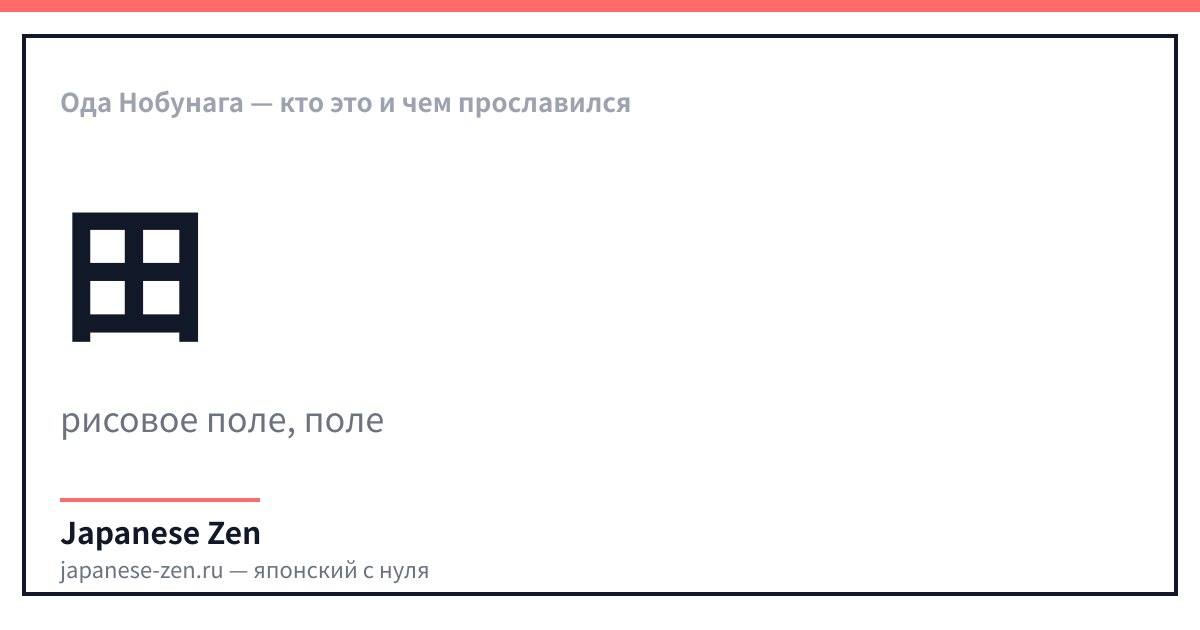
田 — значение: rice field, field — онъёми: デン — кунъёми: た — 5 штрих(ов). 田 — "rice field, field": 5 strokes. The same character appears in 水田 (suiden, "irrigated rice field") and 田舎 (inaka, "countryside, village"); in Nobunaga's name it is part of the clan name Oda (織田).
What his name literally means
The kanji 長 is read in different ways: as "chō" — in words like 社長 (shachō, "company president"), as "naga" — in names like "Nobunaga." Unlike old clan names with the particle の, such as "Minamoto no Yoritomo," samurai surnames of the Sengoku period are read as one unit: Oda Nobunaga, not "Oda no Nobunaga." Confusion is also added by order: Japanese sources give the surname first, while some foreign texts swap the given name and surname.
| Japanese | Reading | Translation |
|---|---|---|
| 織田信長 | Oda Nobunaga · Oda Nobunaga | Name of the page's subject |
| 天下布武 | tenka fubu · tenka fubu | Personal motto on Nobunaga's seal: the power of weapons will bring order to the realm |
| 楽市楽座 | rakuichi rakuza · rakuichi rakuza | Free markets — Nobunaga's economic reform |
| 鉄砲 | teppō · teppō | Gun, arquebus — the weapon at Nagashino |
| 城 | shiro · shiro | Castle |
Listen to how the name of the unifier of Japan sounds, and repeat it aloud.
Oda Nobunaga in anime, manga, and games
- Nobunaga no Yabou ("Nobunaga's Ambition") — Koei's strategy series, where the player leads Nobunaga's campaign or his rivals to unify Japan.
- Samurai Warriors (Sengoku Musou) — Koei Tecmo's action series, where Nobunaga is one of the key playable characters from the first installment.
- Sengoku Basara — Capcom's series, where Nobunaga is shown as a grotesque "demon conqueror" with supernatural powers.
- Drifters — Kouta Hirano's manga and anime, where Nobunaga is one of three heroes transported to another world after death.
- Fate/Grand Order — here Nobunaga is portrayed as a female military commander: a reinterpretation in the spirit of the Fate series, not history.
Where the demon image came from
Supernatural abilities, a female form in Fate/Grand Order, transportation to a parallel world in "Drifters" — all entirely authorial fiction: the historical Nobunaga had neither magic nor a second chance after Honnō-ji. These works usually take the image of the demonic tyrant literally, although the source was more the reputation of a ruthless reformer than a supernatural being.
What legend made of him
The three unifiers of Japan are often contrasted through the parable of a cuckoo that does not sing: Nobunaga orders it killed, Hideyoshi will make it sing, Ieyasu will wait until it sings on its own. The aphorism neatly conveys each one's reputation, but it was born in Edo-period texts decades after the death of all three, not as their actual words. The same principle of simplification fixed the image of Nobunaga as a mad tyrant. The source of the image is real — burned monasteries, destroyed Ikkō-ikki communities, tens of thousands killed over years of war. But the same man introduced free trade and corresponded with opponents for years: his rule was calculating, not chaotically cruel.
The burning of Enryaku-ji monastery in 1571 is sometimes presented as the act of an atheist. The reason was military and political: Mount Hiei sheltered the troops of the Asai and Asakura clans hostile to Nobunaga, and its armed monks had fought against him for years. The same Nobunaga warmly received Christian missionaries — he cared about control over the military power of religion, not faith as such. At the same time, replying to his rival Takeda Shingen, Nobunaga jokingly signed a letter as the "Demon King of the Sixth Heaven" (第六天魔王) — a nickname around which a separate legend grew.
The legend that Nobunaga's arquebusiers fired coordinated volleys in turn in three ranks is familiar from films and games. The large-scale use of firearms and field fortifications against the Takeda cavalry at Nagashino in 1575 is reliably confirmed. But the polished three-rank rotation scheme became established in retellings decades later — modern historians dispute it as a later simplification.
- True: the burning of Enryaku-ji, the dissolution of the za guilds, the service of Yasuke, and the correspondence with the Jesuits are documented by contemporaries.
- Disputed: the three-rank rotation scheme at Nagashino — historians consider it a later simplification for a dramatic story.
- Late saying: the cuckoo parable about Nobunaga, Hideyoshi, and Ieyasu is an Edo-period invention, not their words.
- Pop-culture fiction: the literal demonic nature and superpowers of Nobunaga in games and anime — sources know no such traits.
FAQ
- Who was Oda Nobunaga?
- Oda Nobunaga was a Japanese military commander of the Sengoku period (1534–1582), the first of the three unifiers of war-torn Japan. He defeated his rivals at Okehazama, marched his troops into Kyoto, and expelled the last Ashikaga shogun, but did not live to see the completion of the country's unification — he died in 1582.
- How did Oda Nobunaga die?
- In 1582, at Honnō-ji temple in Kyoto, Nobunaga's own general Akechi Mitsuhide rose against him. Surrounded in the burning temple with a handful of guards, Nobunaga died — according to the traditional account, by suicide; his body was never found.
- What is Oda Nobunaga known for?
- Oda Nobunaga is known as the first of the three unifiers of Japan, who destroyed the old order: he burned the fortified Enryaku-ji monastery, dissolved trade guilds with the raku-ichi raku-za policy, and was one of the first to use massed firearms volleys in battle.
- How is the name Oda Nobunaga written in Japanese?
- The name is written 織田信長 and read おだのぶなが (Oda Nobunaga). 織田 (Oda) is the clan name, composed of the characters for "weave" and "rice field," while 信長 (Nobunaga) is the personal name: 信 means "faith," 長 means "long" or "senior."
- Is Oda Nobunaga a real person or a legend?
- Oda Nobunaga is a real historical figure; his life is documented in detail by contemporaries and chronicles of the era. It is his posthumous reputation that has become overgrown with legends: the image of a demonic tyrant, the myth of his invention of volley fire, and the cuckoo verses attributed to him by later storytellers are not facts but later accretions.
Sources
Updated: 2026-09-11