The Demon King of the Sixth Heaven — Who He Is and What He's Famous For
"Demon King of the Sixth Heaven" (第六天魔王, だいろくてんまおう) is a nickname of the military commander Oda Nobunaga (1534–1582), not a separate historical figure. The title goes back to the Buddhist lord of the highest of the six heavens of the realm of desire, who hinders those on the path to enlightenment. The nickname stuck in 1573: his rival Takeda Shingen called Nobunaga an enemy of the Buddhist law, and Nobunaga jokingly signed himself with the same title in his reply. Later the image of the demon king migrated into games and anime about Nobunaga.
Sometimes the most recognizable nickname of the Sengoku era is not a name but a barb that a man adopted as a joke. His rival Takeda Shingen called Oda Nobunaga an enemy of the Buddhist law, and Nobunaga replied by signing himself "Demon King of the Sixth Heaven" — and that signature outlived both the war and Nobunaga himself, reaching modern games and anime. Below is what in this story is documented by contemporaries and what was added by culture later.
Who the Demon King of the Sixth Heaven Really Is
"Demon King of the Sixth Heaven" (第六天魔王) is a nickname, not a separate historical person: since 1573 it has referred to the military commander Oda Nobunaga (1534–1582). The title is taken from Buddhist cosmology — it refers to the lord of the highest of the six heavens of the realm of desire, who hinders those on the path to enlightenment. The nickname was born from an exchange of letters with his rival Takeda Shingen, who accused Nobunaga of waging war against the Buddhist law for burning the monastery on Mount Hiei. Contemporaries took the reply as a caustic joke, not a claim to a demonic nature.
| Year | Event |
|---|---|
| 1571 | Nobunaga burns Enryaku-ji monastery on Mount Hiei |
| 1573, January | Takeda Shingen calls Nobunaga an enemy of the Buddhist law |
| 1573, April | Jesuit Luís Fróis records Nobunaga's reply — the signature "Demon King of the Sixth Heaven" |
| 1580 | Surrender of Ishiyama Hongan-ji fortress — end of the war with the Ikkō-ikki |
| 1582 | Nobunaga's death at Honnō-ji; the nickname passes into popular culture |
What Stood Behind the Nickname Besides the Letter
The joke fell on prepared ground: for nearly a decade Nobunaga had been at war with the Ikkō-ikki — an armed movement of followers of the Jōdo Shinshū school that raised several provinces against him. In 1571 he burned Enryaku-ji monastery on Mount Hiei, which sheltered hostile troops, and in 1580 he forced the surrender of their headquarters, the fortress of Ishiyama Hongan-ji. To contemporaries, the destroyer of monasteries looked like a demon in the literal sense — the nickname rested on an existing reputation rather than creating one from scratch.
The Name and the Kanji: 第六天魔王
第六天魔王 is read だいろくてんまおう — "demon king of the sixth heaven": 第六天 means "sixth heaven," 魔王 — "demon king." In Buddhist cosmology the realm of desire (欲界) is divided into six heavens; the highest of them, Takejizaiten (他化自在天), is inhabited by a demon world-ruler who has the power to appropriate the joys of beings below. The demon's full name in the texts is 天魔波旬 (Tenma Hajun). Nobunaga used the title as a retaliatory barb, not as a self-description.
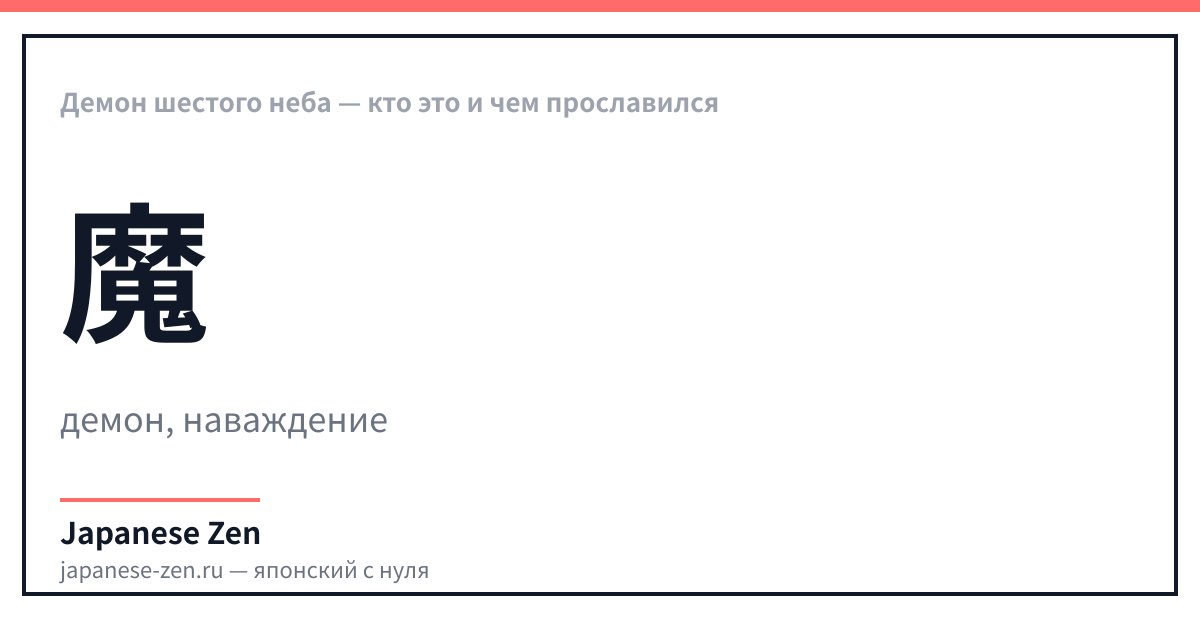
魔 — значение: demon, delusion — онъёми: マ — 21 штрих(ов). 魔 — "demon, delusion": 21 strokes, radical 鬼 (oni, a supernatural being). The same character appears in 魔法 (mahō, "magic") and 悪魔 (akuma, "devil"); in the title it stands before 王 ("king, ruler"), forming "demon king."
Why the Sixth Heaven and Not the First
The six heavens of the realm of desire are arranged in ascending order: the higher the level, the fewer carnal desires and the longer the lives of its inhabitants. At the top of this ladder is Takejizaiten — the heaven whose lord is free to appropriate the pleasures of beings living below. The highest position also gives the demon the greatest power to hold back those on the path to enlightenment — that is why the title is tied specifically to the sixth heaven, not the first.
| Japanese | Reading | Translation |
|---|---|---|
| 第六天魔王 | Dairokuten Maō · Dairokuten Maō | The nickname used in the page title |
| 魔王 | maō · maō | Demon lord — a common word from games and anime |
| 天魔波旬 | Tenma Hajun · Tenma Hajun | The full Buddhist name of the demon of the sixth heaven |
| 延暦寺 | Enryaku-ji · Enryaku-ji | The monastery on Mount Hiei burned by Nobunaga in 1571 |
| 一向一揆 | Ikkō ikki · Ikkō ikki | The armed movement of Jōdo Shinshū Buddhists that fought Nobunaga |
| 仏敵 | butteki · butteki | "Enemy of the Buddhist law" — the charge Shingen made against Nobunaga |
Listen to how the title of the Demon King of the Sixth Heaven sounds and repeat it aloud.
The Legend of the Letter: What Is Confirmed and What Is Not
The exchange of letters itself has not survived — the originals have not been found. It is known from the report of the Jesuit Luís Fróis, who sent a retelling of the correspondence to Rome in April 1573. According to his version, Shingen signed himself as the abbot of the Tendai school and accused Nobunaga of waging war against the Buddhist law, and Nobunaga answered in kind — with the signature "Demon King of the Sixth Heaven, Nobunaga." The story was recorded by a contemporary of the events, but we do not know the exact words of the original.
- Documented by a contemporary: the exchange of remarks is described by the missionary Luís Fróis in 1573 — during the lifetime of both participants, not in later chronicles.
- Not confirmed: the exact text of Nobunaga's letter — the original has not survived, only a retelling by an outside observer is known.
- Independently confirmed: Nobunaga's war with Buddhist institutions — the burning of Enryaku-ji and the defeat of the Ikkō-ikki — is documented separately from the story of the letter.
- Fiction of popular culture: Nobunaga's demonic nature and superpowers in Fate/Grand Order, Sengoku Basara, Nioh, and Onimusha are the authors' invention, not part of the historical nickname.
FAQ
- Who is the Demon King of the Sixth Heaven?
- "Demon King of the Sixth Heaven" (第六天魔王) is not a separate historical person but a nickname of the military commander Oda Nobunaga (1534–1582). The title goes back to the Buddhist lord of the highest heaven of the realm of desire and stuck to Nobunaga after his exchange of letters with his rival Takeda Shingen in 1573.
- Where did the nickname "Demon King of the Sixth Heaven" come from?
- His rival Takeda Shingen accused Nobunaga of waging war against the Buddhist law, signing himself as the abbot of the Tendai school. Nobunaga answered in kind, signing the letter "Demon King of the Sixth Heaven" — a caustic joke, not a statement about his demonic nature.
- How is "Demon King of the Sixth Heaven" written in Japanese?
- 第六天魔王, read だいろくてんまおう (Dairokuten Maō). 第六天 means "sixth heaven" — the highest heaven of the realm of desire in Buddhist cosmology — and 魔王 means "demon king," the lord of that heaven who hinders those on the path to enlightenment.
- Is the Demon King of the Sixth Heaven a real story or a legend?
- There is a real person behind the nickname — Oda Nobunaga — and his war with Buddhist institutions is independently documented. The exchange of letters itself, however, is known only from the retelling by the missionary Luís Fróis: the originals have not survived, and we do not know Nobunaga's exact words.
- In which games and anime does the Demon King of the Sixth Heaven appear?
- Nobunaga's demonic image appears in Fate/Grand Order, where he is featured as a separate servant under this title. In Sengoku Basara he calls himself the "Demon King of the Sixth Heaven," and in the games Nioh and Onimusha he receives power from demons.
- Who was called the Demon King of the Sixth Heaven?
- The Demon King of the Sixth Heaven was the name given to Oda Nobunaga (1534–1582) — a military commander of the Sengoku era who burned the monastery on Mount Hiei and fought the Ikkō-ikki movement. The nickname does not refer to any other historical figure in Japan and does not describe a separate being.
Sources
Updated: 2026-09-11