Takeda Shingen — who he was and what he is famous for
Takeda Shingen (武田信玄, 1521–1573) was the daimyo of Kai Province in the Sengoku period, the rival of Uesugi Kenshin in five battles at Kawanakajima, and the author of the motto 風林火山 on his battle banner. He took over the clan at 21 by overthrowing his father, introduced the Kōshū Hatto no Shidai legal code, and built a dam on the Kamanashi River. In 1572 he defeated Oda Nobunaga and Tokugawa Ieyasu at Mikatagahara, but a year later he died on a new campaign before reaching Kyoto.
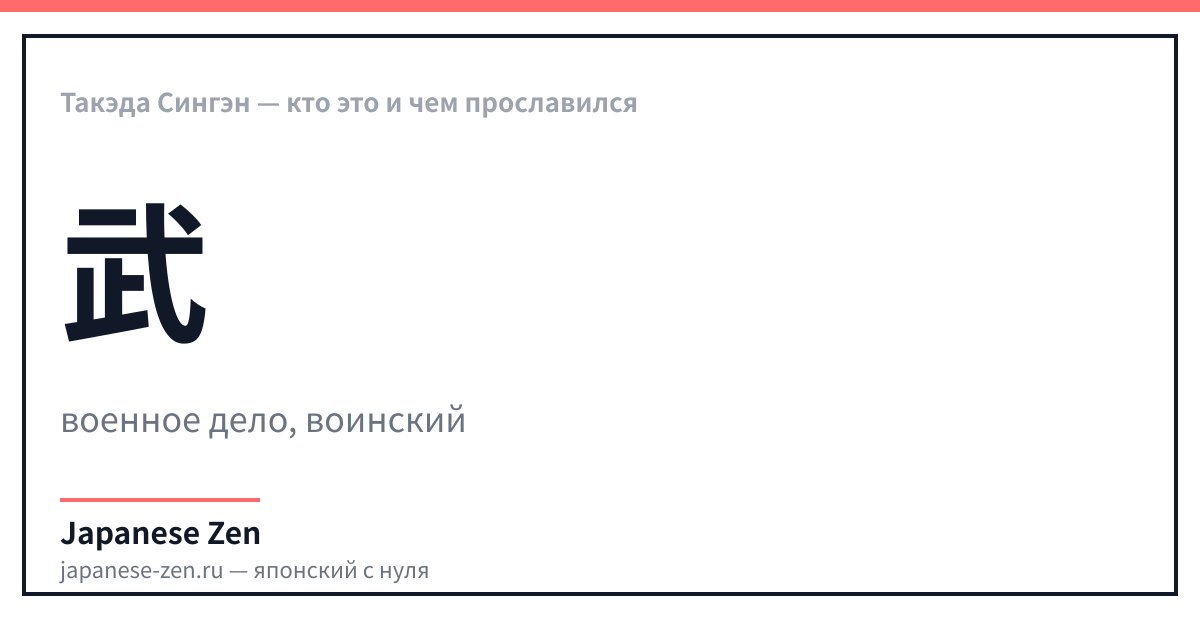
Takeda Shingen entered history not only as Uesugi Kenshin's rival on the battlefield. For the Sengoku period he is a rare type — a landowner: the Kōshū Hatto no Shidai legal code described the life of the province in more detail than most neighboring codes, and the dam on the Kamanashi River still bears his name. The five battles at Kawanakajima brought him no decisive victory, but they left the era the motto 風林火山. His death gave rise to both a sword duel and a sniper's shot; let's sort out which of these is confirmed by the chronicles.
Who Takeda Shingen really was
Takeda Shingen (武田信玄, 1521–1573) was the daimyo of Kai Province in central Japan, one of the strongest military commanders of the Sengoku period. In 1541 he overthrew his own father Nobutora and took over the clan at 21. For twelve years — from 1553 to 1564 — he fought for northern Shinano against Uesugi Kenshin: the five battles at Kawanakajima never produced a winner. In 1572 he crushed the allied army of Oda Nobunaga and Tokugawa Ieyasu at Mikatagahara, but a year later he died on a new campaign, never reaching Kyoto.
| Year | Event |
|---|---|
| 1521 | Born in Kai Province, son of Takeda Nobutora; given the name Katsuchiyo at birth |
| 1536 | Coming-of-age ceremony, name Harunobu — the character 晴 from shogun Ashikaga Yoshiharu |
| 1541 | Overthrew his father Nobutora and took over the Takeda clan at 21 |
| 1547 | Promulgated the Kōshū Hatto no Shidai legal code (甲州法度之次第) |
| 1553–1564 | Five battles at Kawanakajima against Uesugi Kenshin for northern Shinano |
| 1559 | Took monastic vows and the Buddhist name Shingen (信玄) |
| 1572 | Defeated the allied army of Oda Nobunaga and Tokugawa Ieyasu at Mikatagahara |
| 1573 | Died during the western campaign near Komba in Shinano Province |
What he did in a peaceful province
Shingen was not only a commander but also an administrator. To tame the floods of the Kamanashi River, the Shingen-tsutsumi (信玄堤) dam was built under him — a hydraulic system, part of which still works today. In 1547 he promulgated the Kōshū Hatto no Shidai legal code: 57 articles on land tenure, taxes, and order among vassals, supplemented with quotes from Chinese classics on everyday behavior. The gold of Kai Province fed his treasury and gave rise to his own coin — Kōshū kin (甲州金).
Name and kanji: 武田信玄
The full name 武田信玄 is read たけだしんげん (Takeda Shingen) and splits into the clan surname 武田 (Takeda) and the personal name 信玄 (Shingen). Takeda is a branch of the Kai Genji clan: 武 "martial" plus 田 "field", after the name of the ancestral domain in Kai Province. At birth the future commander was given the name Katsuchiyo, and after the coming-of-age ceremony in 1536 — the name Harunobu (晴信): the character 晴 was granted by shogun Ashikaga Yoshiharu, and 信 was inherited from his father, Takeda Nobutora. In 1559, having taken monastic vows, he took the Buddhist name Shingen: 信 preserved clan continuity, and 玄 — "profound, deep" — a common character in the names of Buddhist monks.
武 — значение: military affairs, martial — онъёми: ブ、ム — кунъёми: たけ、たけ.し — 8 штрих(ов). 武 — "military affairs, martial": 8 strokes. The same character appears in the first kanji of the surname Takeda (武田) and in the word 武士道 (bushido), "the way of the warrior": two widely circulated markers of the Sengoku period share one root.
Why he was called both Harunobu and Shingen
In chronicles and games the name "Shingen" is extended over his whole life. But the first three battles at Kawanakajima — of 1553, 1555, and 1557 — he fought still as Harunobu: the tonsure happened in 1559, before the fourth and hardest battle of 1561. This is common practice: a monastic name over time displaces the lifetime name in historical memory. The same happened with his main rival, Uesugi Kenshin, who received that name only in 1570, eight years before his death.
| Japanese | Reading | Translation |
|---|---|---|
| 武田信玄 | Takeda Shingen · Takeda Shingen | Name of the page's hero |
| 甲斐の虎 | Kai no Tora · Kai no Tora | "Tiger of Kai" — Shingen's nickname |
| 風林火山 | fūrinkazan · fūrinkazan | "Swift as the wind, quiet as the forest, fierce as fire, immovable as the mountain" — the motto from his banner, from Sun Tzu's The Art of War |
| 甲州法度之次第 | Kōshū Hatto no Shidai · Kōshū Hatto no Shidai | The legal code of Kai Province, promulgated in 1547 |
| 川中島 | Kawanakajima · Kawanakajima | The plain where Shingen and Kenshin clashed five times |
| 戦い | tatakai · tatakai | Battle, fight |
Listen to how the name of the "Tiger of Kai" and the words of his era sound.
Takeda Shingen in anime, manga, and games
- Sengoku Basara (Capcom) — Shingen is one of the key characters of the series: he fights with a giant flaming axe and, by the authors' design, is too big for one horse — he rides two at once.
- Samurai Warriors (Sengoku Musou, Koei Tecmo) — a playable character throughout almost the entire series, leader of the Takeda clan.
- Nobunaga no Yabou ("Nobunaga's Ambition", Koei) — a playable daimyo of Kai Province with consistently high stats in the series' rankings.
- Total War: Shogun 2 (Creative Assembly) — the Takeda clan is a separate playable faction, starting in Kai Province and superior to rivals in cavalry.
- Sengoku Basara: Samurai Kings (Production I.G, 2009) — an anime based on the same game: Shingen and Kenshin are the main pair of rivals here, and their duels are placed at the center of the plot.
What in the game image comes from Capcom
The giant flaming axe and the habit of fighting on two horses at once in Sengoku Basara are entirely Capcom's fantasy: the historical commander, like any daimyo of the era, commanded battle on horseback with ordinary weapons and a saihai baton. The image of a cautious strategist who preferred negotiations to unnecessary bloodshed has hardly survived in games — the military action genre values spectacle more than historical accuracy.
Legends about his death
The most widely circulated episode is the personal duel with Uesugi Kenshin in the fourth battle at Kawanakajima. Kenshin supposedly broke through on horseback to Shingen's headquarters and struck three times with his sword, while Shingen fended him off with a tessen war fan. The scene comes from the chronicle Kōyō Gunkan (甲陽軍鑑), compiled by clan comrades decades after the events, and is not confirmed by any contemporary of the battle.
The second legend is about a sniper's shot. According to the version used in Akira Kurosawa's film Kagemusha (1980), Shingen was shot by a marksman during the siege of Noda Castle in 1573, when the commander was listening to a night flute performance. The true cause of death has not been established: sources name stomach cancer, pulmonary tuberculosis, and other illnesses. The version with the shot is not documented in any way.
The same Kōyō Gunkan compares Shingen's death to the death of the strategist Zhuge Liang from the Chinese novel Romance of the Three Kingdoms — the image of a star fading in the autumn wind. This is a deliberate literary device by the chronicle's authors, who sought to place Shingen in the pantheon of great strategists of the past, and not a historical testimony about his last days.
- Fact: the five battles at Kawanakajima in 1553–1564, the Kōshū Hatto no Shidai legal code of 1547, the dam on the Kamanashi River, and the rout of Oda and Tokugawa at Mikatagahara in 1572 — confirmed by chronicles of the era.
- Legend: the personal duel with Uesugi Kenshin with swords and a war fan — an episode from Kōyō Gunkan, compiled decades later, without confirmation by contemporaries.
- Version, not fact: death from a sniper's shot at the siege of Noda, widely circulated by the film Kagemusha — the true cause of Shingen's death remains medically unclear.
- Literary device: the comparison of Shingen's death with the death of Zhuge Liang in the same chronicle — an image for the pantheon of strategists, not a historical detail.
FAQ
- Who was Takeda Shingen?
- Takeda Shingen was the daimyo of Kai Province in the Sengoku period (1521–1573), one of the strongest military commanders of his time. He took over the clan at 21 by overthrowing his father, introduced his own legal code, and for twelve years fought Uesugi Kenshin for northern Shinano at Kawanakajima.
- What is Takeda Shingen famous for?
- Takeda Shingen is famous for the five battles at Kawanakajima with Uesugi Kenshin, the rout of Oda Nobunaga's and Tokugawa Ieyasu's forces at Mikatagahara in 1572, and the motto 風林火山 on his battle banner. He also introduced the Kōshū Hatto no Shidai legal code and built a dam, part of which still works today.
- How is the name Takeda Shingen written in Japanese?
- 武田信玄, read たけだしんげん. At birth he was given the name Harunobu (晴信), and "Shingen" is a Buddhist name taken in 1559 upon his tonsure; chronicles and modern retellings use both variants for different periods of his life.
- Was Takeda Shingen a real person or a legend?
- Takeda Shingen was a real historical figure; his rule is documented in detail by the chronicles of the era. Legends have grown around his death: the duel with Uesugi Kenshin with swords and the sniper's shot at the siege of Noda are later or cinematic versions, not confirmed facts.
- Where can you see Takeda Shingen in games and anime?
- Most often Takeda Shingen appears in games: he is playable in Sengoku Basara and Samurai Warriors, and the Takeda clan is a cavalry faction in Total War: Shogun 2. Among anime there is the adaptation Sengoku Basara: Samurai Kings, where he is featured together with Uesugi Kenshin.
- When did Takeda Shingen live?
- Takeda Shingen lived from 1521 to 1573. He took over the clan at 21, fought Uesugi Kenshin for twelve years at Kawanakajima, and defeated Oda Nobunaga and Tokugawa Ieyasu at Mikatagahara in 1572. A year later he died on a campaign to Kyoto.
Sources
Updated: 2026-09-11