Aruki-miko — Wandering Shrine Maidens: Did They Really Serve Takeda's Intelligence?
Aruki-miko (歩き巫女) were wandering Shinto shrine maidens of the Sengoku period: they traveled from village to village offering divination and rituals, not attached to any single shrine. The legend that their leader was Mochizuki Chiyome, who ran a network of female spies for Takeda Shingen, is a 20th-century reconstruction: it first appeared in print in 1930, and the espionage version specifically in 1971.
Wandering shrine maidens are a historical fact: they went around villages, performed divination and rituals for pay. But their involvement in Takeda Shingen's intelligence is a much shakier story. Let's look at how aruki-miko differed from shrine-attached miko, where the legend of Mochizuki Chiyome came from, and why it is so easy to retell but so hard to confirm with documents.
Wandering Shrine Maidens Without a Shrine of Their Own
Aruki-miko (歩き巫女) were women who, unlike ordinary miko, were not attached to a single shrine but traveled from village to village. They earned a living through divination, rituals, and "spirit summoning" (口寄せ, kuchiyose) — speaking with the dead through a medium. In different regions such wanderers were also called by other names, for example "azusa miko" (梓巫女), after the catalpa bow used in the ritual.
How aruki-miko differed from shrine-attached miko
A miko serving at a Shinto shrine today is more of an administrative and ritual position: assisting the priest, performing kagura dances, selling amulets. Aruki-miko are a much older and freer phenomenon: without a fixed place of service or a single authority, and their earnings depended on where they were allowed to perform divination and prayers.
Mochizuki Chiyome and the Spy Network Attributed to Her
According to legend, Mochizuki Chiyome was the widow of Mochizuki Moritoki — a relative and vassal of Takeda Shingen, who supposedly died in 1561 at the Battle of Kawanakajima. Historians note that almost nothing is known about Moritoki, and the one who died in that battle was another Mochizuki — Nobuyori. After his death, she is said to have become the head "miko-gashira" (巫女頭) — the senior over the wandering shrine maidens of Kai and Shinano provinces, and received this appointment officially by Shingen's red seal of 1569. The trouble is that the document itself has not been found today, and there are no other documents from her era confirming the story.
The name Mochizuki Chiyome first appeared in print in 1930 — three and a half centuries after her supposed life. And the very idea that aruki-miko not only performed divination but gathered information for Takeda was put forward in 1971 by the popular historian Inagaki Shisei. His argument: it was unbecoming for a military commander's widow to associate with low-status shrine maidens, therefore the maidens must have been spies. The 1930 book he relied on says nothing about espionage, and Mie University researcher Yoshimaru Katsuya considers the whole version a fabrication.
Why the legend of Chiyome stuck so firmly
The story combines two things that sound plausible separately: wandering shrine maidens really did travel all over the country, and a wanderer arouses less suspicion than an armed man. Combining them into a ready-made plot about Takeda's "female intelligence unit" was tempting, and since the 1970s this version has migrated into books, games, and Sengoku TV series almost as fact.
歩 — The Same Step as in an Ordinary Walk
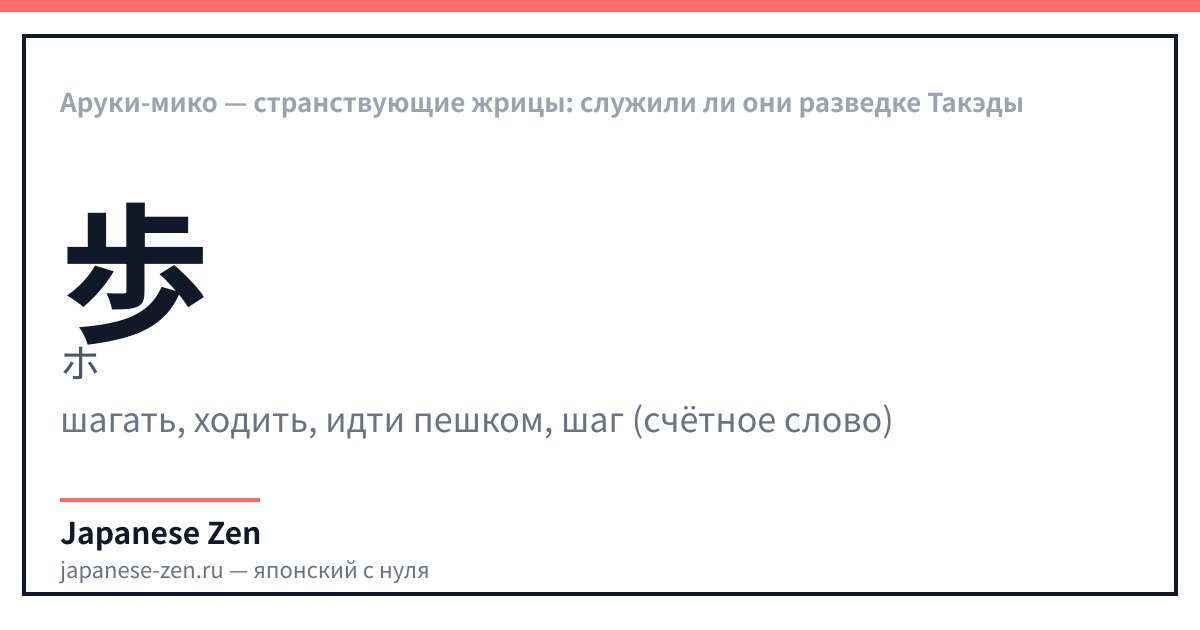
歩 — значение: to step, to walk, to go on foot, step (counter word) — онъёми: ホ、ブ、フ — кунъёми: ある.く、あゆ.む — 8 штрих(ов). 歩 — "to step, to walk": in 歩き巫女 (aruki-miko) this word literally means "a shrine maiden who walks." The same character appears in 散歩 (sanpo) "a walk" and 歩道 (hodō) "sidewalk."
歩き巫女 — "walking" plus "shrine maiden"
歩き巫女 literally combines 歩く "to walk" and 巫女 "shrine maiden": the second word, in turn, is 巫 "shaman, medium with spirits" plus 女 "woman." There is nothing mysterious in the spelling: the word honestly names a woman who, unlike a shrine-attached miko, walks from place to place rather than serving in one spot. The character 歩 is read ホ (ポ) in 歩道 "sidewalk" and 散歩 "a walk," and in Japanese as ある in 歩く "to go on foot."
| Japanese | Reading | Translation |
|---|---|---|
| 歩き巫女 | aruki miko · aruki miko | Wandering shrine maiden — the subject of this page |
| 歩く | aruku · aruku | To walk, to go on foot |
| 散歩 | sanpo · sanpo | A walk — the same character 歩 as in aruki-miko |
| 巫女 | miko · miko | Shrine maiden of a Shinto shrine |
| 口寄せ | kuchiyose · kuchiyose | The ritual of "spirit summoning" through a medium |
| 武田信玄 | Takeda Shingen · Takeda Shingen | The military commander to whom the spy network is attributed |
Write 歩 along the guides — the character for "to step" from the word 歩き巫女, "walking shrine maiden."
散歩 — The Same Walk, Only Without the Ritual
散歩 (sanpo), an ordinary everyday "walk," consists of 散 "to scatter, to go unhurriedly" and the same 歩 "to step" — the character that in 歩き巫女 denotes a completely different, ritual walking. The movement is the same, but the meaning is different: for aruki-miko the journey was work and a way to earn a living, not rest.
FAQ
- Who were the aruki-miko?
- Aruki-miko (歩き巫女) were wandering Shinto shrine maidens who, unlike ordinary miko, were not attached to a single shrine: they traveled from village to village, earning a living through divination, rituals, and "spirit summoning." The phenomenon is known from the late Middle Ages and is not directly connected to intelligence gathering.
- Is it true that aruki-miko spied for Takeda Shingen?
- This is a popular but poorly supported version: the name of the supposed network leader, Mochizuki Chiyome, first appeared in print in 1930, and the idea of a spy network itself was proposed by a historian only in 1971. The Takeda Shingen document that is mentioned has not been found today, and there are no other documents from her era about Chiyome.
- Who was Mochizuki Chiyome?
- According to legend, she was the widow of Mochizuki Moritoki, a relative and vassal of Takeda Shingen, who supposedly died in 1561 at Kawanakajima. It is believed that after his death she led a network of wandering shrine maidens in Kai and Shinano provinces, but no documents from her own era have been found to confirm this — the story is known only from later retellings.
- How did aruki-miko differ from ordinary miko?
- An ordinary miko serves at one shrine: assisting the priest, dancing kagura, selling amulets. An aruki-miko was not tied to a place: she traveled from village to village, earning a living through divination and rituals rather than permanent service.
- How is "aruki-miko" written in kanji?
- 歩き巫女, read あるきみこ. 歩く means "to walk," 巫女 means "shrine maiden": 巫 "shaman, medium with spirits" plus 女 "woman." The spelling honestly names a wandering shrine maiden — unlike the espionage legend, there is no mystery here.
Sources
Updated: 2026-09-15