Tokyo in Japanese: 東京 — "Eastern Capital" and How It's Written
Tokyo in Japanese is written 東京 and read Tōkyō — literally "eastern capital": 東 means "east", 京 means "capital". Until 1868, the city of Edo stood on this site, and Tokyo was named "eastern" because it lies east of the former capital, Kyoto. The city's official name today is 東京都, the "Tokyo Metropolitan Area".
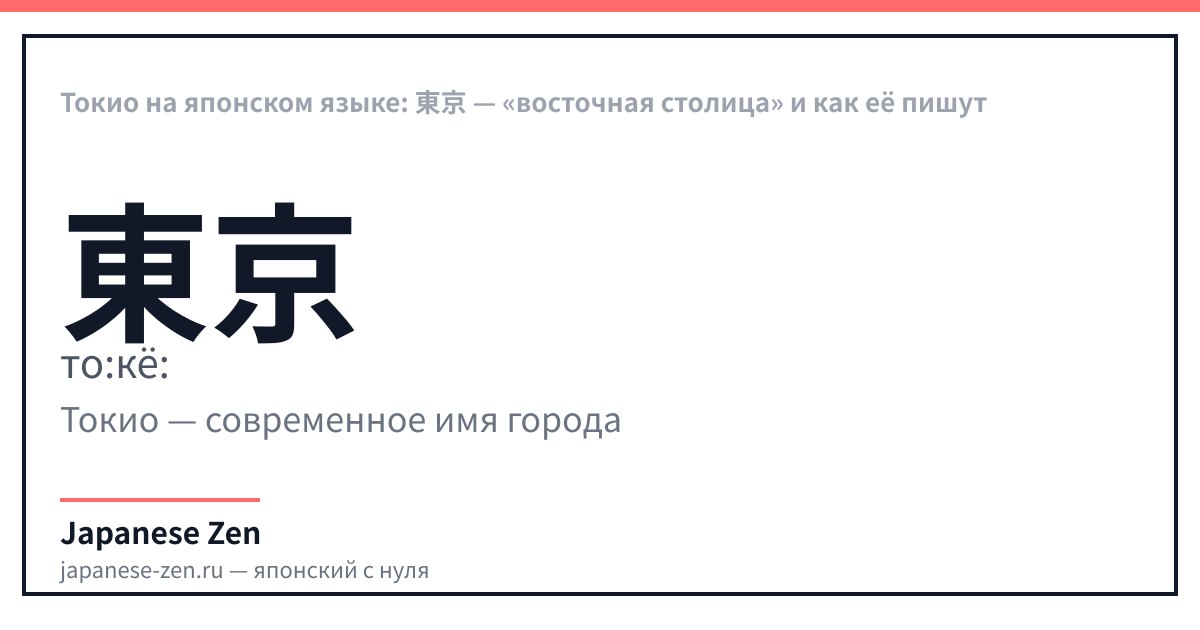
Let's break down the kanji 東京 piece by piece, learn how the city's name sounded differently in the first decades after the renaming, and learn not to confuse the colloquial "Tokyo" with the official 東京都. We'll also compare what Tokyo and Kyoto have in common in writing, and debunk a few persistent myths — for example, that Tokyo was always the capital.
What "Tokyo" Means
東京 is read とうきょう (Tōkyō) and literally means "eastern capital": 東 — "east", 京 — "capital, major city". The name doesn't describe the nature of the place but fixes its position relative to the former capital — Tokyo lies east of Kyoto, hence "eastern". Until 1868, the city of Edo (江戸, "entrance to the bay") stood on this site, and only after the fall of the shogunate was it renamed and made the emperor's residence.
| Japanese | Reading | Translation |
|---|---|---|
| 東京 | Tōkyō · Tōkyō | Tokyo — the modern name of the city |
| トーキョー | Tōkyō · Tōkyō | Tokyo in katakana — the foreign-sounding version of the word, as in manga and advertising |
| 東京都 | Tōkyō-to · Tōkyō-to | The official name — "Tokyo Metropolitan Area" |
| 江戸 | Edo · Edo | The old name of the city before 1868 |
How "Tokyo" Was Also Read After the Renaming
The name 東京 was established in 1868, but no law fixed its reading. The main reading became とうきょう, while in the late 1880s and early 1890s, とうけい (Tōkei) was also often heard. The character 京 has two on'yomi readings, きょう and けい, and the second still lives on — for example, in 京浜 (Keihin, "Tokyo–Yokohama"). The reading とうけい was displaced by daily newspapers and schools: in the first state primer, 東京 was glossed as "トーキョー".
Breaking Down the Kanji: 東京
The second character in 東京 is 京, "capital, major city": the same character appears in the name Kyoto (京都) and in the word 上京 (jōkyō) — "to go to the capital". The first character, 東, means "east": according to the school version, it depicts the sun (日) rising behind a tree (木). The explanation is beautiful, but modern research into ancient oracle bone inscriptions sees in the original form more likely a bag or a pack tied at both ends, rather than the sun behind a tree — the exact origin of the character 東 is not established.
都 — значение: capital, metropolis, metropolitan area (in the name of Tokyo) — онъёми: ト、ツ — кунъёми: みやこ — 11 штрих(ов). 都 — "capital, metropolis": the third character in the full name 東京都. It also appears in 京都 (Kyoto) and in 首都 (shuto) — "capital".
Write 都 along the guides — the third character in Tokyo's official name, 東京都.
Tokyo and Kyoto — the Shared Character 京
The name Kyoto is older: 京都 simply meant "capital city". When the emperor's residence was moved to Edo in 1868, the new name was built from the same character 京 with a direction added — "eastern capital". So the two names retain a pair: the old capital and the new one, east of it.
How Tokyo Is Written and Pronounced
- Long vowels: Tōkyō, not three short syllables "To-ki-o" — both syllables are drawn out longer than usual.
- 東京都 is the official name, "metropolitan area", not just "Tokyo city".
- 23 special wards (特別区) instead of a single city government.
- On station signs and maps, it's written simply 東京 without 都, and in Latin script as Tokyo without any macrons over the vowels.
How an Address Is Structured: 東京都〇〇区
A Japanese address goes from large to small: first 東京都 ("Tokyo Metropolis"), then the name of one of the 23 wards with the suffix 区 (ku) — for example, 東京都渋谷区 (Shibuya-ku), then the block and house number. The familiar English address order is the reverse, so when translating, the parts are usually rearranged.
Common Misconceptions About Tokyo
- "Tokyo is a city." Formally, no: the city of Tokyo (東京市) was abolished in 1943 and merged with Tokyo Prefecture into the metropolitan area 東京都. Since then, the 23 central wards have no common mayor's office: some city affairs are handled by the wards themselves, some by the metropolitan government.
- "Tokyo has always been the capital of Japan." Tokyo became the capital only in 1868–1869, when the emperor moved there, and before that the court had lived in Kyoto for over a thousand years.
- "Tokyo was called eastern because it's in the east of the country." In fact, "eastern" refers to its position relative to the old capital Kyoto, not to all of Japan: geographically, Tokyo is more in the middle part of the archipelago.
- "Tokyo and Kyoto are the same word reversed." The coincidence is visible only in Latin script without vowel lengths: in Japanese they are Tōkyō and Kyōto, and the only thing the two names share is the character 京.
FAQ
- How do you say "Tokyo" in Japanese?
- In Japanese, "Tokyo" is written 東京 and read とうきょう (Tōkyō). The word consists of two characters: 東 "east" and 京 "capital" — together "eastern capital". The city's official full name is 東京都, the "Tokyo Metropolitan Area".
- What does "Tokyo" literally mean?
- Literally, 東京 means "eastern capital": the name doesn't describe the city itself but points to its position east of the former capital, Kyoto. Until 1868, the city of Edo stood on this site with a different name and a different meaning.
- What was Tokyo called before?
- Edo (江戸, "entrance to the bay") — that's what the city was called until 1868, when after the fall of the shogunate it was renamed Tokyo and made the emperor's residence. The historical era before the renaming is still called the "Edo period".
- How do you pronounce "Tokyo" correctly — as three syllables or otherwise?
- In Japanese, "Tokyo" sounds like Tōkyō — two syllables, with a long "o" in both. The English "To-ki-o" with three short syllables will be understood by a native speaker but will sound like a strong accent. Vowel length distinguishes words in Japanese: おばさん (obasan) — "aunt", while おばあさん (obāsan) — "grandmother".
- Why is Tokyo called the "eastern capital"?
- Because it is located east of Kyoto — Japan's capital for many centuries until 1868 — not because it is in the east of the country itself: geographically, Tokyo is more in the middle part of the Japanese archipelago.
- Is Tokyo a city?
- Formally, no: the city of Tokyo (東京市) was abolished back in 1943. Now it is 東京都 — a metropolitan area that includes 23 special wards, 26 cities in the Tama area, as well as towns and islands. The central wards have no common mayor's office: their affairs are divided between the wards themselves and the metropolitan government.
Sources
Updated: 2026-09-13