The Meiji Restoration — How Power Passed from the Shogun to the Emperor and What Changed
The Meiji Restoration was the coup that in 1867–1868 returned supreme power from the shogun to the emperor. On November 9, 1867, Tokugawa Yoshinobu relinquished power, and on January 3, 1868, an edict restored imperial rule. The word 維新 (ishin) literally means "renewal" — "restoration" is only a conventional translation. The country was then plunged into the Boshin War.
The Meiji Restoration is remembered for one thing — power returned to the emperor — but how exactly it happened usually stays off-screen. We break down how the turbulent bakumatsu years led to the coup and who prepared it — the court and the domains of Satsuma, Choshu, and Tosa. And also who defended the shogunate to the last, from Aizu domain to the Shinsengumi, and why the Japanese 維新 does not mean "restoration" at all.
How the Shogunate Yielded Power to the Emperor
The Meiji Restoration was the coup of 1867–1868 that returned supreme power from the shogun to the emperor. On November 9, 1867, the last shogun, Tokugawa Yoshinobu, submitted a petition to return power (大政奉還, taisei hōkan). On January 3, 1868, the imperial court issued an edict restoring imperial rule (王政復古の大号令), and the shogunate officially ceased to exist. The coup was prepared by the domains of Satsuma and Choshu with the support of part of the court nobility, but the shogun's supporters did not accept the decision: a month later the Boshin War began.
- November 9, 1867 — Tokugawa Yoshinobu submits a petition to return power to the emperor (taisei hōkan).
- January 3, 1868 — the imperial court issues the restoration edict and formally abolishes the post of shogun.
- January 27–31, 1868 — the Battle of Toba-Fushimi near Kyoto: the shogun's supporters are defeated, and the Boshin War begins.
- April 6, 1868 — the new government adopts the Charter Oath of Five Articles (五箇条の御誓文), a program of future reforms.
- May 3, 1868 — the surrender of Edo Castle without a fight after negotiations between Saigo Takamori and Katsu Kaishu.
- 1871 — the edict abolishing the domains and establishing prefectures (廃藩置県) completes the dismantling of the old domain system.
Why the Shogunate Did Not Survive
The formal trigger was Yoshinobu's relinquishment of power, but the ground had been prepared for decades. Treaties with foreign powers in the 1850s undermined the shogunate's authority as the country's defender. The sonnō jōi movement ("revere the emperor, expel the barbarians") from the early 1860s turned the slogan of loyalty to the emperor into a political program. The decisive factor was the Satsuma-Choshu alliance (薩長同盟), concluded on March 7, 1866, with Sakamoto Ryoma as intermediary: yesterday's rivals united their forces against a common enemy.
Who Carried Out the Restoration
| Side | Who | Role in the Coup |
|---|---|---|
| Imperial court | The young Emperor Mutsuhito and court advisers | Formal source of legitimacy for the new government |
| Satsuma and Choshu | The "Three Great Heroes of the Restoration" (維新の三傑): Saigo Takamori, Okubo Toshimichi, and Kido Takayoshi | Military and political force of the coup, fighting at Toba-Fushimi |
| Tosa | Yamauchi Yodo, Goto Shojiro, Sakamoto Ryoma | Proposed that the shogun voluntarily return power; Ryoma was assassinated less than a month before the edict |
| Tokugawa shogunate | Tokugawa Yoshinobu, the domains of Aizu and Kuwana, and in Kyoto the Shinsengumi | Formally surrendered power, but some supporters continued resistance in the Boshin War |
The coup also had a shadowy prehistory. In 1862–1864, Kyoto was swept by a wave of political assassinations, and their perpetrators — hitokiri, "man-slayers" — were feared throughout the city for several years before the restoration.
The Name and the Kanji: 明治維新
明治維新 is read めいじいしん (Meiji Ishin) and consists of two words: 明治 — the era name of the young emperor, "enlightened rule," and 維新 — "renewal" (維 "to bind, tie" plus 新 "new"). The English word "restoration" is not a literal translation but an interpretation: it emphasizes the return of power to the emperor. 維新, however, speaks of renewing the state, not of returning to the old order.
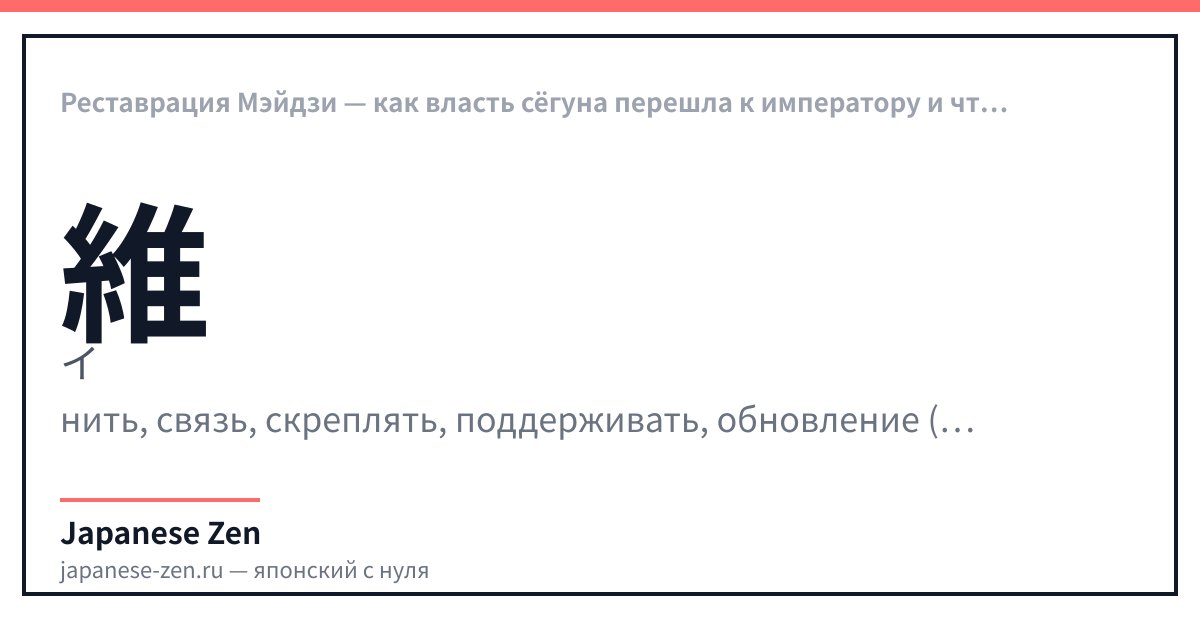
維 — значение: thread, connection, to bind, to support, renewal (as part of 維新) — онъёми: イ — 14 штрих(ов). 維 — "thread, to bind": 14 strokes, N2 level. The first character of the word 維新 (ishin, "renewal") — the very one rendered in English as "restoration."
| Japanese | Reading | Translation |
|---|---|---|
| 明治維新 | Meiji Ishin · Meiji Ishin | The Japanese name of the event — literally "Meiji renewal" |
| 大政奉還 | taisei hōkan · taisei hōkan | Return of power by the shogun to the emperor, November 9, 1867 |
| 王政復古 | ōsei fukko · ōsei fukko | Edict restoring imperial rule, January 3, 1868 |
| 廃藩置県 | haihan chiken · haihan chiken | Abolition of domains and establishment of prefectures, 1871 |
| 天皇 | tennō · tennō | Emperor — the central figure of the restoration |
| 新しい | atarashii · atarashii | "New" — the same character 新 as in 維新 |
Restoration or Revolution?
Some historians debate whether the word "restoration" accurately describes what happened. Formal power returned to the emperor, but the real rulers became former samurai of Satsuma and Choshu, who had previously been outside the shogunate's power structure. In the end, the country received not the old order but a constitution, a European-style army, and a parliament — which is why the events of 1868 are sometimes called a revolution from above rather than a restoration in the literal sense.
Listen and repeat the key words of the Meiji Restoration.
The Meiji Restoration in Film and Games
- "Rurouni Kenshin: Trust & Betrayal" (るろうに剣心 追憶編, OVA, 1999) — the hero's backstory: young Kenshin, nicknamed Hitokiri Battosai, kills on the orders of the Choshu shishi. The story ends on the threshold of Meiji.
- "維新の嵐" (Ishin no Arashi, Koei, 1988) — a strategy game where the player takes on the role of a historical figure of the bakumatsu era and must lead the restoration to victory through diplomacy and alliances, not just weapons.
What's Wrong with the Picture on Screen
The restoration itself is not the most spectacular event for adaptation: power changed hands not in a single battle but through a series of edicts, letters, and negotiations stretched over several months. That is why films and anime more often show either the preceding years of confrontation or life after 1868, rather than the moment of transfer of power itself.
FAQ
- What is the Meiji Restoration?
- The Meiji Restoration (明治維新) was the coup of 1867–1868 that returned supreme power from the shogun Tokugawa to Emperor Mutsuhito. On November 9, 1867, Shogun Yoshinobu relinquished power, and on January 3, 1868, an edict restored imperial rule. The event opened the way to the country's industrialization.
- When did the Meiji Restoration take place?
- The key events took less than two months: on November 9, 1867, Shogun Tokugawa Yoshinobu submitted a petition to return power, and on January 3, 1868, the imperial court issued the restoration edict. Already on January 27, 1868, the shogun's and the emperor's supporters clashed at the Battle of Toba-Fushimi — the Boshin War began.
- Who carried out the Meiji Restoration?
- The coup was carried out by the domains of Satsuma and Choshu together with part of the court nobility, while Tosa sought a gentler path — the voluntary transfer of power by the shogun. The main figures were the "Three Great Heroes of the Restoration" — Saigo Takamori, Okubo Toshimichi, and Kido Takayoshi. The Satsuma-Choshu alliance in 1866 was helped by Sakamoto Ryoma of Tosa.
- How does "restoration" differ from the Japanese 維新?
- "Restoration" emphasizes the return of power to the emperor, as if the country had returned to the old order. The Japanese 維新 (ishin) means "renewal" — and more accurately describes the essence: the country received not the old order but a constitution, a parliament, and a European-style army. The English translation is a conventional but not literal rendering of the meaning.
- How is the Meiji Restoration connected to the Boshin War?
- The shogun's supporters did not recognize the restoration edict of January 3, 1868, and already on January 27 the fighting at Toba-Fushimi began — the first battle of the Boshin War. The hostilities continued for a year and a half and ended with the capitulation of the Republic of Ezo in Hakodate in June 1869.
- In which anime and games is the Meiji Restoration shown?
- The moment of transfer of power itself rarely becomes a plot. The OVA "Rurouni Kenshin: Trust & Betrayal" (追憶編, 1999) shows the eve of the restoration through the story of the hitokiri Battosai, while the game "維新の嵐" (Koei, 1988) lets the player guide a historical bakumatsu figure through the coup itself.
Sources
Updated: 2026-09-13