Shinsengumi — the force that guarded Kyoto for the shogun
The Shinsengumi (新選組) was an armed police force of the Tokugawa shogunate that kept order in Kyoto from 1863 to 1869 under the patronage of Aizu domain. The Shinsengumi grew out of Kiyokawa Hachiro's ronin corps and became known for harsh discipline and its hunt for supporters of the emperor, including the Ikedaya Incident of 1864. The force fought to the end of the Boshin War: its last fighters laid down their arms in Hakodate in 1869.
Half of readers know the Shinsengumi from Gintama or Hakuoki, where the fighters brawl under parody names or battle demons. Let's look at what the force actually did: how it got its name and why Kyotoites nicknamed it the "Wolves of Mibu." And also — which of the commanders made it to Hakodate and what in anime is true and what is fiction.
What the Shinsengumi was and why it was created
The Shinsengumi (新選組) was a force that kept order in Kyoto on the side of the Tokugawa shogunate from 1863 to 1869. Its core was made up of swordsmen from the Shieikan dojo led by Kondo Isami and Serizawa Kamo's group — they stayed in Kyoto after Kiyokawa Hachiro's ronin corps (浪士組), brought there to guard the shogun, was disbanded. Those who remained were taken under the patronage of Matsudaira Katamori, lord of Aizu and head of Kyoto's security.
| Name | Role | Fate |
|---|---|---|
| Kondo Isami | commander (局長) | executed May 17, 1868 in Itabashi |
| Hijikata Toshizo | deputy commander (副長) | killed in battle June 20, 1869 in Hakodate |
| Okita Soji | captain of the first unit | died of tuberculosis July 19, 1868 |
| Saito Hajime | captain of the third unit | survived the war, died in 1915 under the name Fujita Goro |
| Serizawa Kamo | one of the first commanders | eliminated by his own men in October 1863 |
| Nagakura Shinpachi | captain of the second unit | survived the war, left late memoirs |
Patrols, raids, and arrests
The force's daily work was patrolling streets, checking inns, and arresting supporters of overthrowing the shogunate at the height of the wave of political assassinations of 1862–1864 known as tenchu, "heaven's punishment." The set of internal rules most often cited as the Shinsengumi's harsh code (局中法度), with seppuku as punishment for offenses, does not appear in that form in documents of the era. It is known from later retellings — Nagakura Shinpachi's memoirs of the 1910s and Shimozawa Kan's book Shinsengumi Shimatsuki (1928).
The name and kanji: 新選組
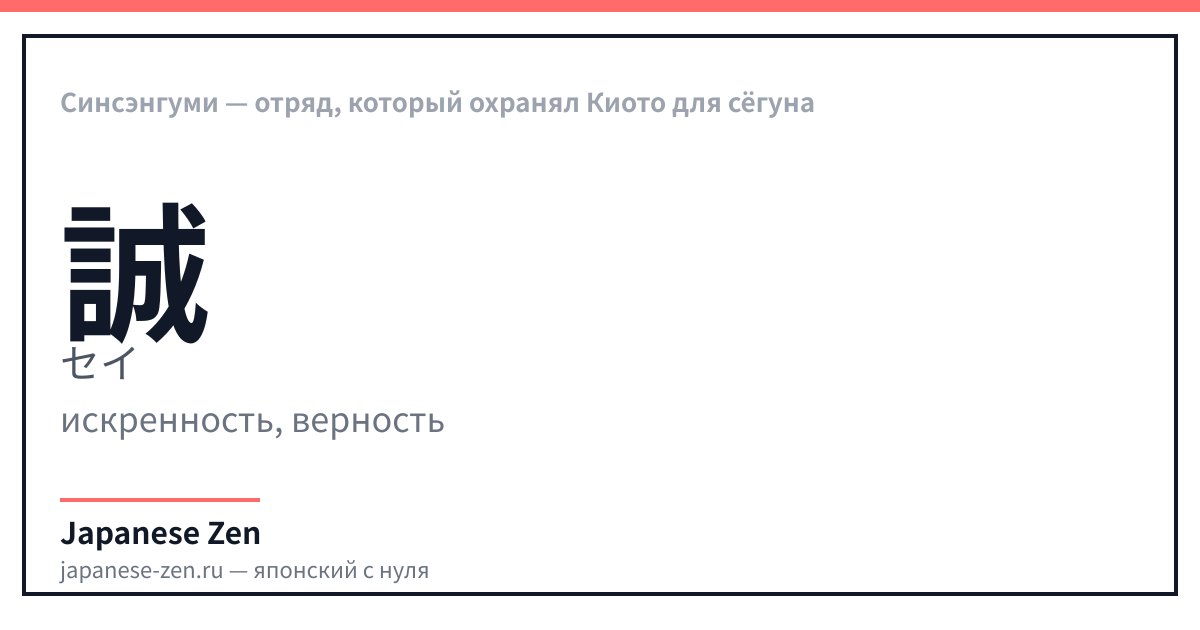
誠 — значение: sincerity, loyalty — онъёми: セイ — кунъёми: まこと — 13 штрих(ов). 誠 (makoto) — "sincerity, loyalty": this character was on the force's battle banner and became the Shinsengumi's unofficial motto.
What the name means, part by part
新選組 is read Shinsengumi and is made up of three characters: 新 "new," 選 "to select, choose," and 組 "unit, group" — together "newly selected corps." In documents of the era, including letters by Kondo Isami himself, the spelling 新撰組 with the similar-meaning character 撰 also appears; today the spelling 新選組 is standard. The spelling "Shinsengumi" follows Hepburn romanization.
| Japanese | Reading | Translation |
|---|---|---|
| 新選組 | Shinsengumi · Shinsengumi | The force's name — "newly selected corps" |
| 誠 | makoto · makoto | "Sincerity" — the character on the force's banner |
| 局長 | kyokuchō · kyokuchō | Force commander — Kondo Isami's title |
| 副長 | fukuchō · fukuchō | Deputy commander — Hijikata's title |
| 壬生浪 | Mibu-ro · Mibu-ro | "Mibu ronin" — a mocking nickname from contemporaries |
| 壬生狼 | Mibu-ro · Mibu-ro | "Wolves of Mibu" — the same word written with the character 狼 "wolf": a later literary variant |
Write 誠 along the guides — the character of loyalty from the Shinsengumi's battle banner.
The Shinsengumi in anime and games
- Gintama (2006, Sunrise) — the Shinsengumi has a parody counterpart here, the 真選組 (same reading, different first character), with commander Kondo Isao and deputy Hijikata Toshiro.
- Hakuoki (2010, Deen) — an adaptation of the Otomate romance visual novel (2008), in which the Shinsengumi also defend Kyoto from a supernatural threat.
- Rurouni Kenshin (1996–1998, Gallop and Deen) — former unit captain Saito Hajime serves in the Meiji police under the name Fujita Goro, and the young swordsman Seto Sojiro is based on Okita Soji.
- Peacemaker Kurogane (2003, Gonzo) — the story of a fictional boy servant who joins the Shinsengumi and meets Kondo, Hijikata, and Okita.
- Golden Kamuy (2018–2020, Geno Studio; 2022–2023, Brain's Base) — an alternate history in which Hijikata Toshizo did not die in Hakodate but decades later, as a very old man, escapes from Abashiri Prison.
How close is this to history
Rurouni Kenshin is closer to history than the others: Saito's postwar career in the police is taken from his biography, though his signature move gatotsu is invented. Gintama and Peacemaker Kurogane take only the names and personalities, building a comedy or an alternate plot around them; Hakuoki and Golden Kamuy turn the Bakumatsu story directly into fantasy and do not claim accuracy.
How it all ended
After the defeat of the shogun's forces at Toba-Fushimi in January 1868, the force retreated to Edo and was reorganized into the Koyo Chinbutai under Kondo and Hijikata, but was defeated at Katsunuma. Kondo surrendered at Nagareyama and was beheaded as a state criminal on May 17, 1868 in Itabashi. The remnants of the force, led by Hijikata, retreated north through Aizu territory and eventually joined the forces of the Republic of Ezo in Hakodate. There Hijikata was killed in battle on June 20, 1869 — a week before the surrender of Goryokaku fortress on June 27, which ended the Boshin War. Saito Hajime stayed to defend Aizu and survived the war.
FAQ
- What is the Shinsengumi?
- An armed police force of the Tokugawa shogunate that kept order in Kyoto from 1863 to 1869 under the patronage of Aizu domain. The core of the force was made up of fighters from the Shieikan dojo led by Kondo Isami and Hijikata Toshizo.
- When did the Shinsengumi exist?
- From 1863, when part of Kiyokawa Hachiro's ronin corps stayed in Kyoto and came under Aizu's patronage, until 1869, when the last fighters laid down their arms in Hakodate after the surrender of Goryokaku fortress.
- What does the name "Shinsengumi" mean?
- 新選組 is made up of the characters 新 "new," 選 "to select," and 組 "unit" — together "newly selected corps." In documents of the era, including letters by Kondo Isami himself, the spelling 新撰組 with a similar-meaning character also appears, but today the spelling 新選組 is standard.
- Why was the Shinsengumi called the "Wolves of Mibu"?
- The force was stationed in the Mibu district on the outskirts of Kyoto, and townspeople mockingly called the fighters "Mibu-ro" (壬生浪) — "Mibu ronin," alluding to penniless ronin (浪人). Later the same word came to be written with the character 狼 "wolf": the sound stayed the same, but the meaning became more menacing — "Wolves of Mibu" (壬生狼). This variant caught on in literature and anime.
- How many people were in the Shinsengumi?
- The force began with roughly two dozen fighters in 1863, and at its peak, by various estimates, numbered about 230. Its membership changed constantly due to losses, purges, and new recruits; in 1867 the fighters were enrolled as direct vassals of the shogun.
- Which anime feature the Shinsengumi?
- In Gintama as the parody force 真選組, in Hakuoki in a fantasy with demons, in Golden Kamuy in an alternate history, while Rurouni Kenshin and Peacemaker Kurogane stay closer to their historical prototypes.
Sources
Updated: 2026-09-13