Takasugi Shinsaku — a samurai from Chōshū who created a unit regardless of class
Takasugi Shinsaku (高杉晋作, 1839–1867) was a samurai from Chōshū, a student of Yoshida Shōin and the creator of the Kiheitai (奇兵隊). In 1863, it was one of the first units in Japan to recruit fighters regardless of class — both samurai and commoners. In January 1865, Takasugi Shinsaku raised a rebellion at Kōzan-ji temple and turned Chōshū against the shogunate, but on May 17, 1867, he died of tuberculosis, not living to see the Meiji Restoration.
After a trip to Shanghai in 1862, where Takasugi saw what the Western powers had turned China into, he returned to Chōshū a convinced opponent of the shogunate. Let's examine who actually made up the Kiheitai and what happened at Kōzan-ji temple in the winter of 1865. Separately — who added the second line of his famous death poem: Takasugi himself or the woman who cared for him in his final days.
From Yoshida Shōin's dōjō to a commander without class distinctions
Takasugi Shinsaku was born in 1839 in Hagi, into a middle-ranking samurai family of the Chōshū domain. He studied at the private school Shōka Sonjuku under Yoshida Shōin, where he and Kusaka Gensui were called 'the two pillars of the school.' In 1862, the domain sent Takasugi to Shanghai. There he saw how the Western powers had effectively subjugated Qing China, and he returned home convinced that Japan would face the same fate unless the country's military structure was changed. In 1863, he created the Kiheitai (奇兵隊, 'unit of extraordinary warriors') — a militia that was one of the first to recruit not only samurai but also peasants and townspeople.
| Year | Event |
|---|---|
| 1839 | born in Hagi, Chōshū domain |
| before 1862 | studies under Yoshida Shōin at Shōka Sonjuku |
| 1862 | trip to Shanghai on the ship Senzaimaru |
| 1863 | creates the Kiheitai in Shimonoseki |
| January 12, 1865 | raises a rebellion at Kōzan-ji temple against the faction that submitted to the shogunate |
| 1866 | Chōshū repels the second shogunate expedition |
| May 17, 1867 | dies of tuberculosis |
Who actually served in the Kiheitai
Contrary to the popular image of a 'peasant army,' the Kiheitai recruited by ability, not by birth: among the fighters were samurai, peasants, and townspeople, and by some estimates samurai made up about half of the unit. The value of the unit was not that it was peasant-based, but that origin ceased to matter in selection — by the standards of 19th-century class-based Japan, this was almost revolutionary.
杉 in the surname, 奇 in the unit's name
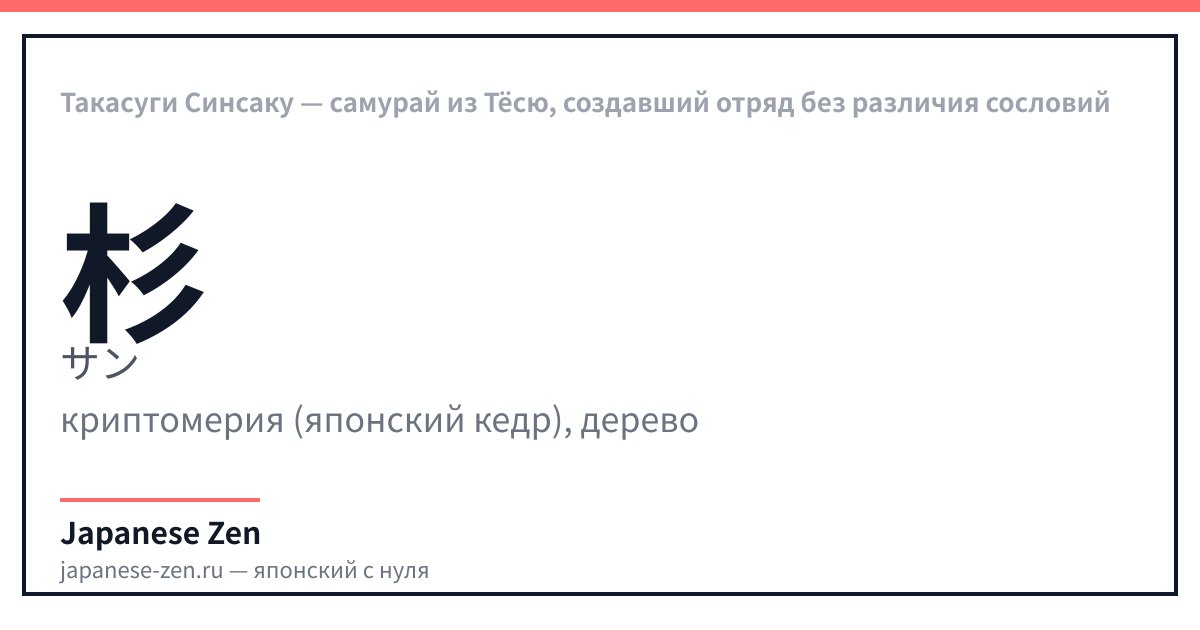
杉 — значение: cryptomeria (Japanese cedar), tree — онъёми: サン — кунъёми: すぎ — 7 штрих(ов). 杉 — 'cryptomeria,' Japanese cedar: the first kanji of the surname Takasugi (高杉, literally 'high cryptomeria'). Trees are a common source of surnames in Japan, like 松 'pine' or 桂 'katsura tree.'
Why the unit was called 'extraordinary'
奇兵隊 is read Kiheitai and is composed of 奇 'extraordinary, irregular,' 兵 'warrior, army,' and 隊 'unit.' The character 奇 here is opposed to 正 'regular, standard': the Kiheitai was not the domain's elite guard, but a volunteer militia outside the usual military structure.
| Japanese | Reading | Translation |
|---|---|---|
| 高杉晋作 | Takasugi Shinsaku · Takasugi Shinsaku | Full name |
| 奇兵隊 | Kiheitai · Kiheitai | Unit that recruited regardless of class |
| 松下村塾 | Shōka Sonjuku · Shōka Sonjuku | Yoshida Shōin's private school |
| 奇妙 | kimyō · kimyō | 'Strange, curious' — with the 奇 from the name Kiheitai |
| 杉 | sugi · sugi | 'Cryptomeria' — the tree in the surname Takasugi |
Listen to how 奇妙 and 杉 sound — the app will evaluate your pronunciation.
Deathbed poem: what was added by someone else
Takasugi lived only 27 years — tuberculosis took him to the grave just months before Chōshū's victory over the shogunate. Even his most famous line turned out not to be entirely his own.
- Legend: on his deathbed, Takasugi uttered the first half of the poem — 'おもしろき こともなき世を おもしろく' ('to make interesting a world where nothing is interesting'). The second half, 'すみなすものは心なりけり' ('but it is the heart that decides everything'), was added by the poet-nun Nomura Bōtō, who cared for him. Upon hearing it, Takasugi is said to have remarked 'interesting' and died soon after.
- Myth: the Kiheitai was a purely peasant army that rose up against samurai rule. Sources say otherwise: it was a mixed militia where a fighter's origin did not matter in selection, not a peasant revolt against class.
- In 'Gintama,' the hero's former comrade is named Takasugi Shinsuke (高杉晋助) — the entire name matches except for the last kanji, but this is a separate character — a gloomy main antagonist, not a biopic.
FAQ
- What is Takasugi Shinsaku known for?
- A samurai of the Chōshū domain, a student of Yoshida Shōin, who in 1863 created the Kiheitai — a militia that recruited not only samurai. In January 1865, he raised a rebellion at Kōzan-ji temple and turned Chōshū's internal politics toward war with the shogunate. He died of tuberculosis in 1867.
- Is it true that the Kiheitai consisted only of peasants?
- No: the unit recruited by ability, not by birth, and among the fighters were samurai, peasants, and townspeople — by some estimates samurai made up about half of the unit. The value of the Kiheitai was precisely that class ceased to be a criterion for selection.
- What does the surname Takasugi mean?
- 高杉 — 'high cryptomeria': 高 'high' and 杉 'cryptomeria,' Japanese cedar. The full name is written 高杉晋作 — Takasugi Shinsaku. In 'Gintama,' the character with a similar name, Takasugi Shinsuke (高杉晋助), has only the last character changed.
- What did Takasugi see in Shanghai in 1862?
- He saw a city where the Western powers effectively controlled Qing China, and the locals were treated as servants in their own port. This convinced Takasugi that Japan would face the same fate without a strong modern army — and pushed him toward the idea of the Kiheitai.
- What is Takasugi Shinsaku's death poem about?
- 'おもしろき こともなき世を おもしろく' — 'to make interesting a world where nothing is interesting.' According to legend, Takasugi managed to utter only this half, and the second half — 'すみなすものは心なりけり,' 'but it is the heart that decides everything' — was added by the poet-nun Nomura Bōtō, who cared for him in his final days.
- When did Takasugi Shinsaku die?
- On May 17, 1867, of tuberculosis, at the age of 27 — less than a year after Chōshū repelled the second shogunate expedition. He missed the Meiji Restoration, which began in late 1867 – early 1868, by only a few months.
Sources
Updated: 2026-09-13