Bakufu — What It Really Means
Bakufu is the Japanese name for the military government under a shogun: literally "field headquarters," from the campaign tent of a commander (幕) and the word for "office" (府). It referred to the power that actually governed the country while the emperor in Kyoto remained the formal sovereign. Japanese history had three bakufu — Kamakura, Muromachi, and Tokugawa — and the word itself became widely established in this sense fairly late.
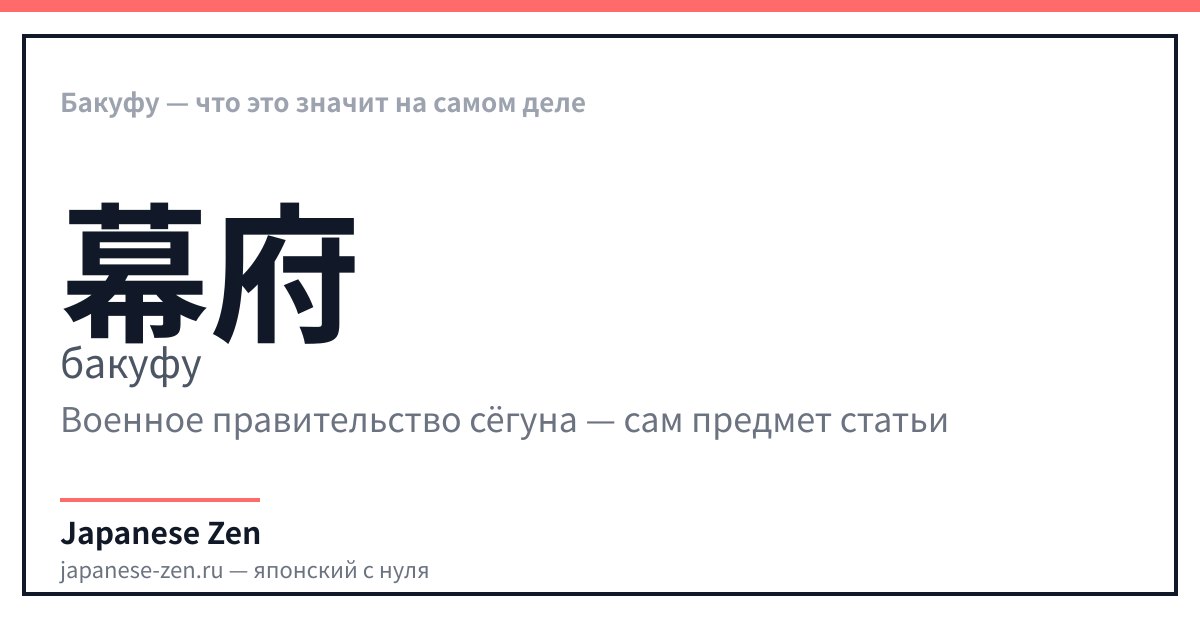
The same phenomenon has two names in English — "shogunate" and "bakufu" — and that is where the confusion begins. "Bakufu" is not a translation but a Japanese word with its own history, one that Tokugawa contemporaries almost never used. Let's look at where the term came from, what it is made of, and why it became established much later than is commonly thought.
What "Bakufu" Means
Bakufu (幕府) is a Japanese word for the military government that existed alongside a living imperial court: the shogun and his apparatus governed the land, the army, and the courts, while the emperor in Kyoto remained a formal sovereign without real power. Literally, 幕府 means "field headquarters": 幕 is the campaign curtain used to enclose a commander's tent on campaign, and 府 is an office or institution. The word came from China, where it referred to a commander's headquarters, and in Japan it became attached to military power, which took over this metaphor from itself: the country was governed like an army on the march.
How to Translate It Without Losing the Meaning
English dictionaries translate 幕府 as "tent government" — closer to the original than "shogunate." "Shogunate" points to the power of a specific shogun, while "bakufu" refers to the institution itself, which outlasted many shoguns. It is more accurate to say not "they are the same thing" but "bakufu is the Japanese name for the same phenomenon."
| Japanese | Reading | Translation |
|---|---|---|
| 幕府 | bakufu · bakufu | The shogun's military government — the subject of this article |
| 公儀 | kōgi · kōgi | What Tokugawa contemporaries themselves called the shogun's power |
| 将軍 | shōgun · shōgun | The head of the bakufu, the military ruler of Japan |
| 幕末 | bakumatsu · bakumatsu | The end of the bakufu era, the second half of the 19th century |
Breaking Down the Kanji: 幕府
幕 — значение: curtain, canopy, headquarters (institution) — онъёми: マク、バク — кунъёми: とばり — 13 штрих(ов). 幕 — "curtain, canopy, tent": 13 strokes; paired with 府 "office," it forms the word 幕府.
What Parts Make Up the Character 幕
According to one interpretation, 幕 is made up of the phonetic 莫 (read "maku/baku") and the radical 巾 "cloth" — together, "a sheet of fabric that blocks the view," that is, a tent curtain. The character 府 "office" is composed of the radical 广 "building" and the phonetic 付 "to entrust" — "a place where matters are handed over."
Write 幕 along the guides — the first character in 幕府, the "curtain" in the term's original sense.
Common Misconceptions
- "Bakufu is only the Tokugawa shogunate" — no, there were three bakufu: Kamakura (from 1192), Muromachi (from 1338), and Tokugawa (from 1603). The word describes a form of government, not a single period.
- "Tokugawa contemporaries themselves called their government bakufu" — not quite: they more often said 公儀 (kōgi), "official authority." The current meaning of 幕府 became widely established fairly late, largely through the efforts of Meiji-era historians.
- "The term 幕府 was invented in Japan" — no, the word is of Chinese origin: it referred to a commander's campaign headquarters for the duration of a campaign. Japan adopted this image and applied it to its own military government.
FAQ
- What does "bakufu" mean?
- Bakufu (幕府) is a Japanese word that referred to the military government under a shogun: literally "field headquarters," from the campaign curtain of a commander (幕) and the word for "office" (府). It referred to the real power in the country while the emperor in Kyoto remained a formal sovereign without an army or lands.
- How is "bakufu" written in kanji?
- In kanji it is written 幕府: 幕 is "curtain, tent," and 府 is "office, institution." The literal meaning is "an office at a field headquarters": the word originally described not a building but a commander's campaign camp, where administration was moved during wartime.
- Where did the word "bakufu" come from?
- The term came from China, where 幕府 referred to a commander's field headquarters on campaign. In Japan the word came to refer to the power of a military ruler at court — first in Kamakura from 1192, then in Muromachi and Tokugawa. In the modern sense of "the shogun's government," the word became widely established fairly late.
- How did the bakufu govern the country?
- The bakufu governed the country like a camp: the shogun granted and confiscated lands, appointed vassals, issued laws, and kept the daimyo under control, while the emperor remained a formal sovereign without real power. The details of how power was structured differed noticeably in each of the three bakufu.
- What is most often confused about the bakufu?
- The bakufu is confused with the Tokugawa shogunate, although there were three bakufu in history — Kamakura, Muromachi, and Tokugawa. The second mistake is to think that contemporaries themselves called their government "bakufu": they more often said 公儀, and the current meaning of the term became widely established among Meiji-era historians.
- How do you say this in Japanese?
- In Japanese it is 幕府, read ばくふ (bakufu). The literal meaning is "field headquarters": 幕 "curtain, tent" and 府 "office." Contemporaries of the Tokugawa era more often used a different word for the same government — 公儀 (こうぎ, kōgi), "official authority."
Sources
Updated: 2026-09-11