Bakumatsu — the Twilight of the Tokugawa Shogunate: Years, Events, People
Bakumatsu is not an official era with its own reign name, but the term historians use for the final years of the Tokugawa shogunate. Its start is usually dated to the arrival of Commodore Perry's fleet in 1853, while its end is defined differently: 1867, 1868, or 1869, depending on the author. During these years the country went from closed ports to the Boshin War and the Meiji Restoration.
The word "bakumatsu" has no fixed boundaries and no imperial decree that established it — it is a label later applied to the last decade and a half of the shogun's rule. We look at where the term itself came from, what slogans defined the era — "revere the emperor, expel the barbarians" and "union of court and bakufu" — and who the shishi, the "men of high purpose," were, giving bakumatsu its own face.
Which Years Are Called Bakumatsu
Bakumatsu (幕末, literally "end of the bakufu") was not an official era with its own reign name — it is a term historians use for the final years of the Tokugawa shogunate. Its start is usually dated to July 8, 1853, when Commodore Perry's fleet anchored at Uraga. Its end is defined differently: some authors mark the boundary with the decree of restoration of January 3, 1868, others with the end of the Boshin War in 1869. There is simply no single date when the bakumatsu period ended.
| Year | Event |
|---|---|
| 1853 | July 8 — Commodore Perry's fleet at Uraga; the start of bakumatsu is usually dated from this |
| 1854 | The Kanagawa Treaty opens the ports of Shimoda and Hakodate to American ships |
| 1858 | The "unequal" Ansei treaties with Western powers; the Ansei purges begin |
| 1860 | March 24 — tairo Ii Naosuke is assassinated at the Sakurada Gate |
| 1862–1864 | A wave of political assassinations in Kyoto under the slogan tenchū (天誅, "heavenly punishment") |
| 1863 | Kiyokawa Hachirō's ronin corps arrives in Kyoto; those who remain in Mibu become the core of the Shinsengumi |
| 1866 | March 7 — the Satsuma-Chōshū alliance, brokered by Sakamoto Ryōma |
| 1867 | November 9 — Shogun Yoshinobu submits his request to return power; December 10 — Sakamoto Ryōma is assassinated |
| 1868 | January 3 — the decree restoring imperial rule; the end of bakumatsu according to the most common view |
How Bakumatsu Differs from the Meiji Era
The Edo period before 1853 was a time of closed ports and unchanging social classes, while the Meiji era after 1868 was a time of reforms from above. Bakumatsu is the years of rupture between them: the country opened to foreign powers but still lived by old class rules, and the shogun's power weakened faster than a replacement could be found.
Breaking Down the Word 幕末: Not an Era, but a Historians' Term
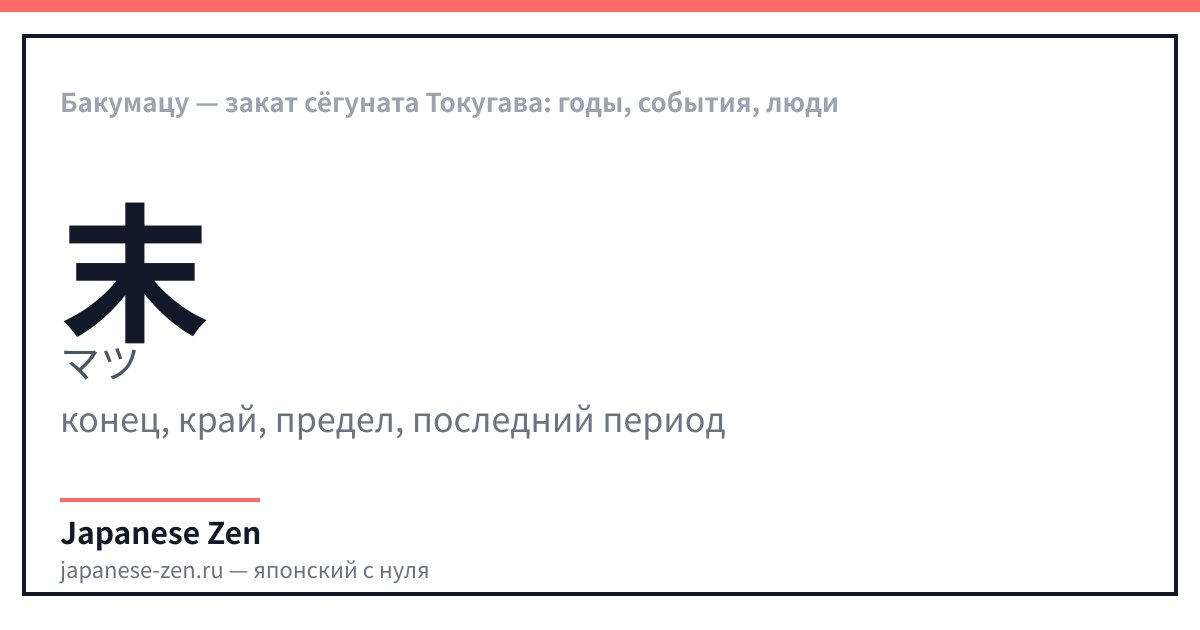
幕末 is read ばくまつ (bakumatsu) and is made up of two characters: 幕 — "tent, camp," the same as in 幕府 (bakufu, "shogun's government"), and 末 — "end." Literally — "end of the bakufu." The word looks at the era from the future: these years could only be called the "end" after the shogunate had actually fallen.
末 — значение: end, extremity, limit, final period — онъёми: マツ、バツ — кунъёми: すえ、うら、うれ — 5 штрих(ов). 末 — "end, extremity": 5 strokes, N3 level. The second character in 幕末 ("end of the bakufu") and in 週末 (shūmatsu, "weekend").
| Japanese | Reading | Translation |
|---|---|---|
| 幕末 | Bakumatsu · Bakumatsu | The name of the period — "end of the bakufu" |
| 尊王攘夷 | sonnō jōi · sonnō jōi | "Revere the emperor, expel the barbarians" — the main slogan of the era |
| 公武合体 | kōbu gattai · kōbu gattai | "Union of court and bakufu" — a policy of compromise instead of rupture |
| 志士 | shishi · shishi | "Men of high purpose" — activists of sonnō jōi |
| 週末 | shūmatsu · shūmatsu | Weekend, end of the week — the same character 末 as in bakumatsu |
Write 末 along the guides — the second character in 幕末, "end of the bakufu."
Shishi and the Slogans of the Era
Radical supporters of sonnō jōi were called shishi (志士) — "men of high purpose": mostly poor low-ranking samurai from Chōshū, Satsuma, and Tosa, for whom sonnō jōi became a program of action rather than just a phrase. They were opposed by supporters of kōbu gattai (公武合体) — a compromise between the court and the bakufu without a revolutionary break of the system.
Bakumatsu in Anime and Games
- "Bakumatsu Kikansetsu Irohanihoheto" (幕末機関説 いろはにほへと, 2006) — an original anime series by Sunrise: a fantasy plot about searching for artifacts unfolds against the backdrop of the Boshin War, and the title directly includes the word "bakumatsu."
- "Bakumatsu Roman: Gekka no Kenshi" (幕末浪漫 月華の剣士, SNK, 1997) — a fighting game for arcades and Neo Geo: swordsmen of the bakumatsu era fight each other, and the title literally translates as "Bakumatsu Romance: Swordsmen of the Moonlight."
How to Recognize Bakumatsu on Screen
Bakumatsu on screen is almost always recognized by the mix of eras in the frame: samurai swords alongside revolvers and Western-style cannons, kimono alongside European military uniforms. And the plot almost always involves choosing a side — the shogunate or the emperor. Bakumatsu is distinguished from the Meiji era by details: there are no railways or parliament yet, and European uniforms and rifles are only beginning to replace armor.
FAQ
- Which years are called bakumatsu?
- Most often the boundaries are given as 1853 — the arrival of Perry's fleet — and 1868, when the decree restoring imperial rule was issued. But there is no single end date: some authors extend bakumatsu to the end of the Boshin War in 1869, because armed resistance to the shogunate continued for another year and a half.
- How long did the bakumatsu period last?
- From 14 to 16 years, depending on which year is considered the end — 1867, 1868, or 1869. The word 幕末 itself does not denote an era with a fixed term, like reign names such as Meiji: it is a historical term for the last, most turbulent years of the shogunate's power.
- What happened during the bakumatsu period?
- Under pressure from Western powers, Japan opened its ports, signed unequal treaties, and experienced a wave of political assassinations in Kyoto in 1862–1864. The country split into supporters of the shogunate and supporters of the emperor under the slogan sonnō jōi (尊王攘夷), and it all ended with the Boshin War and the Meiji Restoration.
- How is "bakumatsu" written in kanji?
- In kanji it is 幕末: 幕 — "tent, camp," the same character as in 幕府 (bakufu, "shogun's government"), and 末 — "end." The literal meaning of the word is "end of the bakufu": that is what the final years of shogunal power came to be called after the restoration.
- Who were the shishi during the bakumatsu period?
- Shishi (志士, "men of high purpose") were mostly young low-ranking samurai from Chōshū, Satsuma, and Tosa who demanded the immediate expulsion of foreigners and the return of power to the emperor. Some of them took part in political assassinations under the slogan tenchū (天誅, "heavenly punishment") in Kyoto in 1862–1864.
- Which anime and games are called "bakumatsu"?
- The name is directly borne by the anime "Bakumatsu Kikansetsu Irohanihoheto" (2006) about searching for artifacts against the backdrop of the Boshin War, and the SNK fighting game series "Bakumatsu Roman: Gekka no Kenshi" (1997) for arcades and Neo Geo.
Sources
Updated: 2026-09-13