Naginata — Japanese Cold Weapon: Blade Types and History
The naginata is a Japanese polearm with a curved blade on a long shaft, something between a sword and a spear. Naginata types are distinguished primarily by blade width and shape — from a narrow blade resembling a tachi blade to a wide, heavy one. Originally an infantry weapon, it later became something taught to women of samurai households.
For a long time in Japan, the naginata was associated not only with the battlefield but also with the home: this weapon was taught to women who needed to defend themselves and their household while the men were at war.
What is a naginata and what blade types does it have
The naginata (薙刀) is a polearm with a curved single-edged blade about 30–60 cm long, mounted on a shaft about 1.2–2.4 m long. Formally it is not a sword but rather a "sword on a long handle": the blade was forged just like a katana blade, and it is detachable — it could be replaced or remounted separately from the shaft. Such a weapon gave an advantage in reach against cavalry and infantry with shorter blades.
- Blade — forged like a sword, curved, single-edged, attached to the shaft via a tang.
- Shaft — long, wooden, often with metal rings for strength.
- Scabbard — fitted onto the blade separately, as for a sword.
- Blade attachment to the shaft — detachable; if needed, the blade could be remounted into another weapon.
What types of naginata blades exist
| Type | Blade | Feature |
|---|---|---|
| Shizuka-gata (静形) | narrow, slightly curved, closer in silhouette to a tachi blade | a lighter and faster variant to handle |
| Wide blade type (the name "ōmono-gata" appears in literature) | wide, noticeably curved and heavy | designed for a powerful cutting blow rather than speed |
| Nagamaki (長巻) | similar to a naginata, but the handle is almost as long as the blade and wrapped with cord like a sword | a separate related weapon, not a subtype of naginata |
The nagamaki is formally not part of the classification of naginata types — it is a separate weapon with a similar idea of a long blade on a shaft, but a fundamentally different handle: not a lacquered shaft, but a cord-wrapped handle almost equal to the blade length, like a sword. Historically, both types of weapon are often confused precisely because of their visual similarity at a distance.
The naginata as a weapon of women of samurai households
Unlike the katana, the naginata was for a long time considered also a household weapon: women from samurai families were trained to wield it to defend the home while the men were on campaign or in service. The legendary warrior Tomoe Gozen, told of in the Tale of the Heike, is often depicted with a naginata in later illustrations and retellings, although early sources describe her martial skill in general, without a detailed list of weapons. A better-documented example is the women's unit Jōshitai at Aizu in 1868: its member Nakano Takeko died in battle with a naginata in her hands.
How the naginata differs from the European glaive
Outwardly, the naginata and the European glaive are confused because of their common silhouette — a curved blade on a long shaft — but their construction is different. The naginata blade is forged and tempered like a sword, detachable, with a full tang; the glaive blade is rigidly riveted to the shaft and usually wider, with a straight or slightly curved edge, sometimes with a hook or spike on the back. The technique also differs: the naginata is primarily used to cut with a broad swinging motion, while the glaive is more often used to chop and thrust, inheriting techniques from European polearm designs of the 14th–16th centuries.
薙刀 — "the blade that mows": a verb in the weapon's name
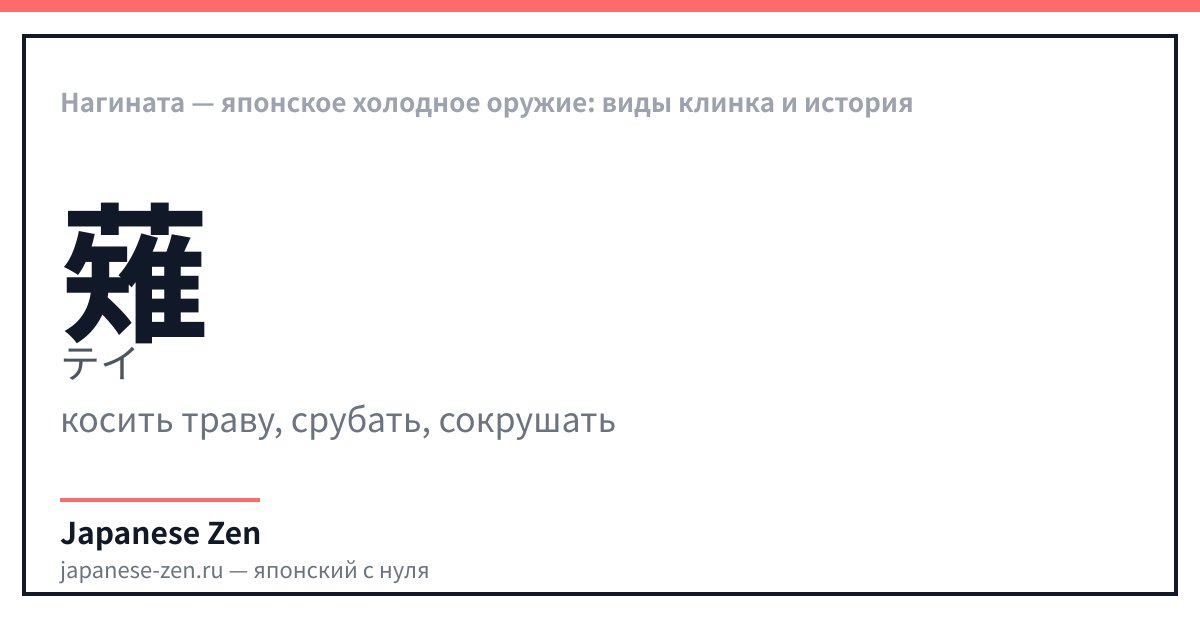
薙刀 is read なぎなた (naginata): 薙 — "to mow, to cut down", 刀 — "sword, blade". Literally — "mowing blade", a literal description of the technique of broad cutting strikes for which the long shaft is intended.
薙 — значение: to mow grass, to cut down, to mow down — онъёми: テイ、チ — кунъёми: な.ぐ、なぎ、か.る — 16 штрих(ов). 薙 — "to mow, to cut down": a rare character that almost never appears outside the word 薙刀 (naginata) and the verb 薙ぐ (nagu, "to cut down with one motion").
How it is read and what it literally means
| Japanese | Reading | Translation |
|---|---|---|
| 薙刀 | naginata · naginata | polearm with a curved blade |
| 薙ぐ | nagu · nagu | to cut down with one broad motion |
| 長刀 | naginata · naginata | old spelling of the same word |
| 長巻 | nagamaki · nagamaki | related weapon with a wrapped handle |
| 薙刀道 | naginatadō · naginatadō | modern competitive discipline of naginata fencing |
Write 薙 along the guides — the character "to mow, to cut down" from the name naginata.
The naginata today: from the dōjō to rare appearances in anime
Who practices the naginata today
Today the naginata is studied not as a martial art of the past but as a competitive discipline — naginatadō: in Japan it is practiced predominantly by women, and the discipline itself grew out of prewar and postwar school physical education for girls. In popular culture, the naginata appears noticeably less often than the katana. There are few recognizable characters wielding this weapon in major titles: the naginata rests on real history, not on screen appearances.
FAQ
- What is a naginata?
- The naginata (薙刀) is a Japanese polearm with a curved single-edged blade about 30–60 cm on a shaft about 1.2–2.4 m long. The blade is forged like a sword and is detachable. Originally an infantry weapon, it later became something taught to women of samurai households.
- What types of naginata are there by blade?
- The main difference is blade width: the narrow shizuka-gata is closer in silhouette to a tachi blade and easier to handle; the wide and heavy type is designed for a powerful cutting blow. The nagamaki stands apart — a related but independent weapon with a handle almost equal to the blade length.
- How does the naginata differ from the glaive?
- The naginata blade is forged and tempered like a sword, detachable, with a full tang; the glaive blade is rigidly riveted to the shaft and usually wider. The naginata is primarily used to cut with a broad swinging motion, while the glaive is more often used to chop and thrust — these are different combat traditions, not one weapon under different names.
- Is it true that the naginata was wielded mainly by women?
- Originally the naginata was primarily an infantry weapon, but over time it also became established as a weapon of women of samurai households for defending the home. A documented example is the women's unit Jōshitai at Aizu in 1868. Today's competitive naginatadō in Japan is also predominantly a women's discipline.
- What does the word "naginata" literally mean?
- The written form is 薙刀, read なぎなた. 薙 means "to mow, to cut down", 刀 — "sword, blade". The literal translation is "mowing blade": the name directly describes the technique of broad cutting strikes for which the long shaft is needed.
- How does the nagamaki differ from the naginata?
- The nagamaki (長巻) looks similar to the naginata — also a long blade on a shaft — but is constructed differently: the handle is almost as long as the blade and wrapped with cord like a sword, not lacquered like the naginata shaft. It is a separate related weapon, not a subtype of naginata.
Sources
Updated: 2026-09-10