Yari — the Japanese Spear: Why Ashigaru Fought with It Instead of the Sword
Yari (槍) is a Japanese spear with a straight or cross-shaped head on a long shaft, the main weapon of infantry in the Sengoku period. Ashigaru, commoner foot soldiers, were armed with yari en masse: holding a long spear in formation is quicker and easier to learn than mastering a sword. Oda Nobunaga armed his ashigaru with especially long spears — up to 3.5 ken, about 6 meters — and this gave his infantry an advantage in close combat.
In East Asia the spear long lacked the prestige of the sword, though it won almost any real battle in formation of simple infantry. Let's look at what kinds of yari heads existed, why infantry replaced the naginata and mounted spearmen on the battlefield, what is known about the 'three great spears' and the Hozoin-ryu school of spearmanship.
Straight Blade or Cross: What a Yari Consists Of
The yari head is forged like a sword blade — from the same steel and with the same hardening technique — and then mounted on a long wooden shaft via a tang. The most common type of head, su-yari (素槍), is a simple straight blade for thrusting. In jumonji-yari (十文字槍), two short blades extend crosswise from the sides of the main point: they could hook and pull a rider off his horse, not just stab. Spears with sickle-shaped side blades are called kama-yari (鎌槍), and the variant with one such blade is katakama-yari (片鎌槍).
| Head type | In Japanese | Feature |
|---|---|---|
| Su-yari | 素槍 | simple straight blade, the most common type of head |
| Jumonji-yari | 十文字槍 | cross-shaped, with two side blades — hooked riders |
| Kama-yari | 鎌槍 | with sickle-shaped side blades — one or two |
The shaft was made of wood, often with metal rings for strength — and its length decided the outcome of close combat for infantry. In the early Sengoku period, a spear of about 2.5 ken, roughly 4.5 meters, was considered standard. Oda Nobunaga armed his ashigaru with spears 3–3.5 ken long, about 5.4–6.3 meters — such a formation was hard to fence with individually, but a dense wall of points kept both cavalry and sword-wielding infantry at a distance.
Why the Long Spear Beat the Short Sword in Close Combat
A sword is effective at arm's length, but a palisade of spears did not let the enemy get that close at all. Ashigaru with yari hardly needed to master fine fencing technique: the formation thrust simultaneously, and teaching a commoner to hold a spear in the ranks could be done in weeks, not years as with a sword.
When the Spear Overtook the Naginata and Became a Mass Infantry Weapon
Before the Sengoku period, heavy infantry on the battlefield more often relied on the naginata — a polearm blade swung in a wide arc. The yari displaced the naginata in the 15th–16th centuries, when wars were fought by huge foot armies rather than elite mounted retinues: a thrusting spear in dense formation is more effective than a cutting weapon that needs room to swing. Mass production of simple su-yari heads and training ashigaru in spear formation proved faster and cheaper than raising naginata fencers.
What Happened at Shizugatake in 1583
In 1583, at the Battle of Shizugatake, the young commanders of Toyotomi Hideyoshi distinguished themselves with the spear in hand-to-hand combat against Shibata Katsuie's army. Seven of them — among them Kato Kiyomasa and Fukushima Masanori — later came to be called the 'Seven Spears of Shizugatake', though some lists include up to nine men among the distinguished.
The Three Famous Spears of Japan and the Hozoin-ryu School of Spear Fighting
The 'Three Great Spears of the Realm' (天下三名槍) is an honorary list of three historical yari, each famous through its owner or a legend. Tonbogiri belonged to the commander Honda Tadakatsu and, according to legend, got its name after a dragonfly that landed on its point was cut in two. Otegine was kept by the Yuki clan, who ruled Yuki Castle in Shimosa Province, and is named for its scabbard's resemblance to a mallet for pounding rice cakes. Nihongo originally belonged to the imperial court, then passed to Fukushima Masanori from Toyotomi Hideyoshi, and later to a vassal of the Kuroda house in a famous drinking contest.
The Art of Sojutsu and the Monk Who Invented the Cross Spear
The art of spear handling is called sojutsu (槍術). The largest and most famous school, Hozoin-ryu, was founded in the 16th century by the monk In'ei of Hozoin temple at Kofuku-ji in Nara: according to legend, the idea of the cross-shaped head came to him from the reflection of a crescent moon on Sarusawa Pond. It is said that with such a spear one can thrust, cut, and hook an opponent with the same movement.
槍 and 突: The Spear and the Thrust It Exists For
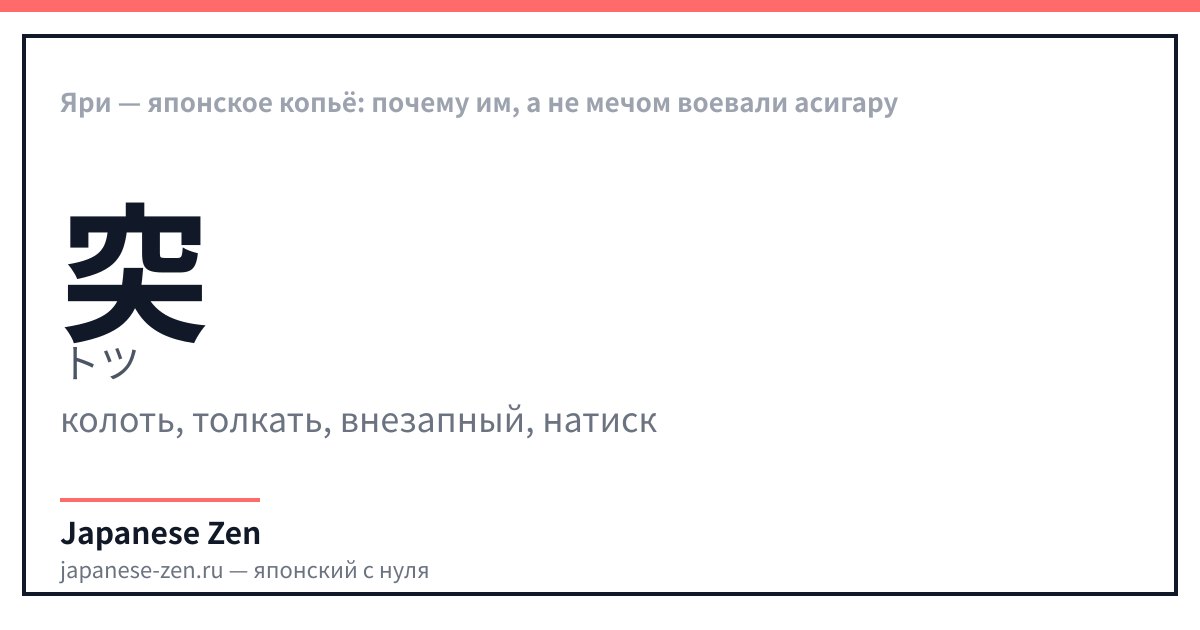
The word 'yari' has its own character, 槍, read やり. But for our topic another kanji is more important — 突: it means 'to thrust, to push' and describes not the object itself but the main action for which the spear exists — a sharp thrust forward. This character is read トツ in compound words and つ(く) in the native Japanese verb 'to thrust'.
突 — значение: to thrust, to push, sudden, onslaught — онъёми: トツ、カ — кунъёми: つ.く — 8 штрих(ов). 突 — 'to thrust, to push': the same character in 突く (tsuku, 'to thrust') and 突撃 (totsugeki, 'attack, charge'). The thrusting strike is the spear's main job.
What 'First Spear' Means — 一番槍
一番槍 (ichiban-yari), 'first spear', is an honorary title for the warrior who was the first in the whole army to enter close combat with a spear in a particular battle. It was not just speed but a huge risk: the first man met the densest enemy resistance, but the glory and reward from the commander were correspondingly great. At the Battle of Shizugatake, it was for the 'first spear' that Fukushima Masanori received a generous land grant from Toyotomi Hideyoshi.
| Japanese | Reading | Translation |
|---|---|---|
| 槍 | yari · yari | spear |
| 突く | tsuku · tsuku | to thrust, to push |
| 十文字槍 | jūmonji-yari · jūmonji-yari | cross-shaped spear with side blades |
| 一番槍 | ichiban'yari · ichiban'yari | honor of being first into battle with a spear |
| 素槍 | suyari · suyari | simple straight spear, the most common type |
| 穂先 | hosaki · hosaki | spear or sword point |
Write 突 along the guides — the character for 'thrust', which describes the yari's main movement.
FAQ
- What is a yari?
- Yari (槍) is a Japanese spear with a straight or cross-shaped steel head on a long wooden shaft. It was the main weapon of infantry in the Sengoku period: ashigaru held yari in dense formation, and such a wall of thrusting spears stopped both cavalry and sword-wielding infantry.
- How does a yari differ from a naginata?
- The yari head is mostly straight or cross-shaped and works by thrusting, while the naginata has a curved single-edged blade for wide cutting strikes, like a sword on a long handle. The yari is cheaper to produce and easier to master for mass infantry, so over time it pushed the naginata aside as the main weapon of armies.
- How long was an ashigaru's spear?
- In the early Sengoku period, a spear of about 2.5 ken, roughly 4.5 meters, was considered standard. Oda Nobunaga armed his ashigaru with even longer spears — 3–3.5 ken, about 5.4–6.3 meters — and a dense formation of such shafts kept the enemy at a distance, not letting him close for a sword strike.
- Which spears are called the three great ones?
- The 'Three Great Spears of the Realm' are Tonbogiri of the commander Honda Tadakatsu, Otegine of the Yuki clan, and Nihongo, which went from the imperial court first to Fukushima Masanori and then to a vassal of the Kuroda house in a famous drinking contest. All three are real historical spears; Otegine was destroyed in the bombing of Tokyo in 1945.
- Why did the spear become the main weapon of the Sengoku period?
- With a spear in dense formation one could fight effectively after weeks of training, not years as with a sword or naginata — and Sengoku armies were recruited primarily from simple peasant ashigaru. The yari head was also forged as simply as an ordinary blade, which made mass arming of infantry affordable.
- How is 'yari' written in Japanese?
- Yari is written with the character 槍, read やり. The same kanji appears in the word 竹槍 (takeyari) — a homemade bamboo spear. And the thrusting movement for which the spear exists is conveyed by the character 突 — 'to thrust'.
Sources
Updated: 2026-09-15