Japanese Swords: Types and Names with Photos — from Tachi to Naginata
Japanese swords are divided into several types by blade length and how they were worn: tachi, katana, wakizashi, tanto, odachi, naginata, and the earlier straight tsurugi. Below are the names and types of each sword in words, not just photos: the difference is visible in the blade curve, the length of the tang, and the shape of the guard.
Each of these blades has its own job, its own grip, and its own place in history: some were used to cut from horseback, others in tight indoor spaces, and still others were not so much weapons as symbols of status.
Main Types of Japanese Swords: from Tachi to Naginata
Japanese edged weapons are classified by blade length and how they were worn, not by how "cool" they are. The tachi and katana are related single-edged curved swords, but the tachi was worn with the blade facing down, suspended from the belt, while the katana later came to be thrust through the obi with the blade facing up. The wakizashi and tanto are shorter than the katana and served as secondary weapons. The odachi and nodachi exceed standard length. The naginata is formally not a sword but a polearm with a curved blade on a long shaft.
| Sword | Blade Length | How Worn / Purpose |
|---|---|---|
| Tachi (太刀) | usually 70–80 cm | suspended with the blade facing down, weapon of mounted warriors of the Heian–Kamakura periods |
| Katana (刀) | about 60–73 cm | thrust through the obi with the blade facing up, main weapon of the samurai from the Muromachi period |
| Wakizashi (脇差) | 30–60 cm | always carried, including indoors, part of the daisho set |
| Tanto (短刀) | up to 30 cm | dagger for close combat and as a personal weapon |
| Odachi / Nodachi (大太刀 / 野太刀) | from 90 cm, some examples over two meters | carried on the shoulder or on the back, a rare weapon for battle and temple offerings |
| Naginata (薙刀) | blade 30–60 cm on a shaft 1.2–2.4 m | polearm of the infantry, later a weapon of women in samurai households |
| Tsurugi (剣) | short straight double-edged blade | earlier weapon of the Kofun–Nara periods, by the late Middle Ages mainly a ritual object |
How They Differ in Length and Way of Wearing
Visually, the types are distinguished by three features: the curve of the blade (strong in the tachi, gentler in the katana, almost straight in the tsurugi), the length of the tang under the handle, and the shape of the tsuba guard. On battle swords the tsuba is usually a simple circle, while on ceremonial and later examples it is decorative.
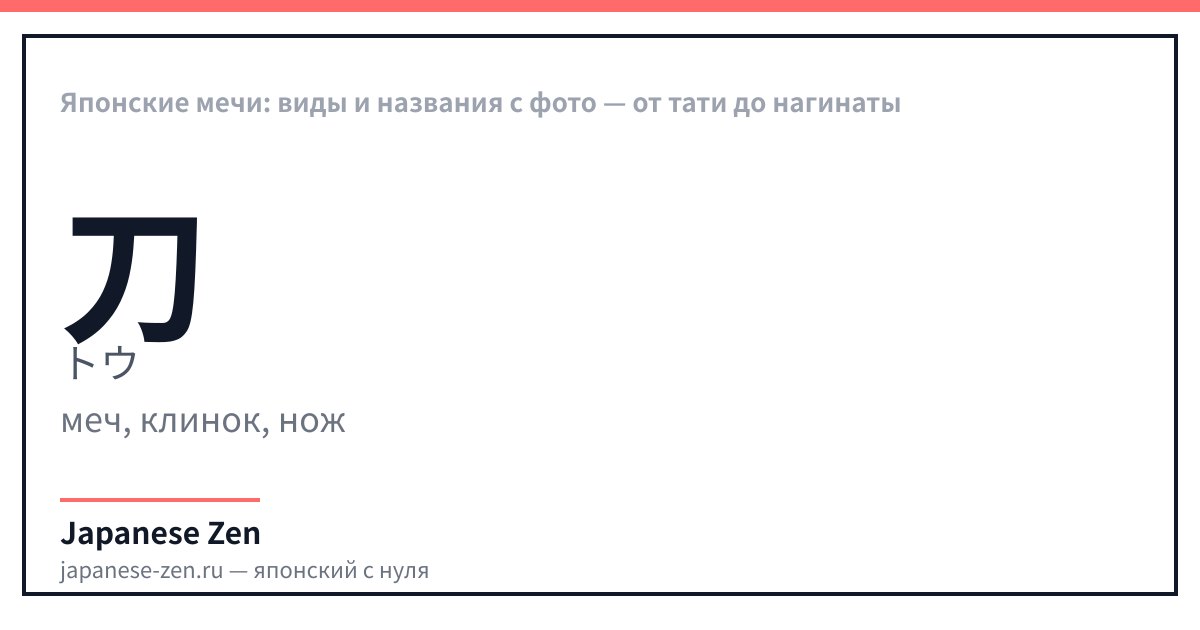
刀 — Two Strokes That Begin the Name of Any Sword
刀 is the basic character meaning "sword, blade," read as かたな (katana) in the standalone word and as とう in compound words like 日本刀 (nihontō, "Japanese sword" — a general term for all the types listed) and 短刀 (tantō, short sword).
刀 — значение: sword, blade, knife — онъёми: トウ — кунъёми: かたな、そり — 2 штрих(ов). 刀 — "sword, blade, knife": a basic N3-level character, part of 日本刀 (nihontō), 短刀 (tantō), and dozens of other words about edged weapons.
How the Basic Character for "Sword" Is Read
| Japanese | Reading | Translation |
|---|---|---|
| 日本刀 | nihontō · nihontō | Japanese sword — a general term for all types |
| 刀 | katana · katana | sword, blade |
| 太刀 | tachi · tachi | sword — an earlier word, predecessor of the katana |
| 刀鍛冶 | katanakaji · katanakaji | swordsmith |
| 反り | sori · sori | blade curvature |
Write 刀 along the guides — the basic character for "sword."
Japanese Swords in Anime and Games: Where the Whole Set Appears at Once
A Game Built Entirely on Sword Types
- Touken Ranbu (Nitroplus / DMM, 2015) — a game where the characters are anthropomorphized historical swords of various types: tachi, katana, wakizashi, tanto, and odachi are represented as separate playable characters.
- In most samurai anime, the katana appears most often on screen — wakizashi, tanto, and especially odachi are seen much less frequently and usually belong to secondary or unusual characters.
- The silhouette of the blade on screen is a practical way to tell which type of sword is meant, even without a label: its length relative to the character's height and whether they remove the weapon when entering a room.
FAQ
- What types of Japanese swords are there and what are they called?
- The main types are tachi, katana, wakizashi, tanto, odachi (also known as nodachi), and naginata, as well as the earlier straight tsurugi. They differ primarily in blade length and how they were worn: some were worn with the blade facing down, others thrust through the belt with the blade facing up, and still others on the shoulder or back.
- How do Japanese swords differ from one another?
- By blade length, curvature, tang length, and how they were worn. The katana and tachi are similar in shape, but the tachi was worn with the blade facing down as a weapon of mounted warriors, while the katana was worn with the blade facing up, thrust through the obi, as a weapon of the foot samurai.
- How does the katana differ from the tachi?
- The tachi is slightly longer than the katana and was suspended from the belt with the blade facing down — a weapon of the Heian–Kamakura periods for fighting on horseback. The katana was worn thrust through the obi with the blade facing up, allowing an attack immediately upon drawing the blade — it became the main sword from the Muromachi period.
- What are odachi and nodachi?
- A class of extra-long Japanese swords with a blade of 90 cm or more, with some examples over two meters. "Odachi" and "nodachi" in most sources refer to the same weapon, with only a different emphasis — on blade length or on the way it was worn on the back.
- What is a tsurugi?
- The tsurugi (剣) is an earlier straight double-edged sword that preceded the curved tachi and katana: such blades are characteristic of the Kofun and Nara periods. By the late Middle Ages, the tsurugi was mostly preserved as a ritual and symbolic object rather than a combat weapon.
- Which sword is the shortest and which is the longest?
- The shortest is the tanto, a dagger with a blade up to 30 cm. The longest is the odachi (also known as nodachi): in large surviving examples the blade exceeded two meters, making such a sword more of a rarity and ceremonial object than an everyday weapon.
Sources
Updated: 2026-09-10