Muramasa — a school of swordsmiths and the legend of the Tokugawa curse
Muramasa (村正) is not a single master but a school of swordsmiths from Kuwana in Ise Province, active for several generations starting around the late 15th century. The school's actual blades are prized for their sharp edge and expressive wavy temper pattern. The legend of the 'Muramasa curse against the Tokugawa clan' took shape in the Edo period and spread through kabuki theater, not through documents.
The blades of the Muramasa school have a reputation more dangerous than their documented history: a few accidents involving members of the Tokugawa clan gave rise to a tale of a blade that seeks blood on its own. The legend is beautiful, but it pays to distinguish honestly between it and the work of the workshop.
Who Muramasa is: a master or a school of swordsmiths
村正 (Muramasa) is not the name of one person but of a school of swordsmiths from the town of Kuwana in Ise Province, active over several generations starting around the late 15th century: at least two or three masters in succession bore the name 'Muramasa.' The school's blades are katana and wakizashi known for a distinctly wavy temper pattern (hamon) and a reputation for an extremely sharp edge. There is no separate 'weapon named Muramasa' — it is the school's signature on blade types common for their time.
- Muramasa is the family name of a school of swordsmiths, not a single master.
- Ise Province, the town of Kuwana — the school's place of work.
- The school's hamon (temper pattern) is distinguished by its pronounced waviness.
- They mainly made katana and wakizashi, not a unique type of weapon.
The legend of the Tokugawa curse
Several real accidents involving blades of the Muramasa school are connected with the Tokugawa clan — wounds and deaths among the ancestors and relatives of Tokugawa Ieyasu. On this basis, a legend took shape in the Edo period of a blade that 'thirsts for the blood' of the Tokugawa clan. How formal the ban on wearing Muramasa blades at the shogunate court was is a disputed question: historians cite few strict documentary confirmations of a broad official ban, while the legend itself is, by contrast, well documented in later literature and theater.
How Muramasa blades differed from Masamune blades
The comparison with Masamune (正宗) — a master from Sagami who worked roughly a century and a half earlier — is a persistent pairing in discussions of Japanese swords, but comparing 'Muramasa versus katana' directly is meaningless: Muramasa is itself a school that forged katana. Technically, Muramasa school blades are distinguished by a sharper, wavier hamon and a reputation for an exceptionally sharp edge; Masamune's works are valued for the fine structure of the metal and technical perfection, not only for sharpness.
The legend of the cut leaves
A well-known Edo-period parable compares two blades through a test: a Muramasa sword supposedly cut everything that touched its edge, including fallen leaves, while a Masamune sword did not touch the leaves — allegedly out of the metal's 'compassion.' This is a beautiful metaphor about 'evil' and 'good' weapons, not a historical fact: the parable itself is a literary device that cemented the image of Muramasa as a blade beyond the master's control.
村正 — the master's name that became a brand
村正 is read むらまさ (Muramasa): 村 means 'village,' 正 means 'correct, true.' Like most swordsmith names of that time, it carries no direct meaning of 'evil' or 'blade' — the connection with the legend appeared much later, through stories, not through the name itself.
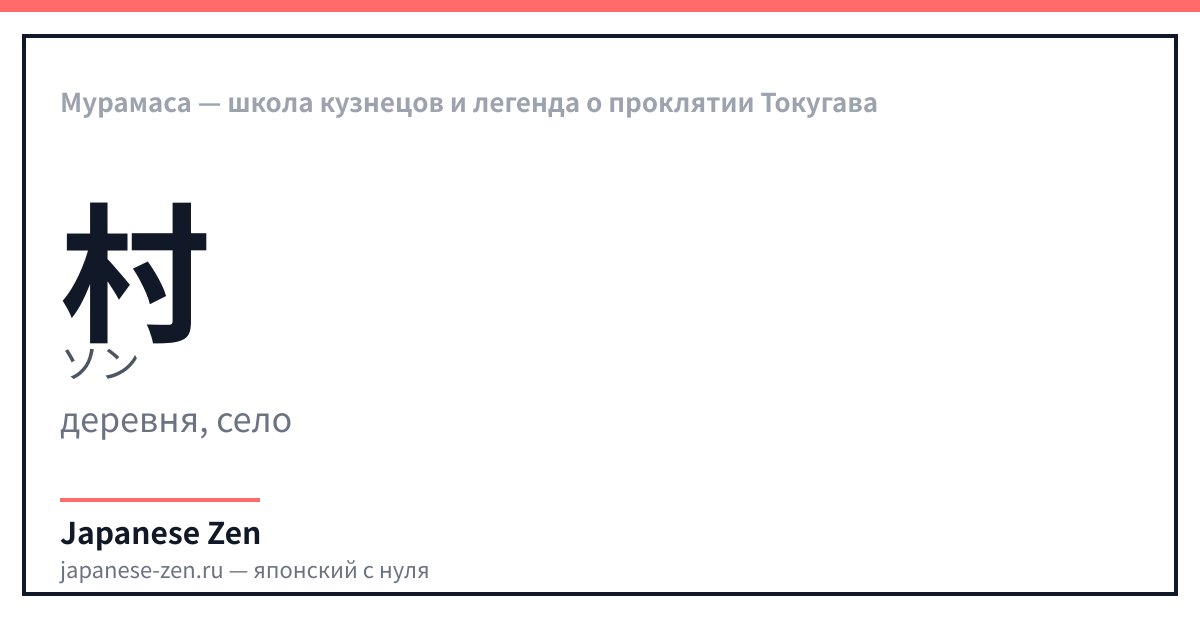
村 — значение: village, rural settlement — онъёми: ソン — кунъёми: むら — 7 штрих(ов). 村 — 'village, rural settlement': the same character in 農村 (nōson, village as opposed to city).
How the school's name is read
| Japanese | Reading | Translation |
|---|---|---|
| 村正 | Muramasa · Muramasa | name of the swordsmith school from Ise |
| 村 | mura · mura | village |
| 正宗 | Masamune · Masamune | master swordsmith from Sagami, legendary rival |
| 刀鍛冶 | katanakaji · katanakaji | swordsmith |
| 妖刀 | yōtō · yōtō | 'demon blade' — what Muramasa is called in legends |
Write 村 along the guides — the 'village' character from the name of the Muramasa school.
Muramasa in games: how the legend survived the Edo period
Where the name became a brand of the 'dangerous sword'
- Muramasa: The Demon Blade (Vanillaware, 2009) — a game built entirely around the legend of the cursed blades of the Muramasa school.
- In the Onimusha and Nioh series, blades named 'Muramasa' appear as rare, especially dangerous weapons — a direct echo of the bloodthirsty sword legend.
- The very opposition 'Muramasa — Masamune' as 'evil sword versus good' migrated into popular culture precisely from the parable of the leaves, not from documents about real blades.
FAQ
- Who is Muramasa?
- Muramasa is not a single master but the name of a school of swordsmiths from Kuwana in Ise Province, active for several generations starting around the late 15th century. The school's blades are katana and wakizashi known for their wavy temper pattern and a reputation for an extremely sharp edge, not for a unique construction.
- Is it true that Muramasa blades are cursed?
- This is an Edo-period legend that grew out of several real accidents involving the Tokugawa clan, in which blades of the Muramasa school figured. A formal ban on wearing them at the shogunate court is poorly documented — the story of the 'curse' itself is well documented in theater and literature, not in official papers.
- How does Muramasa differ from Masamune?
- Masamune worked in Sagami roughly a century and a half earlier and is valued for the fine structure of the metal and technical perfection. Muramasa school blades are distinguished by a sharper wavy hamon and a reputation for an exceptionally sharp edge. The legendary opposition of the 'evil' and 'good' sword is a parable, not a documented fact.
- What does the name 村正 mean?
- The writing is 村正, read むらまさ. 村 means 'village,' 正 means 'correct, true.' The name itself carries no sinister meaning — the connection with the curse legend appeared much later, through stories, not through the meaning of the kanji.
- Was there an official ban on Muramasa blades at the Tokugawa court?
- Historians cite few strict documentary confirmations of a broad official ban — the legend of the ban is far better documented in later literature and kabuki theater than in the shogunate's own acts. This does not mean the legend arose from nothing: there were real accidents involving the Tokugawa clan.
- What weapons did the Muramasa school make?
- Blade types common for their time — primarily katana and wakizashi. There is no separate 'weapon named Muramasa': it is the workshop's signature on items of familiar shape, known for their edge and characteristic temper pattern.
Sources
Updated: 2026-09-10