The Tanto Knife — A Short Japanese Blade and Why the Blade Shape Got the Name
Tanto (短刀) is a Japanese knife with a blade no longer than one shaku, about 30 centimeters: a samurai carried it as a secondary weapon or a last resort in close combat. In knife shops, the word "tanto" refers not to the blade itself but to the point shape — a faceted, reinforced tip that the American company Cold Steel popularized in the early 1980s.
The tanto has close relatives within the same word: the kaiken, carried for self-defense, and the yoroi-doshi — a blade designed specifically for fighting in armor. Let's look at how they differ, what the Kamakura period and the master Shintogo Kunimitsu have to do with it, and why a knife with a faceted point in a shop bears the same name as an ancient Japanese blade, even though it is built quite differently.
Tanto — A Blade Shorter Than One Shaku, Not Just a "Short Sword"
Tanto (短刀) is the general name for Japanese blades with an edge length of no more than one shaku. A samurai carried such a knife as a personal weapon: a reserve in case the long sword broke or was unavailable, and an everyday blade indoors, where the katana was removed at the entrance.
How Long Is One Shaku
A shaku is an old Japanese unit of length, about 30.3 centimeters. A blade longer than a shaku but retaining the proportions and mounting of a tanto is separately called sunnobi-tanto by Japanese swordsmiths — "stretched-length tanto."
- Kaiken (懐剣) — a small guardless blade for concealed carry. It was used by both men and women where carrying long weapons was forbidden, and today a small kaiken in a brocade case is part of a bride's traditional wedding attire.
- Yoroi-doshi (鎧通し) — a tanto with a nearly straight, very thick-backed blade: according to a common view, such blades appeared at the end of the Kamakura period to stab an opponent through the gaps in armor during close-quarters grappling.
From a Kamakura-Period Combat Blade to a Personal Weapon Under the Tokugawa
The heyday of the tanto as a distinct type of blade came in the Kamakura period. The master Shintogo Kunimitsu is considered one of the foremost swordsmiths who made this type of blade famous; his tantos are among Japan's National Treasures.
What Changed for the Tanto in the Peaceful Edo Period
With the establishment of peace under the Tokugawa shogunate, the role of the tanto shifted from a combat blade to a personal and ceremonial weapon. It was given at the birth of a child in noble families as a "guardian sword" and worn where a long sword was inappropriate. The seppuku ritual is also connected with a short blade: the incision was traditionally made with a tanto or wakizashi, not a long katana.
"Tanto" in Knife Shops — An American Invention with a Japanese Name
From the late 1970s, American maker Bob Lum began making knives with a faceted, angled point inspired by the silhouette of a Japanese blade's tip. In the early 1980s, Cold Steel began mass-producing such knives under the name "tanto," and the shape took hold in tactical and folding knives worldwide.
How a Shop Knife Differs from a Japanese Tanto
| Feature | Japanese tanto | "Tanto" in shops |
|---|---|---|
| What it is | a samurai's combat and personal blade | a folding or fixed-blade everyday carry knife |
| Point shape | usually a nearly straight blade with a gently tapering point | a faceted, reinforced angle for strength when thrusting |
| How it is carried | in a mounting on the belt, as part of samurai attire | in a pocket or belt sheath like an ordinary knife |
| Origin of the word | an old Japanese name for a short blade | the name was borrowed in the 1980s for a point shape |
短 — The Character That Makes Tanto "Short" and Tanki Hot-Tempered
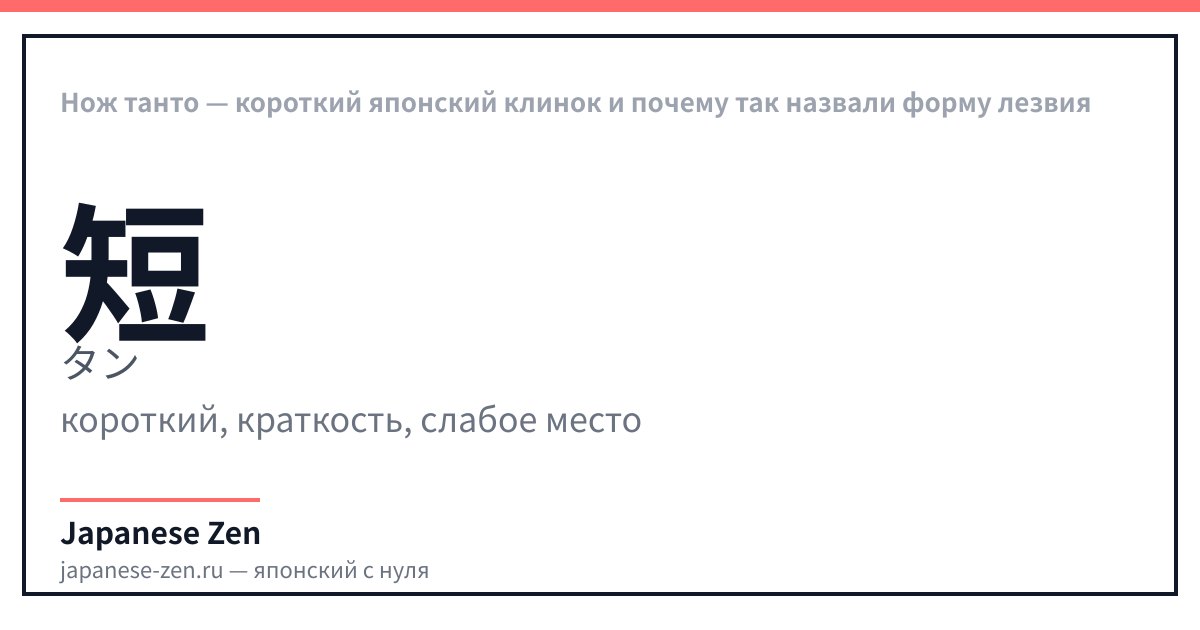
短 — значение: short, brevity, weak point — онъёми: タン — кунъёми: みじか.い — 12 штрих(ов). 短 — "short": the core of the word 短刀 (tanto, "short sword"). The same character appears in 短歌 (tanka, a short thirty-one-syllable poem) and in 短気 (tanki, "short temper").
短刀 breaks down into two characters: 短 "short" and 刀 "sword." The character 短 is read タン (tan) in compound words and みじかい (mijikai) as a standalone adjective meaning "short."
Why 短気 Means "Hot-Tempered"
短気 (tanki) literally means "short spirit": it describes a lack of self-restraint, a tendency to become irritated quickly. The idea is the same as in the English expression "short fuse," except that what is short here is not the length of the fuse but one's patience.
| Japanese | Reading | Translation |
|---|---|---|
| 短刀 | tantō · tantō | short sword, Japanese combat knife |
| 短い | mijikai · mijikai | short |
| 短気 | tanki · tanki | hot-tempered, quick-tempered |
| 短歌 | tanka · tanka | tanka — a short Japanese poem of 31 syllables |
| 寸延短刀 | sunnobi tantō · sunnobi tantō | a tanto longer than one shaku but of the same shape |
| 懐剣 | kaiken · kaiken | a small self-defense blade, part of wedding attire |
Write 短 along the guides — the character for "short" from the word "tanto."
FAQ
- What is a tanto knife?
- Tanto (短刀) is a Japanese blade no longer than one shaku, about 30 centimeters. A samurai carried it as a personal weapon, a reserve in case the long sword was lost, and a blade for tight spaces where a katana was not allowed.
- How long is a tanto?
- A classic tanto is shorter than one shaku — roughly up to 30 centimeters. Blades slightly longer but retaining the same shape and mounting are separately called sunnobi-tanto by Japanese swordsmiths — "stretched-length tanto."
- Why did a samurai carry a tanto?
- As a backup weapon in case the long sword broke or was unavailable, as a personal blade indoors where the katana had to be removed, and as part of ceremonial attire: a "guardian" tanto was given to a newborn in a noble family.
- How does a Japanese tanto differ from a "tanto" in knife shops?
- A shop "tanto" is a point shape: a faceted, reinforced angle invented by American maker Bob Lum in the late 1970s and mass-produced by Cold Steel in the early 1980s. From the Japanese combat blade it has only a borrowed name.
- How does a tanto differ from a wakizashi?
- Primarily in length: a tanto is up to 30 centimeters, a wakizashi is 30 to 60. The wakizashi was part of the paired daisho set along with the katana and was almost always worn with a tsuba guard, while the tanto more often served as a standalone personal weapon and frequently had no guard.
- How is "tanto" written in kanji?
- 短刀, read たんとう. 短 means "short," 刀 means "sword": literally "short sword." The character 短 is read タン (tan) in compound words and みじかい (mijikai) as a standalone adjective. The same first character appears in 短歌 (tanka) and 短気 (tanki, "short temper").
Sources
Updated: 2026-09-15