Ramen — Japanese Noodles in Broth: Types, History, and How to Spell It
Ramen is wheat noodles in broth, brought to Japan from China at the turn of the 19th–20th centuries and transformed almost beyond recognition. The noodles are made with kansui, an alkaline water that gives ramen its yellow color and springy texture, unlike udon. The broth is made from pork bones, chicken, or fish, and the flavor comes from soy sauce, miso, or salt. In English it is simply spelled ramen; the Hepburn romanization rāmen marks the long first vowel.
A bowl of ramen is not a random assortment of ingredients but a settled canon: noodles, broth, and a standard set of toppings that looks different in different Japanese cities. Let's break down the types of broth, noodles made with kansui alkaline water, the origin of the word, and why it is still spelled in two different ways in English.
What Ramen Is and What It's Made Of
Ramen is a dish of wheat noodles in broth that came to Japan from China at the turn of the 19th–20th centuries, along with the opening of port cities and Chinese quarters in Yokohama, Kobe, Nagasaki, and Hakodate. The noodles are made with kansui, an alkaline water that gives them their characteristic yellow color and springiness, which wheat udon lacks.
| Broth | Flavor and Base | Commonly Associated With |
|---|---|---|
| Shōyu (soy sauce) | clear chicken broth with soy sauce | Tokyo — where Rairai-ken, one of the first ramen shops, opened in 1910 |
| Miso | thicker and richer, with miso soybean paste | Sapporo in Hokkaido |
| Shio (salt) | the lightest and clearest, salt instead of soy sauce | Hakodate in Hokkaido |
| Tonkotsu | long-simmered cloudy white pork bone broth | Kurume and Hakata in Kyushu |
A Bowl of Ramen — What It's Made Of
To the noodles and broth, people usually add chashu — slices of braised or simmered pork, menma — fermented bamboo shoots, nori, and half an egg, often marinated beforehand. The set of toppings is not strict: it differs from shop to shop.
Ramen or Rāmen: How to Spell It in English
In Hepburn romanization, ラーメン is written as rāmen, with a long 'a' in the first syllable and an 'e' sound. The form 'ramen' became widespread through the English spelling without diacritics. Everyday English writes it without the macron — 'ramen'; 'rāmen' is the romanization that shows the long vowel.
Why Japanese People Slurp Noodles Loudly
Loud slurping of noodles in Japan is not considered impolite — that's how ramen, udon, and soba are eaten in ordinary noodle shops, and no one turns around. For a visitor from another country, it's more of an unfamiliar local custom than a breach of manners.
How 'Ramen' Is Written: Katakana, Kanji, and Old Names
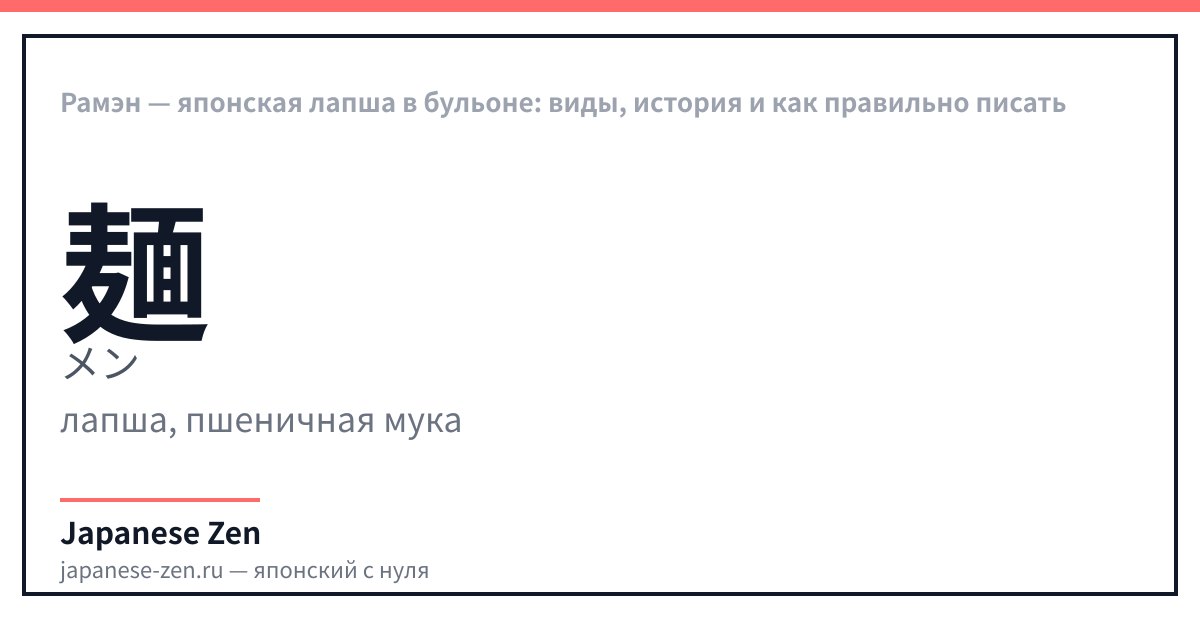
麺 — значение: noodles, wheat flour — онъёми: メン、ベン — кунъёми: むぎこ — 16 штрих(ов). 麺 — 'noodles, wheat flour': the same character appears in the Chinese spelling of ramen 拉麺 and in the old Japanese name for the dish 中華そば.
The word ラーメン itself is almost always written in katakana in Japan, like other loanwords. The kanji spelling 拉麺 is Chinese: the character 拉 means 'to pull by hand' and refers to the method of stretching the dough into long noodles, while 麺 means 'noodles'. Before the word 'ramen' became established, the name 中華そば (chūka soba) — 'Chinese noodles' — was in use: that's what it was more often called before and shortly after World War II.
| Japanese | Reading | Translation |
|---|---|---|
| ラーメン | rāmen · rāmen | Ramen |
| 麺 | men · men | Noodles |
| 中華そば | chūka soba · chūka soba | Old name for ramen, 'Chinese noodles' |
| 替え玉 | kaedama · kaedama | Extra noodles added to the same broth |
| 豚骨 | tonkotsu · tonkotsu | Pork bone broth |
| 味噌 | miso · miso | Soybean paste for broth |
Write 麺 along the guides — the 'noodles' character from the old and new names of ramen.
Why Noodles Are Both 麺 and そば
そば originally means buckwheat noodles, soba, but in colloquial speech this word was historically applied to other types of noodles as well — hence the old name for ramen, 中華そば. 麺, on the other hand, is a general word for any noodles, from wheat to rice, and it is the one that became established as more precise.
From Instant Noodles to Anime
In 1958, the founder of Nissin, Ando Momofuku, released 'Chicken Ramen' — the world's first instant noodles, which only need boiling water. In 1971, the same company introduced 'Cup Noodle' — noodles right in a cup, with no separate bowl. A museum dedicated to the history of ramen itself opened in the Shin-Yokohama district in 1994.
Ramen in Anime
Naruto from the manga and anime of the same name (Kishimoto Masashi, manga since 1999) loves ramen from the 'Ichiraku' shop. It appears in the story more than once as the hero's favorite place, and its owner and daughter are recurring supporting characters.
FAQ
- How do you spell it: ramen or rāmen?
- Closer to the Japanese pronunciation of ラーメン is 'rāmen': that's how Hepburn romanization renders this katakana. The form 'ramen' became widespread through the English spelling without diacritics. Everyday English writes it without the macron — 'ramen'; 'rāmen' is the romanization that shows the long vowel.
- What is ramen?
- Ramen is a dish of wheat noodles made with kansui alkaline water, cooked in broth made from pork bones, chicken, or fish with soy sauce, miso, or salt. It came to Japan from China at the turn of the 19th–20th centuries and has since changed almost beyond recognition.
- How is ramen different from udon and soba?
- Ramen is made from wheat noodles with kansui alkaline water — it gives them a yellow color and springiness. Udon is also wheat noodles, but without kansui, thicker and softer. Soba is buckwheat noodles, with a completely different taste and texture, and the broth is usually lighter.
- What types of ramen are there?
- Types are distinguished primarily by broth: shōyu with soy sauce, miso with soybean paste, shio with salt, and tonkotsu — a long-simmered pork bone broth. Different cities in Japan historically developed their own variant, and there are many variations within each type.
- Who invented instant noodles?
- In 1958, the founder of Nissin, Ando Momofuku, released 'Chicken Ramen' — the world's first instant noodles. In 1971, the same company introduced 'Cup Noodle', noodles in their own cup for quick brewing.
- How is 'ramen' written in Japanese?
- ラーメン, in katakana, read as 'rāmen' with a long 'a'. The old name is 中華そば (chūka soba), 'Chinese noodles'. The kanji spelling 拉麺 is Chinese: 拉 means 'to pull by hand' and refers to the method of stretching the dough, while 麺 simply means 'noodles'.
Sources
Updated: 2026-09-14