Takoyaki — Octopus Balls from Osaka: What They Are and How to Eat Them
What is takoyaki? Balls of liquid batter with a piece of octopus inside, cooked in a pan with half-round indentations and flipped with a thin skewer. They are topped with sauce and mayonnaise, sprinkled with green onion, aonori seaweed, and thin katsuobushi flakes that seem to quiver faintly from the heat, as if dancing. Takoyaki come from Osaka, and the dish was invented in 1935.
Takoyaki are sold on literally every corner in Osaka — from the windows of street stalls, from stands at festivals, in the prepared food sections of supermarkets. Let's look at where the octopus in the batter came from, what a kite has to do with it, and how takoyaki differ from the similar dish akashiyaki from Akashi, the city next to Osaka.
What Takoyaki Are Made Of and Who Invented Them
The batter for takoyaki is mixed with dashi broth, and pieces of octopus, crispy tempura scraps tenkasu, and green onion are added. The mixture is poured into a special takoyaki-ki pan with rows of half-round indentations and cooked over an open flame, turning the balls from time to time with a thin metal skewer — the outside gets a crispy crust, while the inside stays very hot.
Takoyaki were invented by Endo Tomekichi, the owner of the Osaka shop Aizuya, in 1935. Before that, he made a similar dish with beef in soy sauce instead of octopus, and the idea to change the filling came to him from a chance remark by a customer that in the city of Akashi, people put octopus in similar batter.
Akashiyaki — the "egg" takoyaki from Akashi
Akashiyaki, a dish from Akashi, the city next to Osaka, is the direct predecessor of takoyaki: the same batter with octopus, but with a much larger proportion of egg. The serving is different too: akashiyaki are not doused with sauce but dipped in warm dashi broth.
蛸 and たこ: the octopus that is rarely written with kanji
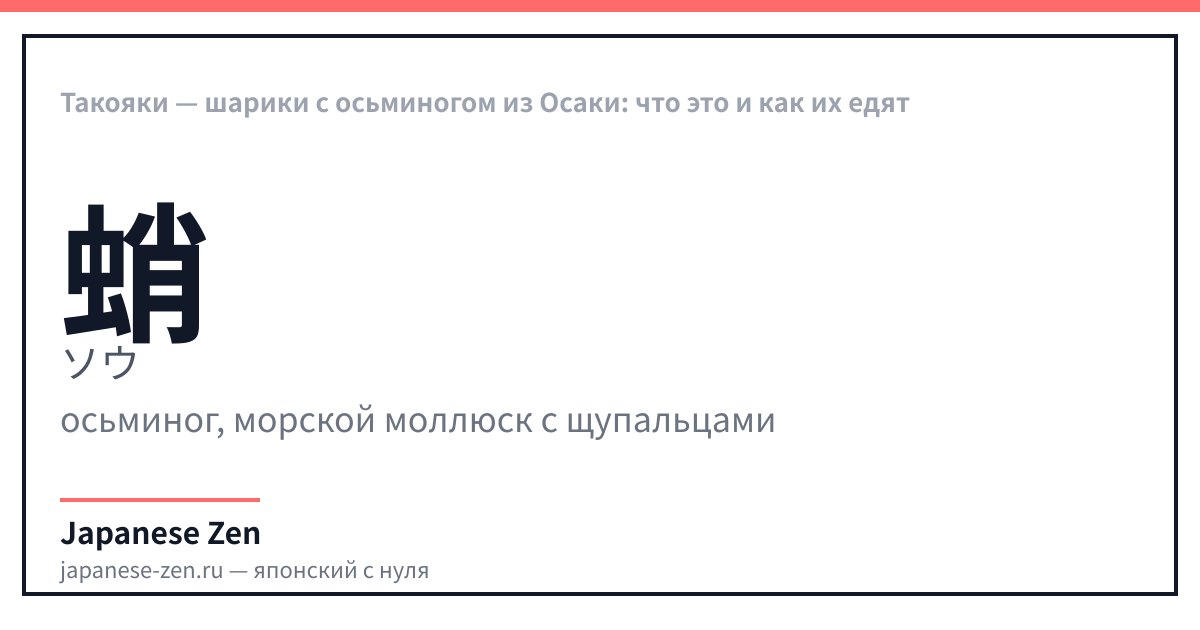
蛸 — значение: octopus, sea mollusk with tentacles — онъёми: ソウ、ショウ — кунъёми: たこ — 13 штрих(ов). 蛸 — "octopus": the radical on the left, 虫 "insect," in kanji often stands for the category of small creatures in general, not literally for kinship with insects.
たこ焼き literally means "grilled octopus": たこ "octopus" plus 焼き "grilling." In everyday texts, the word "octopus" is almost always written not with the kanji 蛸 but with the hiragana たこ — it's simpler and more familiar. The same word たこ also refers to a kite — 凧, a separate character invented in Japan rather than borrowed from China. The octopus and the kite are chance homonyms: the meanings of the characters are not connected to each other in any way.
| Japanese | Reading | Translation |
|---|---|---|
| たこ焼き | takoyaki · takoyaki | Takoyaki |
| たこ | tako · tako | Octopus (usual spelling) |
| 蛸 | tako · tako | Octopus (in kanji) |
| 焼く | yaku · yaku | To grill |
| 明石焼 | akashiyaki · akashiyaki | Predecessor of takoyaki from the city of Akashi |
| 粉もん | konamon · konamon | Osaka word for flour-based food |
Write 蛸 along the guides — the rare everyday kanji for octopus, the hero of takoyaki.
Konamon — Osaka's flour-based food
粉もん (konamon) is an Osaka colloquial word for any food based on liquid or thick batter: okonomiyaki, takoyaki, and similar dishes are all called this together. The word has caught on so well that in Osaka there is an entire association of fans of such food in its honor.
Not sushi, not "anything goes," and not cold
- "Takoyaki are a type of sushi or roll." No: sushi is built around vinegared rice, while takoyaki is built around liquid batter with dashi broth. The only thing the dishes share is their Japanese origin.
- "Takoyaki can have anything inside." In the classic recipe, the filling is octopus — that's how Endo Tomekichi invented them in 1935. A version without octopus in Japan is usually called something else, not takoyaki.
- "Takoyaki are eaten cold." They are served straight from the griddle: crispy on the outside, with a very hot filling inside, so fresh takoyaki are usually cooled first with a breath rather than set aside for later.
FAQ
- What is takoyaki?
- Takoyaki are balls of liquid batter with dashi broth and a piece of octopus inside. They are cooked in a special pan with half-round indentations, flipped with a thin skewer, and served hot with sauce, mayonnaise, and katsuobushi flakes on top.
- What is inside takoyaki?
- In the classic recipe — a piece of octopus, sometimes with green onion and crispy tempura scraps tenkasu added. A version without octopus exists, but in Japan it is called by a separate word, not takoyaki.
- Where do takoyaki come from?
- From Osaka. They were invented by Endo Tomekichi, the owner of the shop Aizuya, in 1935 — he replaced the beef in an old dish with octopus and egg, inspired by the similar dish akashiyaki from the neighboring city of Akashi. Since then, takoyaki have become one of the symbols of Osaka street food.
- How is "takoyaki" written in Japanese?
- たこ焼き, kana たこやき. The word "octopus" here is almost always written in hiragana たこ, not the rare kanji 蛸, although both variants are read the same — "tako." The second character 焼き (yaki) means "grilling" and appears in the names of many Japanese griddle dishes.
Sources
Updated: 2026-09-14