Taiyaki — a sea bream-shaped pastry and the "medetai" pun
Taiyaki (鯛焼き) is a wheat-flour pastry with a filling, usually anko, baked in a metal mold shaped like a tai (sea bream). The shape was not chosen by chance: tai is a festive and expensive fish, and cheap dough in its shape became an affordable substitute. According to one version, taiyaki was invented in 1909 at the Naniwaya shop, but no precise documents about this survive.
Taiyaki is sold on every corner in Japan — from shop windows and street stalls, hot, with a crispy crust outside. Let's look at what the pun with the word "joyful" has to do with it, how taiyaki differs from the similar imagawayaki without the fish shape, and what connects this sweet to a children's song that holds the sales record among Japanese singles.
Dough in the shape of a fish: how taiyaki differs from imagawayaki
Taiyaki is baked in a metal mold that repeats the silhouette of the tai fish: liquid wheat dough is poured into the mold, filling is added — most often anko bean paste, less often cream or chocolate — and it is covered with the second half of the dough. The dish has a simpler relative, imagawayaki (今川焼き): the same dough with the same filling, but round, without the fish silhouette; taiyaki is considered its later and more elaborately shaped version.
The debate over whether the anko should reach the tail
In Japan, there was even a newspaper debate over whether the anko must reach the very tail of the fish. The writer Ando Tsuruo argued in the Yomiuri Shimbun that the tastiest taiyaki is the one with filling in the tail too. Opponents objected: the tail was originally left empty on purpose so that the pastry could be held with the fingers without getting one's hands dirty.
Why the dough was given the shape of an expensive fish
In Japan, tai is a fish of the festive table: its red color is associated with the word medetai (めでたい) — "joyful, auspicious," although by origin these are two different, unrelated words. The coincidence in sound — the ending of medetai and the word tai — was turned into a standing pun in Japan. The god of luck Ebisu in illustrations holds a fishing rod with a tai in his hands, and the word "medetai" itself is sometimes jokingly written with the characters 目出鯛, literally "eye, exit, tai."
Dough instead of a fish that not everyone could afford
A whole tai on the festive table was expensive, while taiyaki — cheap street dough in the same shape — allowed everyone to get a symbol of good luck without buying the real fish. The same was done with other festive shapes: in the same Tokyo shop where, according to one version, taiyaki was invented, at first they also baked round imagawayaki and pastries in the shape of a turtle.
Taiyaki in a 1975 song and on street stalls
"Oyoge! Taiyaki-kun" is a 1975 children's song from the TV program "Hirake! Ponkikki" about a taiyaki that escaped from a shop and swam out to sea. According to Oricon estimates, the version performed by Shimon Masato sold more than 4.5 million copies and is considered the best-selling physical single in the history of the Japanese charts. The prototype of the shop-owner character in the animated music video for the song is said to be the real owner of Tokyo's Naniwaya.
From Meiji-era shops to festival counters
Taiyaki is above all street food: a fresh pastry is taken straight from the mold and eaten on the go, at a shop window, at a festival stall, or from a temporary counter by a station. Baking molds come in two types — for one fish at a time or for several at once — and connoisseurs distinguish them by the crispness of the crust.
A fish with the "fish" radical: how 鯛 is read
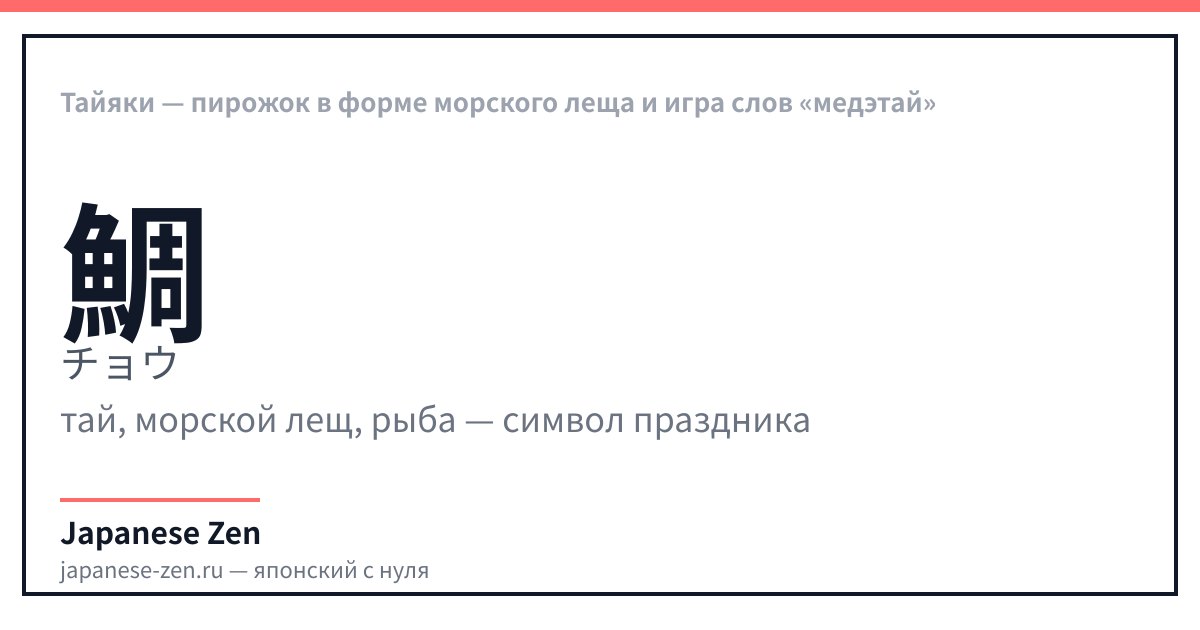
鯛 — значение: tai, sea bream, a fish — symbol of celebration — онъёми: チョウ — кунъёми: たい — 19 штрих(ов). 鯛 — "tai, sea bream": on the left is the radical 魚 "fish," on the right is a phonetic that hints at the reading. The same radical appears in the names of dozens of other fish.
On reading chō, kun reading tai
鯛 has two readings: the on reading chō — rare, almost never found outside reference books — and the kun reading tai, which is heard both in 鯛焼き and in the name of the fish itself. The suffix 焼き (yaki) at the end of the word is not part of the fish's name but the usual Japanese culinary word for "baked, grilled": it is also in yakitori, takoyaki, sukiyaki.
The radical 魚 and other fish
The radical 魚 "fish" appears in the writing of dozens of names: 鮭 (sake or shake) — salmon, 鮪 (maguro) — tuna. By the way, 鮭 has the same reading sake as the alcoholic drink 酒 — this is a chance coincidence of sound, not a kinship of words: their characters are different, and their origins are in no way connected.
| Japanese | Reading | Translation |
|---|---|---|
| 鯛焼き | taiyaki · taiyaki | Taiyaki |
| 鯛 | tai · tai | Sea bream |
| 今川焼き | imagawayaki · imagawayaki | Round pastry, the predecessor of taiyaki |
| 焼く | yaku · yaku | To bake, to grill |
| 鮭 | sake · sake | Salmon |
| 鮪 | maguro · maguro | Tuna |
Write 鯛 along the guides — the character for the tai fish, which gave taiyaki its shape.
FAQ
- Taiyaki — what is this fish-shaped pastry?
- A wheat-flour pastry with a filling inside — usually anko bean paste, less often cream or chocolate — baked in a metal mold in the shape of a tai fish. It is eaten hot, straight from the mold, most often on the street rather than at the table.
- Who invented taiyaki and when?
- It is not known for certain. According to one version, taiyaki was invented in 1909 at the Tokyo shop Naniwaya. But its current owner admits that no precise documents from those times survive, and earlier newspaper notes hint at the existence of similar shops even earlier.
- Why was taiyaki made specifically in the shape of the tai fish?
- Tai is a fish of the festive table; its red color is associated with the word medetai, "joyful": the coincidence of sound made tai a symbol of good luck. The real fish was expensive, while cheap dough in its shape allowed everyone to get the same symbol on the street, without going to a festive meal.
- What does the song "Oyoge! Taiyaki-kun" have to do with it?
- It is a 1975 children's song about a taiyaki that escaped from a shop into the sea. According to Oricon estimates, it is considered the best-selling single in the history of the Japanese charts, and the prototype of the shop owner in the animated music video is said to be the real owner of Tokyo's Naniwaya.
- How does taiyaki differ from imagawayaki?
- The dough and filling are almost the same; the difference is in the shape: imagawayaki is round, without the fish silhouette, while taiyaki repeats the outlines of the tai. Imagawayaki is older and simpler; taiyaki is a later and more elaborate development of the same recipe.
Sources
Updated: 2026-09-15